Nearly everything written about church sound comes from America. It assumes a worship band of drums, bass, guitar and keys, a building where the power never goes off, a budget for genuine microphones, a sermon in one language, and a service that ends on time.
Many of us run sound somewhere else. In a Pentecostal church in Accra where praise is a medley led on the fly. In a Lagos church where the preacher shouts and the interpreter answers phrase by phrase. In a Nairobi church where the band plays seben in the praise section. On a generator, in the harmattan, with a choir of sixty and four microphones, until two in the morning.
I started on the keyboard in churches in Accra, and when I went looking for help with the sound side, I found almost nothing written for us. The research for this guide found the same: there is very little practical writing in English about running sound in African churches. So this is where I am putting it. Every post below is written for the conditions we actually work in.
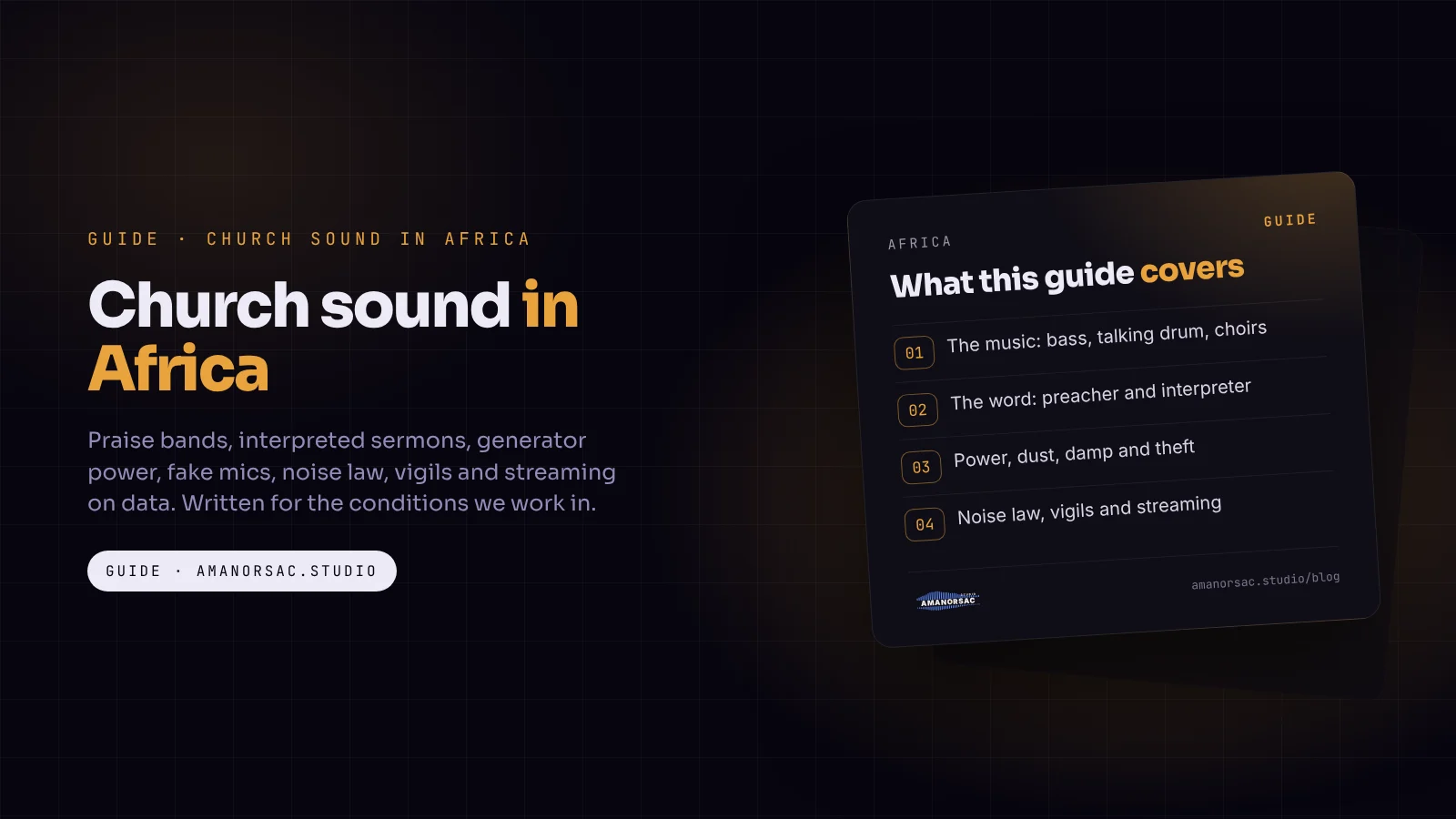
The music
African church music is not American worship with different songs. In Ghana, gospel highlife grew out of Pentecostal churches that let highlife guitar bands into the service (*Popular Music*); in Nigeria, juju grew from Christian congregational singing and Yoruba drumming (Britannica); in Kenya, Congolese seben has been sweeping into praise sessions (The Standard). The bass is a lead voice, the talking drum answers the singer, the bell holds the time, and the service moves between a dancing praise section and a slow worship section.
- Mixing an African praise band: the bass that sings, talking drum, congas, bells and shakers, the highlife guitar, and saving praise, worship and word as separate scenes.
- Mixing gospel vocals and choirs: the wall of sound without mud, and how to mix call and response.
- How to mic a church choir: how many microphones for a big choir, where they go, and why choir mics feed back.
- Key changes and praise medleys: moving between songs and keys without stopping, the way praise is led in many of our churches.
The word
The sermon is the part of the service where clarity matters most, and in many African churches it comes with problems American guides never mention: a preacher who moves from a whisper to a shout, and an interpreter on the same stage.
- Mixing a preacher and an interpreter: two microphones, one message. Matching the voices, the shout, feedback and wireless.
- How to stop feedback in church: the order of fixes, the lapel mic, the preacher in front of the speakers.
Power
Outages, low voltage and generator power damage more church sound equipment than anything else. Ghana's grid failed twice in the middle of 2026 (Citi Newsroom), and Nigeria's national grid collapsed around eleven or twelve times in 2024 (Channels TV).
- Church sound on generator and unstable power: stabiliser, UPS or inverter, the safe power-up and changeover routine, sizing, and why it hums on the generator.
Gear
The gear we can buy, and the places we buy it, come with their own risks: counterfeit microphones, wireless systems on the wrong frequencies, and equipment that has to survive dust, damp and break-ins.
- Is my Shure SM58 fake? A ten-minute check before you pay: weight, price, grille, sound, fake wireless model names and authorised dealers in Ghana, Nigeria and Kenya.
- Keeping church sound gear alive: harmattan dust, heat, humidity, rain on a zinc roof, and theft, with a yearly care calendar.
- Mixing on the Midas MR18: a guide to one of the most common desks in our churches.
Noise and the neighbours
Churches have been fined in Accra and sealed in Lagos over noise. A sound team that understands the limits can keep worship full inside and the church out of court.
- Church noise limits in Ghana, Nigeria and Kenya: the limits, the real cases, and seven practical fixes.
Long nights
All-night prayer meetings, vigils and long Holy Ghost services are part of church life across West Africa. They are a different job from a Sunday morning: hours longer, with tired ears, night-time noise limits and a generator that needs fuel.
- Mixing an all-night vigil: shifts and handovers, ear fatigue, the keyboard pad under prayer, power through the night and staying legal.
Streaming
Live streaming a service on mobile data is a different job from streaming on a fibre line, and audio matters more than the picture.
- Live streaming church on mobile data: how much data a service uses, upload speed, settings for a weak connection, and keeping the stream alive through a power cut.
- Why church live stream audio sounds bad: building a separate stream mix on an X32 or MR18.
People and training
Much of the church sound in Africa is run by volunteers who learned by watching someone else. Training exists, but it is scattered: the Holex Sound Engineering Institute in Accra includes church sound setup in its live sound course (Holex), ADMI in Nairobi runs a sound engineering diploma (ADMI), and the Church Media Masterclass has announced sessions in Accra and Kumasi (Church Media Masterclass).
- What does a church music director do?: the role, the week, rehearsals, and how it works in African churches.
- The live recording run sheet and the mud-free mix card: free printable sheets for the desk.
Help me write the next one
This guide grows with the questions I get. If you run sound in a church in Ghana, Nigeria, Kenya, South Africa, Uganda, Cameroon or in an African church abroad, and something here does not match what you see, or there is a problem nobody has written about, tell me. The next posts come from those messages.
Questions people ask
Why is church sound in Africa different?
The music, the language, the building and the power are different: dance-based praise with a melodic bass and hand percussion, interpreted sermons, large choirs, unstable power, dust and damp, and noise rules in dense neighbourhoods.
What is the most common mixer in African churches?
There is no published survey. Behringer and Yamaha mixers, such as the X32, XR18 and MG series, dominate the listings on the big online marketplaces, which suggests they are common.
How do I learn church sound in Ghana or Nigeria?
Start with the posts in this guide, practise on your own desk during rehearsals, and look at local courses such as Holex in Accra. Learning from a more experienced engineer in your area is still the fastest way.
How can our church stop damaging sound equipment?
Protect the power with a stabiliser and UPS, follow a safe power-up order, keep gear covered and dry, lock it away, and avoid driving speakers into clipping.
Is it normal for African churches to be so loud?
Many are measured above 85 dB(A), and some above 90 dB(A). Loud praise is part of the culture, but long exposure at those levels harms hearing and breaks local noise limits, both of which a sound team can fix without losing the energy.
Written by Stephen Amanor Sackey — producer, mix engineer and music director, Virginia. More about the studio.
Studio news
Struggling to move forward in your music?
Guides from a working music director, written for the churches we actually work in: church sound, worship teams, free sheets for the desk, and the apps, with the free one first. A few letters a month at most, and every one has a link to stop.
You will get one email asking you to confirm. Your first app is 15% off when you join. Privacy.