

Every live worship recording I have engineered had one moment where it could have fallen apart. A singer came in a bar early. The keys player went to the bridge while the band stayed in the chorus. In-ears died mid-song. The recordings that survived those moments were not the ones with the best musicians. They were the ones where the team had decided, weeks before, what everyone would do when it happened.
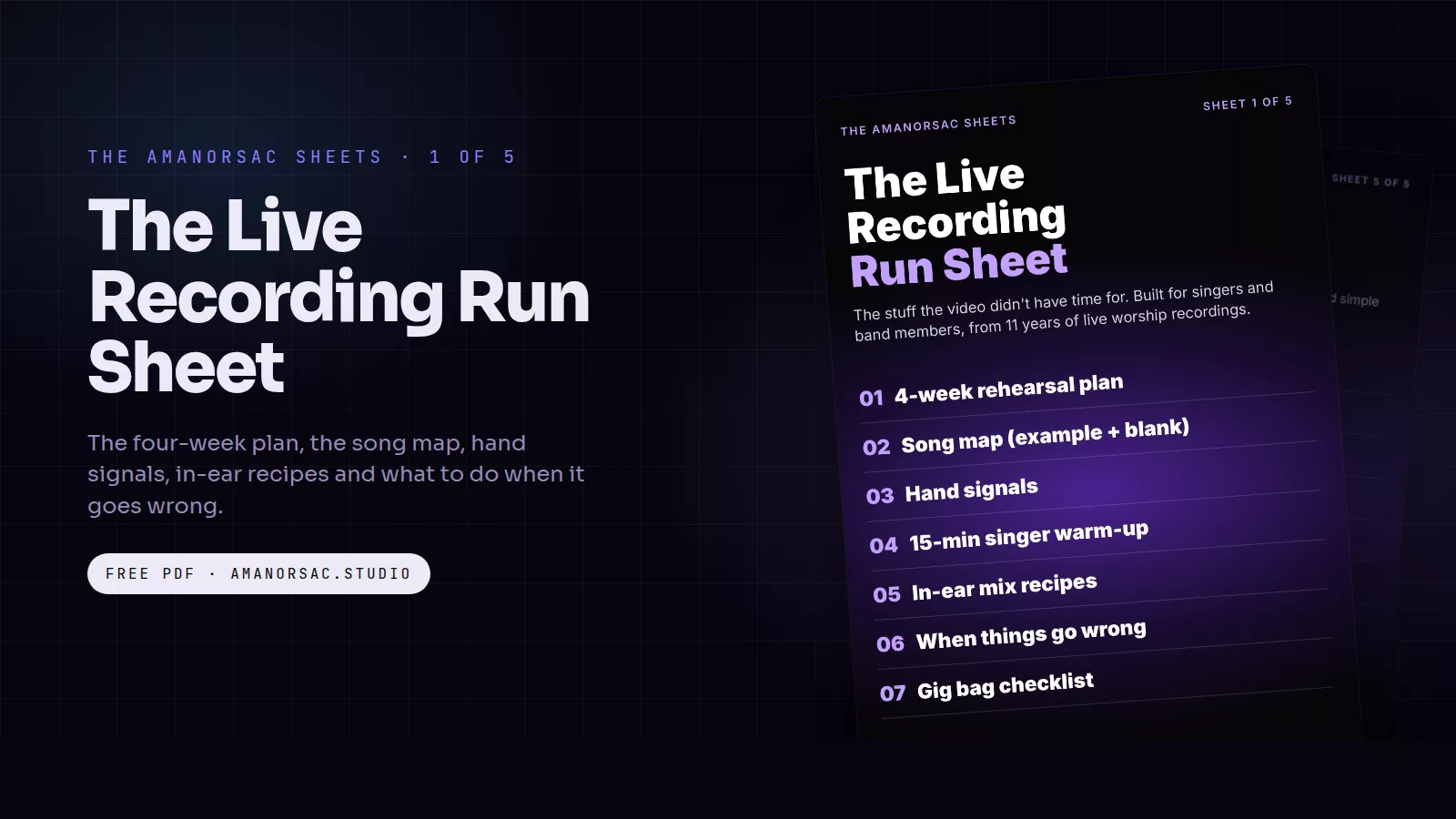
That is what the Live Recording Run Sheet is: the decisions, written down. It is the first of five free sheets I am putting out for worship musicians, singers and engineers, and it covers the things the video did not have time for. Here is what is in it and why.
Every card in this post is free to save and share. Tap one to open it full size.
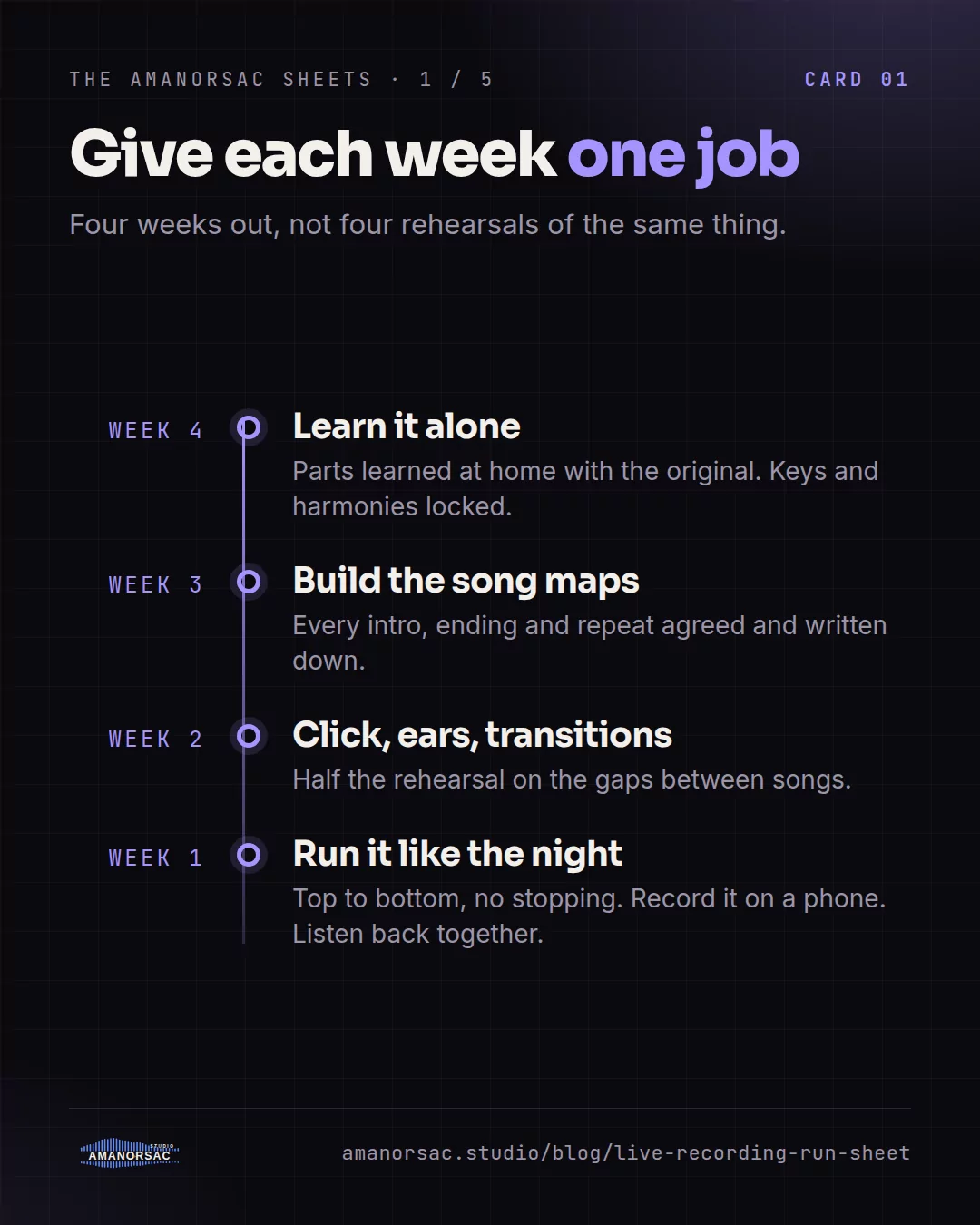
Give each of the four weeks one job
"Let's run the songs" is not a rehearsal plan. Four weeks out, everyone learns their parts alone with the original recording. Singers lock their keys and harmonies. The leader sends the setlist, the keys and the reference links, and nobody shows up to the first rehearsal still learning the melody.
Three weeks out is the first full band rehearsal, and its only job is to build the song maps. Agree every intro, ending and repeat and write it down. No improvising yet. Two weeks out you rehearse with click and in-ears if you will use them on the night, and you spend half the time on the gaps between songs, because that is where most live recordings get awkward. One week out you run the whole set top to bottom without stopping, talk moments and prayers included, record it on a phone and listen back together.
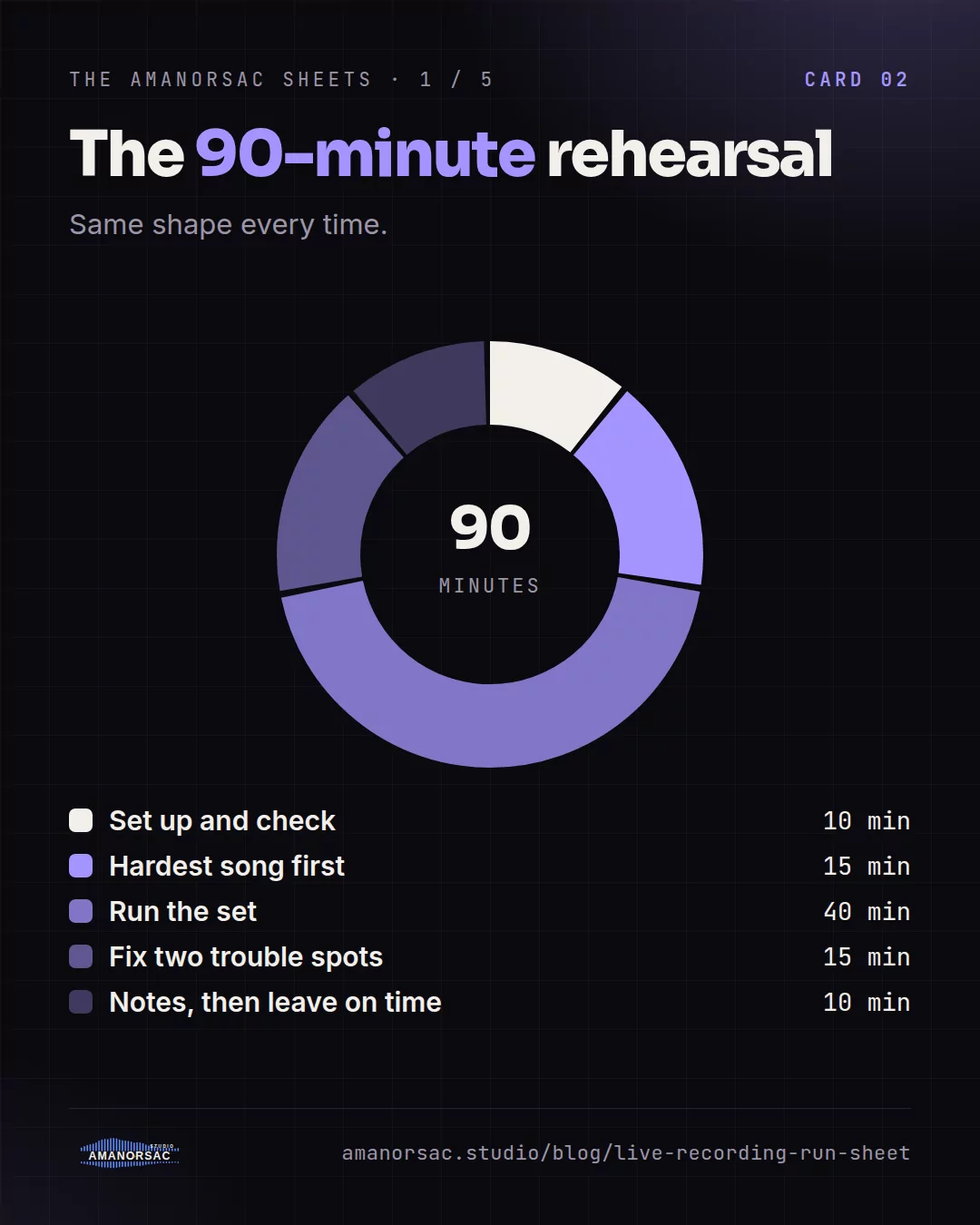
Every rehearsal has the same ninety-minute shape: ten minutes to set up and check, fifteen on the hardest song first, forty running the set, fifteen fixing two trouble spots, ten for notes. Then leave on time. Teams that leave on time keep showing up.
The song map
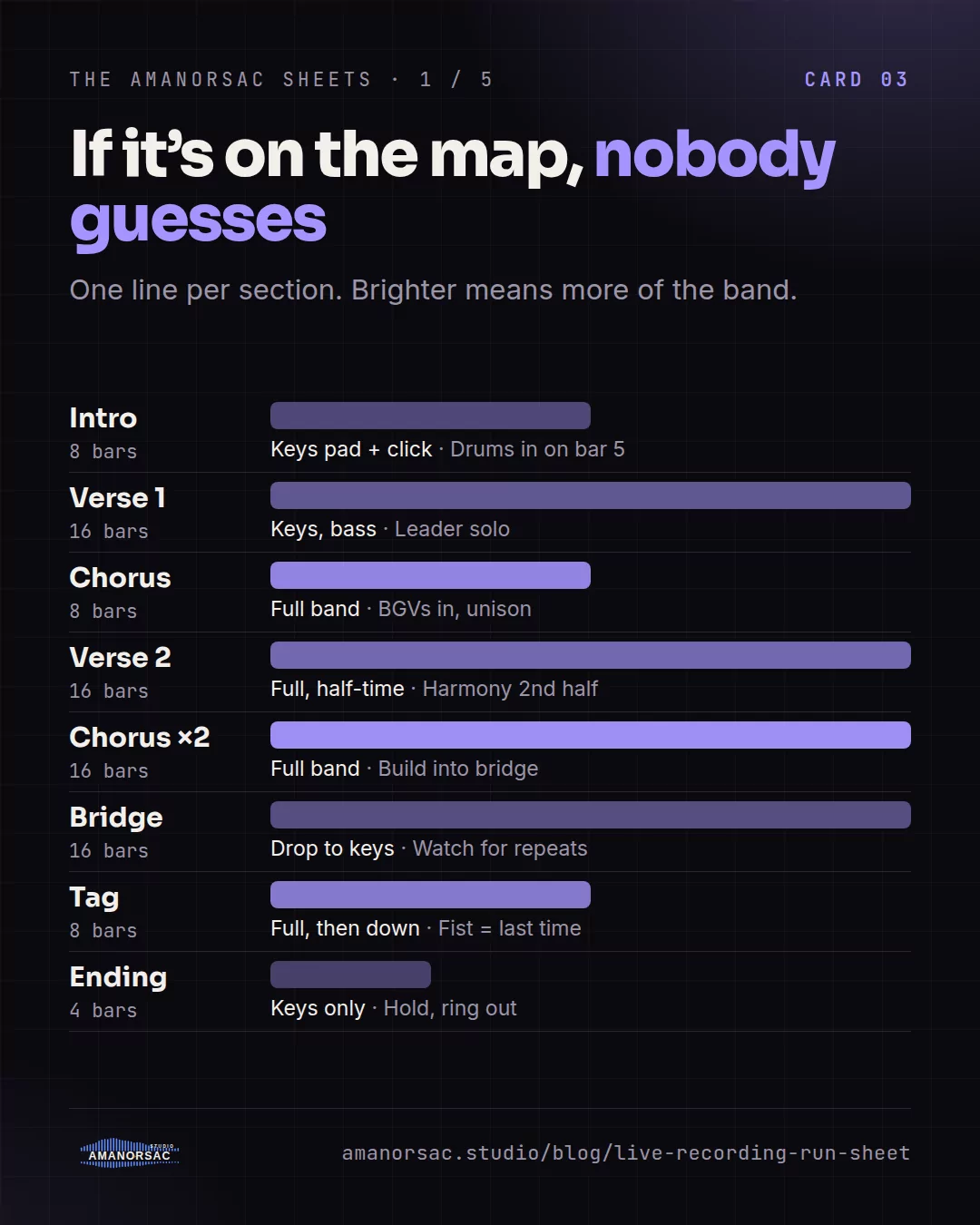
One line per section: how many bars, who plays, and the cue. "Intro, 8 bars, keys pad and click, drums in on bar 5." "Bridge, 8 plus 8, drop to keys, watch the leader for repeats." "Tag, open, full then down, fist means last time."
If it is on the map, nobody guesses on the night. The sheet has a worked example and a blank one to copy for every song in the set.
Hand signals, agreed in week three
Every team has its own signals, and that is fine, as long as everyone on stage has the same ones. The sheet lists the common worship-band set: one finger for verse one, a C shape for chorus, a flat palm for the bridge, a circling finger to repeat, a closed fist for last time, a hand on the head for the top.
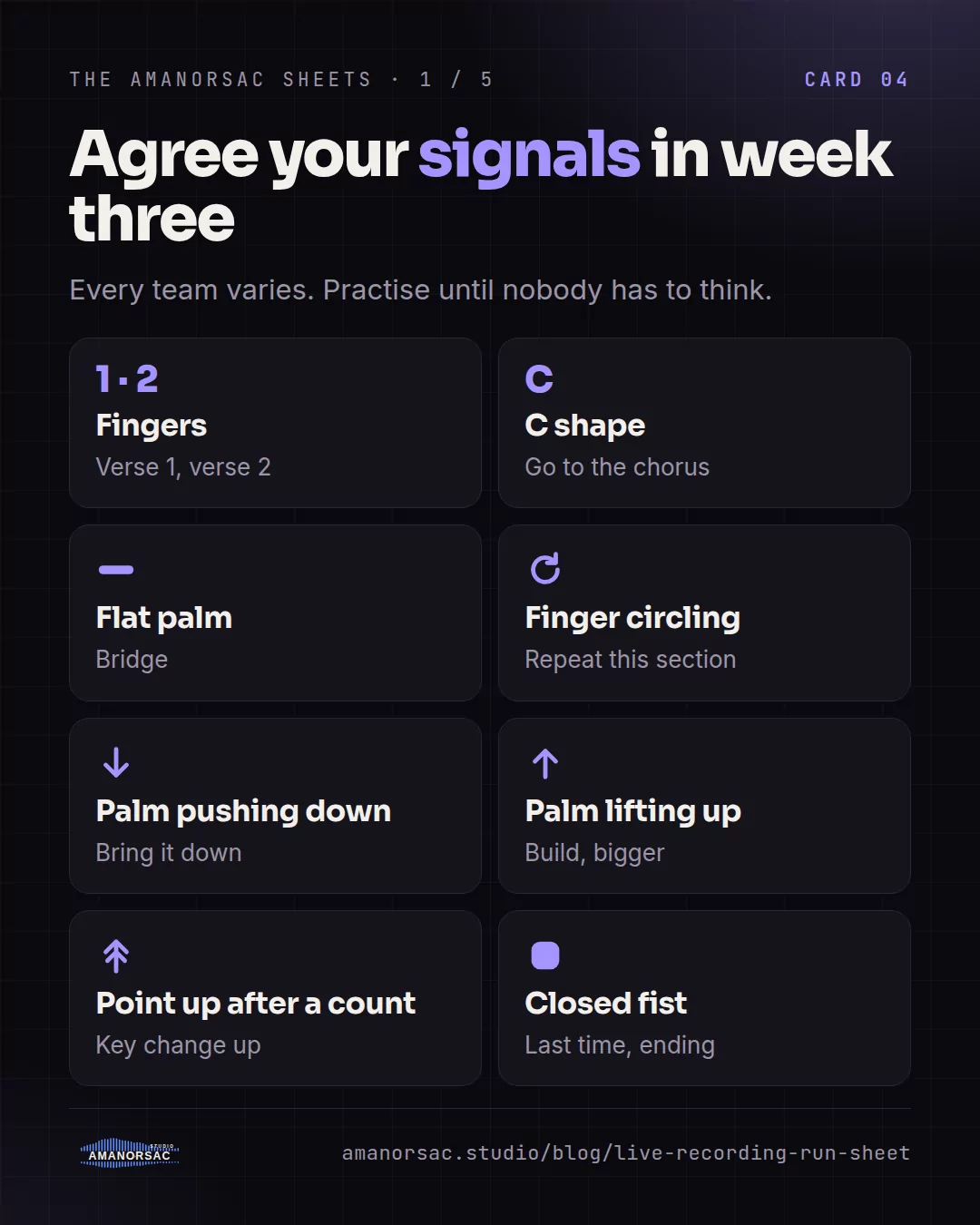
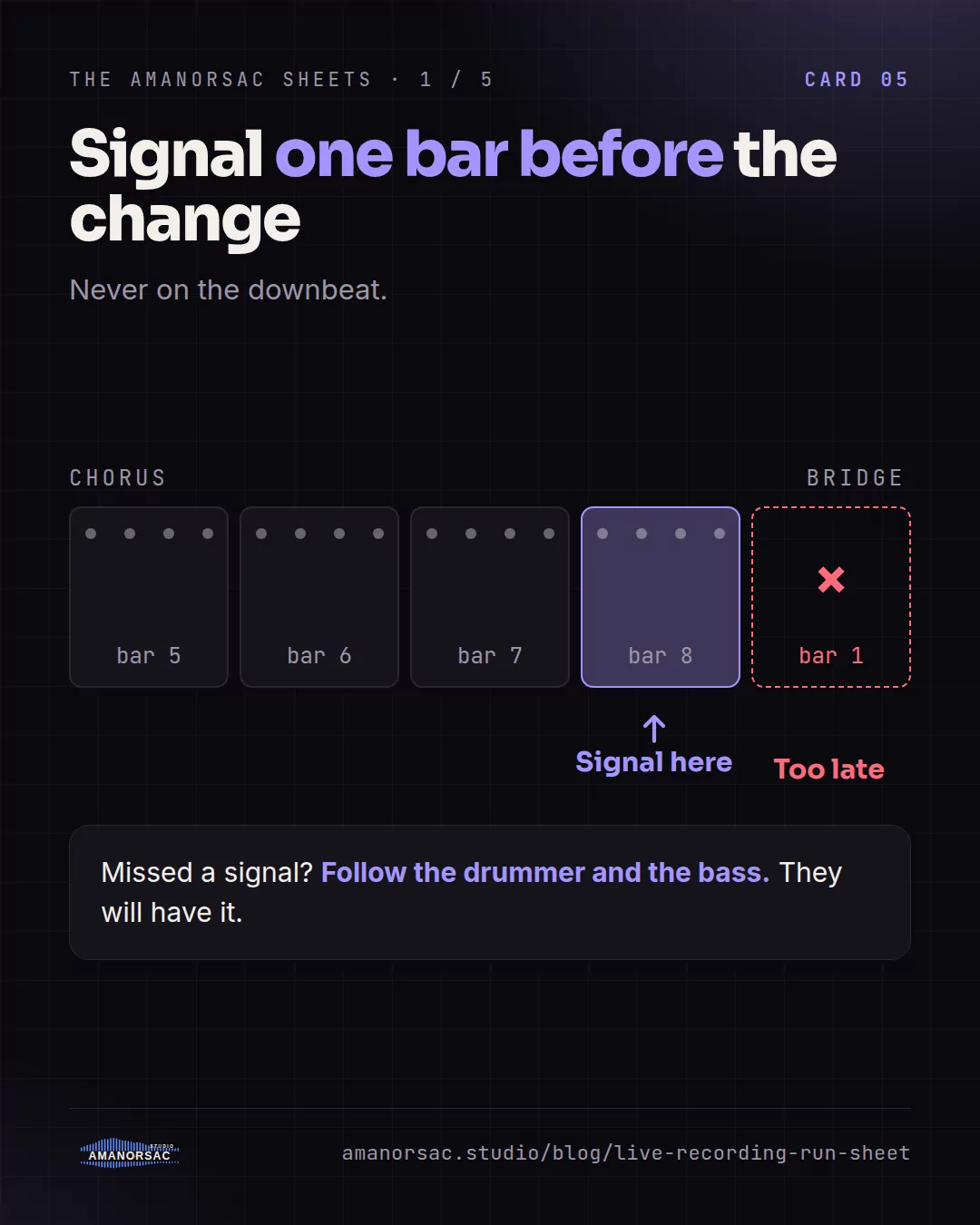
The rule that saves recordings is this: the signal comes one bar before the change, never on the downbeat. And if you miss a signal, follow the drummer and the bass. They will have it.
Warm up before soundcheck, not after
Soundcheck is not your warm-up. The sheet has a fifteen-minute routine for singers to do before it: two minutes of breath, three of lip trills, three of hums and sirens, three of vowels moving up to your top note of the set, two of diction, and two singing the hardest phrase of the night at half volume. Then stop.
Voice care starts forty-eight hours out. Water steadily the day before and the day of, not just on the day. No shouting, no whispering, no late nights. Ten minutes of steam the morning of.
In-ear mixes that let you sing
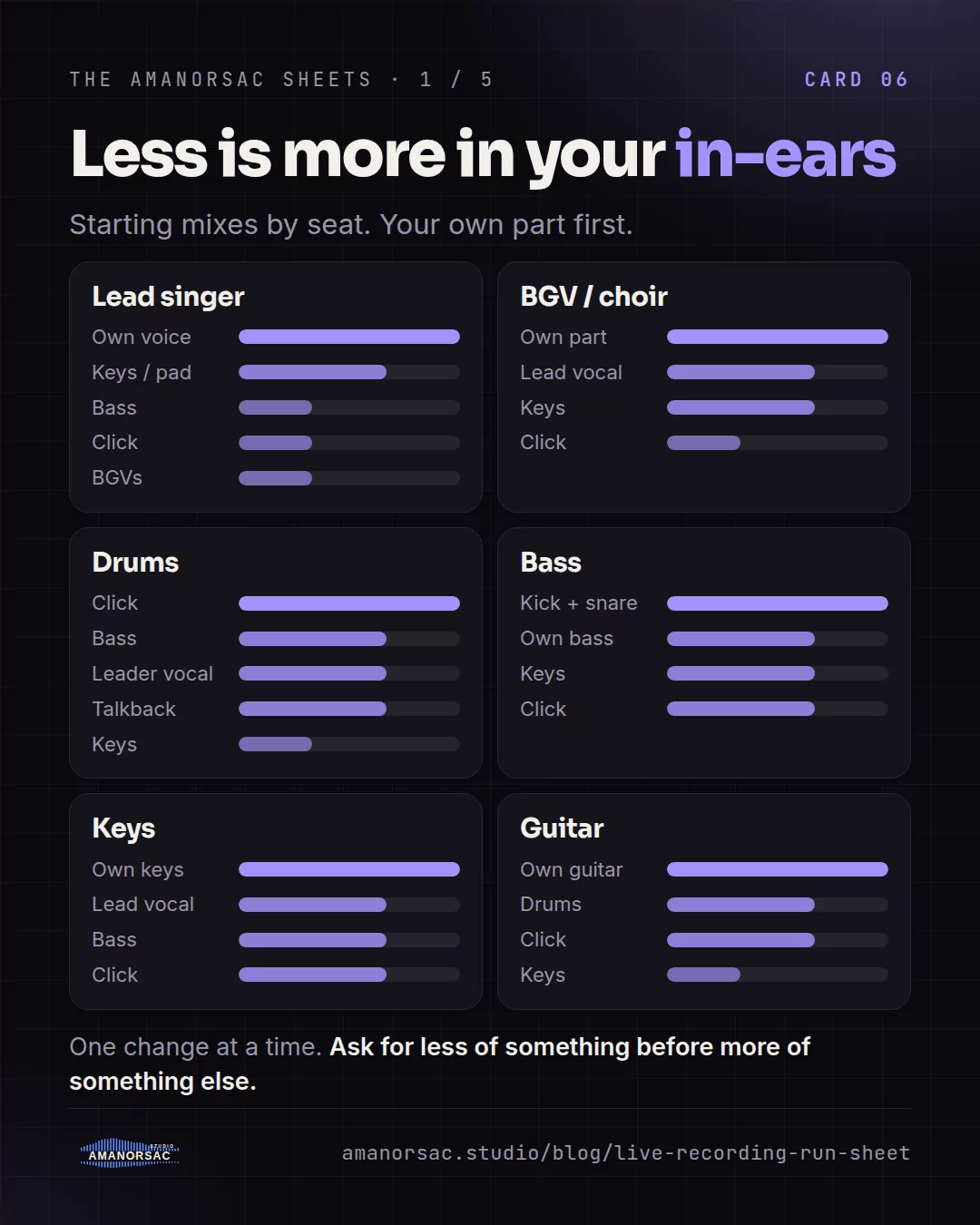
The louder your ears, the worse you will sing and play. The sheet gives a starting recipe for each seat. A lead singer wants their own voice first, then keys, then a little bass, click and backing vocals. A drummer wants click first, then bass and the leader's voice. A bass player wants kick and snare first.
And a way to ask for changes that gets you what you want: one change at a time, name the instrument, ask for less of something before more of something else, thumbs up when it is right, then leave it alone for the night.
When things go wrong
What you do in the next two seconds decides whether the take is usable. Wrong chord: do not stop, pull back or mute to the rhythm until the next downbeat, then come back in clean. Lost your place: look at the leader, listen to the bass, rejoin at the next section rather than mid-phrase. Voice cracks: stay on the mic and sing the next line, because stepping off is more noticeable than the crack. In-ears die: pull one out, play to the room, watch the drummer.
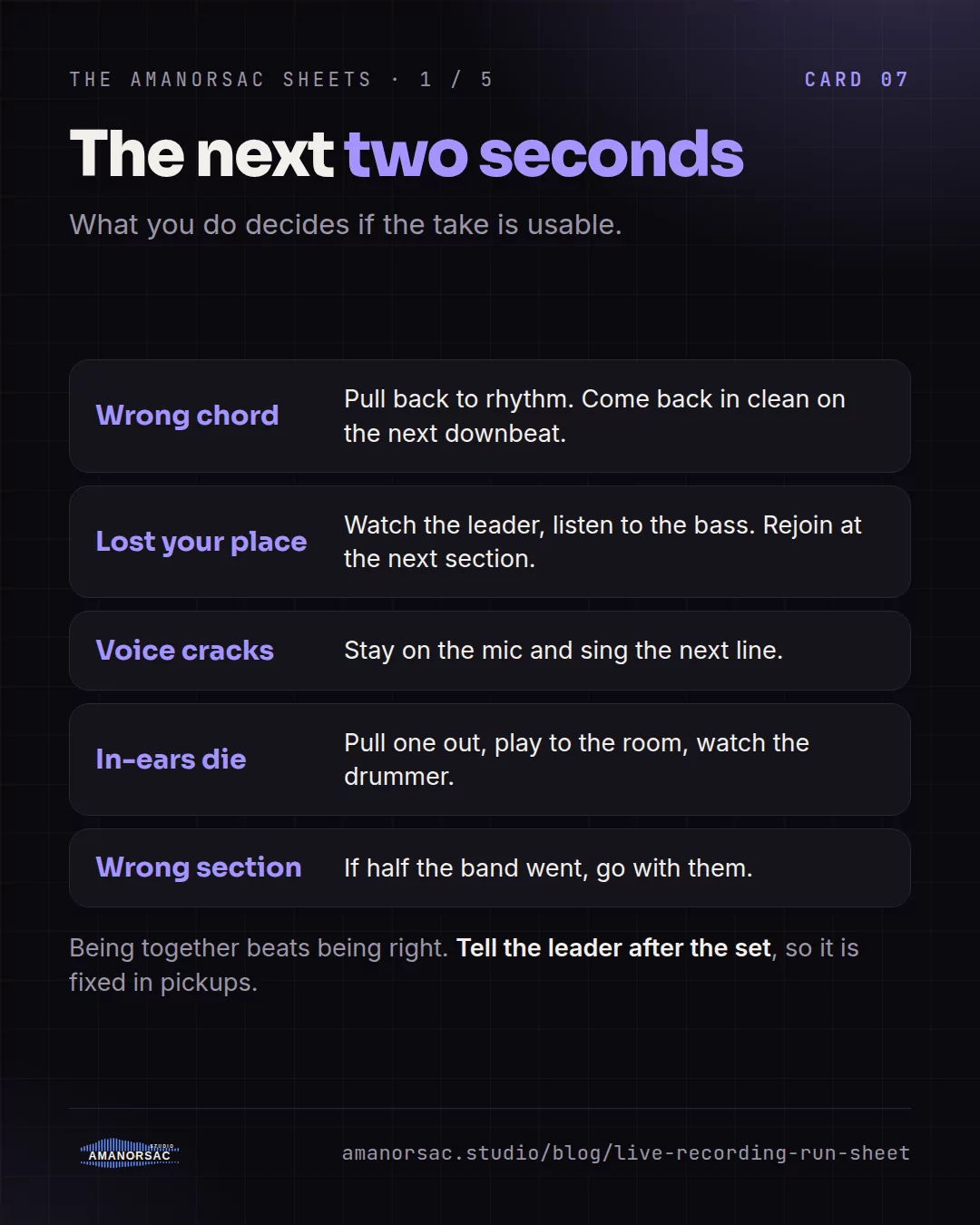
If half the band went to the wrong section, go with them. Being together beats being right. And after the set, tell the leader what went wrong so it can be fixed in pickups. Silence now means it is on the album forever.
The gig bag
Pack it the night before and tick it at the door. Singers: two bottles of water, in-ear tips, lyrics, non-menthol lozenges, a spare outfit. Keys: sustain pedal, power and a spare cable, laptop and charger, interface, patch list. Guitars: spare strings, tuner and batteries, picks, capo, strap, two spare cables. Drums: two pairs of sticks, drum key, dampening gel, a spare snare head. Everyone: in-ear pack and batteries, printed song maps, phone on silent, a snack. And for the camera: solid colours, no tiny stripes, no big logos.
Get the sheet
The Live Recording Run Sheet is nine pages: the four-week plan, the song map with a blank, the hand signals, the warm-up, the in-ear recipes, the trouble list and the gig bag checklist. It is free. Send it to your whole band and singers, because the best recordings come from teams that prepared together.
Download the Live Recording Run Sheet (PDF)
Next in the series: The Mud-Free Mix Card, the settings I actually use once the recording is in the box.
Written by Stephen Amanor Sackey — producer, mix engineer and music director, Virginia. More about the studio.