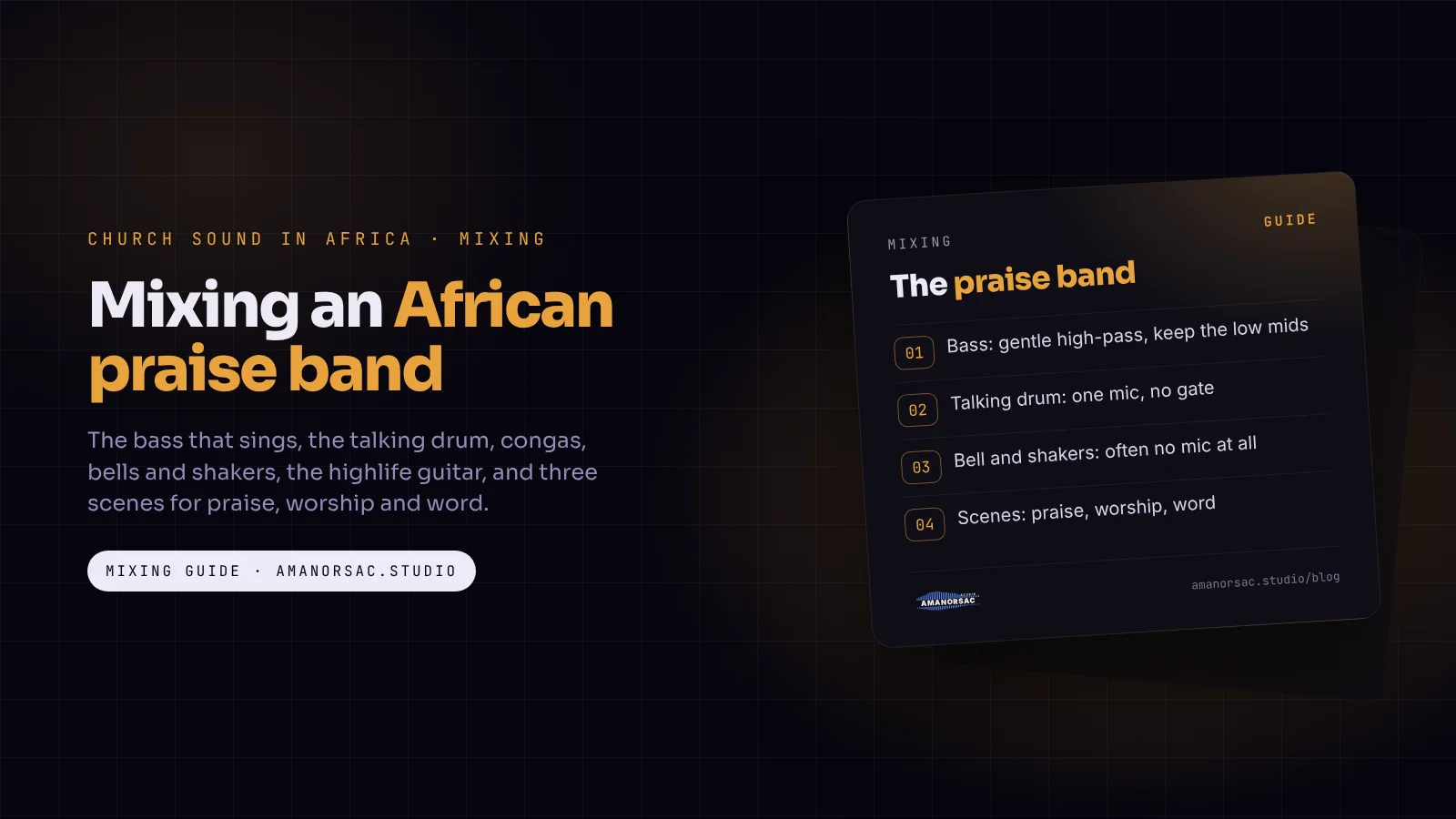
Almost every church sound guide you will find online was written for an American worship band: drums, bass, electric guitar, keys, a lead singer and four backing vocals, playing songs with a verse, a chorus and a bridge. Follow those guides in a Pentecostal church in Accra or Lagos and you will get a lot of things wrong, because the music is different.
I started on the keyboard in churches in Accra, and the first time I sat behind a desk for a praise session I made every one of these mistakes. This is the post I wish I had then. It covers what is different about mixing African praise, instrument by instrument, and what to change on your desk because of it.
First, know what you are mixing
A lot of African church music is dance music. In Ghana, gospel highlife came out of Pentecostal churches that let highlife guitar bands into the service, and grew into its own genre in the 1970s (Owusu-Poku, Popular Music). In Nigeria, juju grew from Christian congregational singing mixed with Yoruba vocal and drum traditions (Britannica).
That history explains the service you hear today. There is usually a praise section, fast, loud and often a medley, where people dance; and a worship section, slow, sometimes with no steady beat at all (Norient). Many Nigerian services start with a short, quiet time of adoration over soft keyboard before the praise (Verbum et Ecclesia).
Those are two different mixes, and the biggest single improvement most churches can make is to stop treating them as one.
The bass is a singer, not a foundation
In much American worship, the bass holds down the root note and stays out of the way. In Ghanaian gospel the bass is a lead voice. Researchers credit the bassist Sammy Otoo's patterns with shaping Ghanaian gospel praise, to the point that they are used as audition pieces, and they trace a style of melodic "substitution bass" back to the thumb piano and the talking drum (Journal of Education and Practice, 2025).
What that means on the desk:
- Do not cut the bass's personality. The high-pass filter on a bass DI should sit very low, around 30 to 40 Hz, only to clear rumble. Many guides tell you to scoop the low mids out of the bass. Here, the low mids are where the melody lives.
- Compress gently. A ratio around 3:1 with only a few dB of reduction keeps the level even without flattening the slides and slaps that make the line move.
- Take a DI and, if you can, the amp. The DI gives you a clean, solid low end; a microphone on the amp gives you the growl. In the 1970s, the Ghana Film Studio engineer Francis Kwakye miked the bass through its combo amp for exactly that character (*Popular Music*).
- Make room with the kick, not against the bass. Let the bass own roughly 100 to 300 Hz, and give the kick its weight lower down and its click higher up (around 2 to 4 kHz). Two instruments fighting over the same low mids is the source of most praise-section mud.
Talking drum
I could not find a single published guide to miking a talking drum for live sound. So this is my method, and it is worth testing in your own room.
The talking drum changes pitch, often by more than an octave, sliding within a single stroke (Wikipedia). The slide is the instrument. So:
- One dynamic microphone (an SM57-type is fine) about 15 to 20 cm from the playing head, angled from the side so the hooked stick never hits it.
- No gate. A gate chops off the slide at the end of the note, which is the part people are listening for.
- A gentle high-pass around 80 Hz and leave the low mids alone. Most of the drum's voice is there.
- Compress lightly, because a talking drummer moves from a whisper to a crack in one phrase.
- Ride it. When the talking drum is answering the singer, it is a lead instrument. Push it up for the answer and back down underneath the verse.
In Ghana the atumpan are played as a pair, a "male" and a "female" drum (Ghana News Agency). Mic each one, or put one mic between them, pointed at the gap.
Congas, djembe and hand drums
For congas and djembe live, mic from above, pointed near the rim rather than the centre of the head (Live Sound International), somewhere between 15 cm and 60 cm away depending on how the player mixes slaps and open tones (Recording). Closer gives you more attack and more bleed control; further gives you a rounder drum and more of the room.
High-pass them around 100 Hz unless the drum has a deep bass tone the band relies on, and pan them gently away from the kit so the groove has width.
Bells and shakers: they need less than you think
The bell (gankogui, dawuro, agogo) holds the time for the whole band, and it is loud. So is the shaker: the axatse in Ghana, a smaller cousin of the shekere, carries over most small percussion (Wikipedia).
In a small or medium church, the bell and shakers often need no microphone at all. Listen from the middle of the room before you give them one. If you do mic them, keep the mic further away, high-pass hard (200 Hz or more), and keep the fader low. A bell that is too loud in the PA turns a groove into a headache in two songs.
The highlife guitar and the keys
The lead guitar in highlife and gospel highlife plays clean, bright, interlocking lines, often answering the singer. It is not a rock guitar wall. Keep it clean in the mix, high-pass it around 100 Hz, and give it its own space in the stereo field, opposite the keys.
The keys player in an African church often covers piano, organ, strings, brass and pads in one evening. Ask for a stereo feed if the keyboard has one, and talk to the player about levels: a sudden jump from a soft piano to a full brass patch is the most common cause of a mix lurching in the middle of a song.
Voice and band: two balances, not one
On the highlife recordings Francis Kwakye made at the Ghana Film Studio, the balance between voice and band moved from the British label's 1:2 to 1:1, because that was how Ghanaian performance blends voices and instruments (*Popular Music*).
That is a useful idea for church. In the praise section, the groove is the point, and voices and band can sit close together. People know the songs, and they are dancing. In the worship section, and always for the sermon, the words come first: pull the band down and put the voice clearly on top.
Save the two mixes as scenes
If your desk has scenes or snapshots, build at least three:
- Praise: band up, bass and drums forward, percussion wide, voices sitting in it.
- Worship: band down, keys pad underneath, lead vocal clearly on top, longer reverb.
- Word: pulpit mic and interpreter mic up, everything else down or muted, no reverb on speech.
Moving between three saved mixes is much easier than chasing faders all morning, and it makes the service sound planned. The MR18 guide shows how snapshots work on one of the most common church desks.
Questions people ask
Why is the bass so loud in African churches?
Partly because the bass is a lead instrument in the music, which is right, and partly because it is often fighting the kick drum in the low mids, which is a mixing problem. Give the kick and bass separate ranges before you turn anything down.
How do I mic a talking drum?
One dynamic mic, 15 to 20 cm from the playing head, angled from the side. No gate, a gentle high-pass and light compression, and ride it when it answers the singer.
Does the bell need a microphone?
Usually not in a small or medium church. It cuts through on its own. If you mic it, keep it low in the mix.
Should the praise section and the worship section have different mixes?
Yes. Save each as a scene so you can move between them in one step.
Where can I learn to mix African church music?
There is very little written about it, which is why this blog exists. Start with church sound in Africa, the full list of posts on running sound in African churches.
Written by Stephen Amanor Sackey — producer, mix engineer and music director, Virginia. More about the studio.
Studio news
Struggling to move forward in your music?
Guides from a working music director, written for the churches we actually work in: church sound, worship teams, free sheets for the desk, and the apps, with the free one first. A few letters a month at most, and every one has a link to stop.
You will get one email asking you to confirm. Your first app is 15% off when you join. Privacy.