

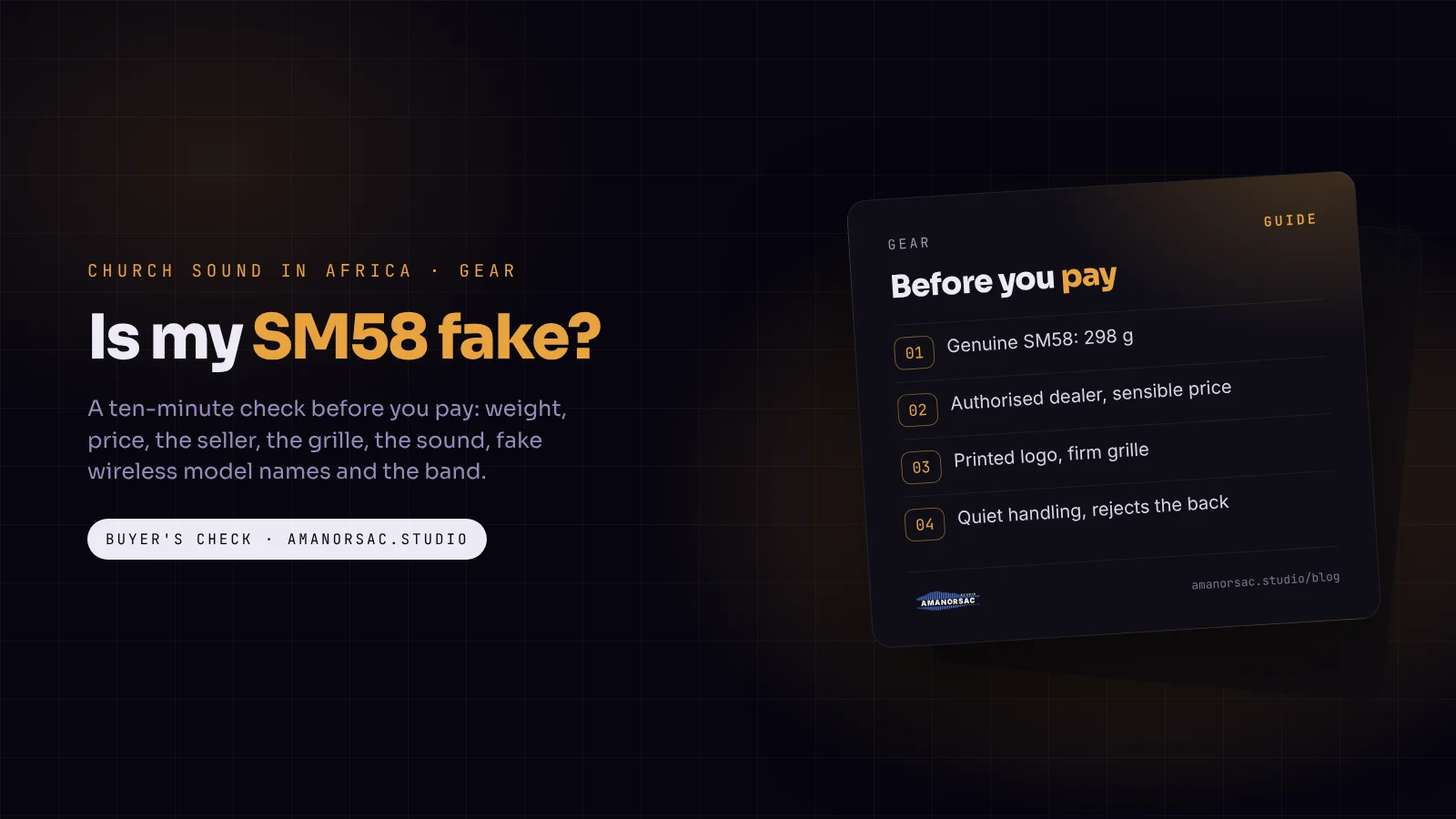
The Shure SM58 is probably the most copied microphone in the world. It is the vocal mic every church wants, it is simple to build a lookalike, and a fake can be sold for a fraction of the real price while still looking right in the box.
The trouble is that a fake does not just sound worse. It feeds back sooner, it handles badly, and it breaks. Shure will not repair it or honour a warranty on it, because counterfeit products from unknown sources cannot be covered or serviced (Shure).
Here is the check I would do before money changes hands, in the market, at a dealer's counter or when a "brother" offers the church a box of mics.
The quick answer
If the price is far below what the authorised dealer charges, it is almost certainly fake. Nobody sells genuine SM58s at a big loss. Everything else on this list is confirmation.
1. Weigh it
This is the most reliable check you can do without opening anything.
A genuine SM58 weighs 298 g, and a genuine SM57 weighs 284 g, according to Shure's specifications. Fakes are usually lighter, because the cheapest way to build a copy is with lighter parts and a cheaper magnet (Behind the Mixer).
A small kitchen scale or a digital pocket scale settles it in a few seconds. Take one to the market. Weigh it without the clip and the bag.
2. Check where it is sold, and by whom
Shure lists its authorised distributors on its own country pages. When I checked in October 2026 they were:
- Ghana: Virtual Sound Laboratory, Accra (Shure Ghana).
- Nigeria: Showgear Ltd, Yaba, and Systems Intelligenz, Gbagada (Shure Nigeria).
- Kenya: Sound Creations, Westlands (Shure Kenya).
Distribution changes: in July 2026 Shure announced Hub Media as a distributor for African markets (press release). So check Shure's own page for your country on the day you buy, and ask the shop whether it buys from that distributor. A genuine reseller will tell you.
Big open markets can be fine for cables and stands, but they are also where counterfeits are sold. Nigeria's consumer protection regulator once called one large Lagos electronics market a "harbour" for counterfeit electronics (News Ghana). Buy microphones from someone who will still be there next month.
3. Look at it closely
Copies have improved, so no single visual sign proves anything. But several together are telling. These are the signs engineers report most often (AudioTechnology, Sine Post):
- The logo on the grille ring. On a genuine SM58 the Shure name is printed on the band. Many fakes use a wrapped sticker or a badge that sits differently.
- The grille. The genuine grille is a firm, even mesh that screws on smoothly. Loose, rough or uneven grilles are a warning.
- The finish. Paint that chips easily, sharp edges, a seam you can feel, or a body that rattles when you shake it.
- The XLR connector. On a genuine mic the pins are clean and the connector fits snugly. Wobbly or crooked pins are a bad sign.
- The box and paperwork. Spelling mistakes, blurred printing and missing paperwork. But do not trust a good box on its own: counterfeiters copy packaging closely.
4. Listen to it
If you can plug it in, do. Bring a genuine SM58 if anyone you know has one, and compare them on the same channel with the same settings.
- Handling noise. Tap the body and move it in your hand. A genuine SM58 is known for low handling noise. Many fakes thump loudly.
- Sound. A fake often sounds thinner or harsher, with less body in the voice, and may need more gain to reach the same level.
- Feedback. Point it near a monitor at the same level. A fake usually feeds back sooner, because its pickup pattern is not as controlled.
- Off-axis. Speak into the side and the back. The SM58's cardioid pattern rejects sound from behind. A fake often picks up much more from the back.
5. Wireless microphones: the fakes are bolder
Fake wireless systems are a bigger problem, because they cost more and the fault only shows on a busy Sunday.
A Kenyan pro-audio retailer lists the most common signs it sees (Pro Audio Kenya). These are the retailer's observations, not Shure's:
- Model names that do not exist. "Shure SH-500" and "SM-820A" are not Shure products, yet they are widely sold.
- The most-faked series are BLX, GLX-D and SLX-D.
- Features that do not work: dead network ports, no working frequency scan, and loud handling thumps.
Check the exact model name on Shure's own website before you buy. If you cannot find it there, it is not a Shure.
The same goes for other brands. Sennheiser says counterfeiters copy its packaging closely, and that it cannot confirm whether a product is genuine from photos or a serial number; the product has to be inspected. Its warning signs include missing or mismatched accessories and a power plug that does not fit your country's sockets (Sennheiser, Sennheiser help).
6. Wireless frequencies: genuine can still be wrong
Even a genuine wireless mic can be the wrong one for your country. The frequencies wireless microphones may use are different from country to country, and Shure advises checking with your local Shure representative rather than relying on its US band chart (Shure).
This matters because bands are being reassigned to mobile networks. Nigeria opened parts of the 600 MHz band, including 617 to 627 MHz, for mobile licensing in 2023 (Business Metrics). In Kenya, 470 to 694 MHz is assigned to digital television (Kenya Law). A second-hand system on a band that phone networks now use can suffer dropouts that no amount of fiddling fixes. Ask the dealer which band the system is on, and whether it is right for your country.
If you already own one you suspect
Do not panic, and do not throw it away. Weigh it, compare it, and if it is fake, use it for the jobs where it matters least: an announcement mic, a spare, a talkback mic for the music director. Put the genuine microphones on the lead vocal and the pulpit, where feedback and clarity matter most.
Then mark it, so nobody puts it back on the pulpit by mistake.
A buying checklist
Print this and keep it in the sound cupboard:
- Is the seller authorised, or do they buy from the authorised distributor?
- Is the price close to the authorised dealer's price?
- Does it weigh 298 g (SM58) or 284 g (SM57) without the clip?
- Is the logo printed on the grille ring, and is the grille firm and even?
- Does it sound full, reject sound from behind, and handle quietly?
- For wireless: does the exact model name exist on Shure's site, and is the band right for this country?
- Do you get a receipt with the shop's name and address?
Questions people ask
How can I tell if my Shure SM58 is fake?
Weigh it first: a genuine SM58 weighs 298 g. Then check the seller, the price, the grille and logo, and how it sounds and handles compared with a known genuine one.
How much does a real SM58 weigh?
Shure's specification gives 298 g for the SM58 and 284 g for the SM57.
Where can I buy a genuine Shure microphone in Ghana or Nigeria?
From Shure's authorised distributors, listed on Shure's own website for each country, or from shops that buy from them. Check the page on the day you buy, because distributors change.
Is the Shure SH-500 real?
According to a Kenyan pro-audio retailer, the SH-500 and SM-820A are not Shure models. If a model name is not on Shure's own website, it is not a genuine Shure.
Will Shure repair a fake microphone?
No. Shure says counterfeit products cannot be covered by warranty or serviced.
Are fake microphones dangerous?
Usually not dangerous, but they feed back sooner, sound worse and break. Fake wireless systems can also be on frequencies that are not permitted in your country.
More on running sound in African churches: church sound in Africa.
Written by Stephen Amanor Sackey — producer, mix engineer and music director, Virginia. More about the studio.
Studio news
Struggling to move forward in your music?
Guides from a working music director, written for the churches we actually work in: church sound, worship teams, free sheets for the desk, and the apps, with the free one first. A few letters a month at most, and every one has a link to stop.
You will get one email asking you to confirm. Your first app is 15% off when you join. Privacy.