Someone at church has just told you that you are the music director now. Maybe you were the best keyboard player, maybe you were the one who always knew the keys, or maybe nobody else said yes. Either way, you have a title and no job description.
Search for one and you find job adverts from large American churches and arguments about whether the music director and the worship leader are the same person. Neither tells you what to do on Tuesday night, or when the pastor goes off plan mid-service.
I started in Accra, playing keyboard and directing music for churches and a live band, and today I am music director and broadcast mix engineer for a multicultural congregation in Virginia. This is the job as I understand it: what it is, what the week looks like, how to run a rehearsal that actually helps, and how the role works in African churches, where the music rarely stops.
What does a church music director do?
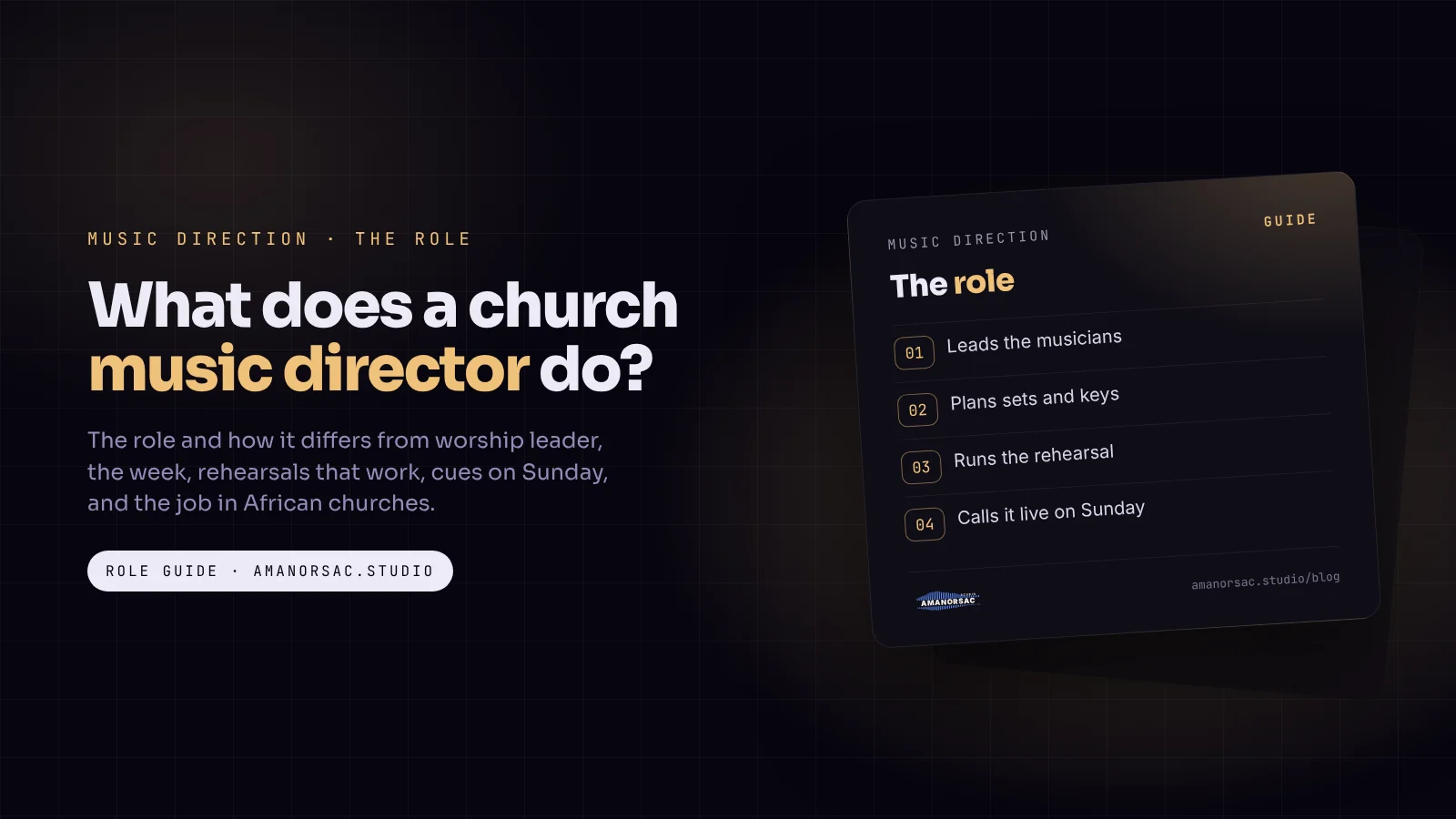
The music director is responsible for how the music works. Not whether it moves people, which is not in anyone's hands, but whether the band and singers know the songs, play them in the right keys, move from one to the next without falling apart, and follow the service as it changes.
In practice that means five things:
- Choosing and preparing the music with the worship leader and pastor: songs, keys, order and transitions.
- Making sure everyone has what they need: charts, recordings, parts for the singers.
- Running rehearsal so the time is spent on what will go wrong, not on what already works.
- Leading the band during the service, usually from an instrument, with signals, talkback and cues.
- Looking after the people: who plays when, who is ready to play more, who needs help.
If the worship leader is the voice the congregation follows, the music director is the person the band follows. When it is done well, nobody in the pews knows the music director exists.
Music director vs worship leader: what is the difference?
This is the question people ask most, and the honest answer is that it depends on the church. In a small church one person often does both. In a larger one they are two jobs, and it helps everyone to know where the line sits.
- The worship leader leads the congregation. They sing, they speak between songs, they read the room and they decide, often in the moment, to repeat a chorus or stay in a quiet place. Their attention faces the people.
- The music director leads the musicians. They make the worship leader's decisions happen: they hear "let's sing that again" and turn it into a signal the drummer can see. Their attention faces the band.
- The choir director shapes the choir's sound: parts, blend, diction, dynamics. In churches with a big choir this is often a separate person who rehearses the choir on their own night and conducts them during the service.
- The pastor sets the direction of the whole service. The music serves the sermon and the moment, and the pastor has the final word on time.
Trouble starts when these overlap without anyone saying so. If the choir director and the music director give the choir different cues, the choir follows neither. Agree, out loud, who calls what.
What does the music director's week look like?
Every church runs differently, but most weeks follow the same shape. Here is mine, written as a list you can copy.
- Early in the week: plan the set. Get the songs from the worship leader, or choose them together. Write down the order and the key of every song for the singer who is leading it, not the key on the original recording.
- Plan the transitions. Decide how each song ends and how the next one starts. Same key, a pivot chord, a drum groove, or a keys pad under a prayer. If a key change is involved, plan the two bars that carry it. The key changes guide covers the moves that work.
- Send charts and references. Chord charts in the right key, a recording, and a short note on anything unusual: "we go to the bridge twice", "the tag drops to keys only".
- Write a rehearsal plan. Ten minutes of thinking before rehearsal saves an hour during it. More on this below.
- Rehearse. Run the plan. Spend most of the time on transitions and starts and endings.
- Before the service: line check with the sound team. Agree the order of service, where the quiet moments are and who will need a microphone when.
- During the service: lead. Count in, signal, cue, listen, adjust.
- After the service: review. What went wrong, why, and what changes next week. Five minutes, while it is fresh.
Choose keys for the voice that is leading, and write them on everything. Musicians who play by ear often think in numbers rather than letter names, so a chart in the Nashville number system (1, 4, 5, 6m, where 1 is the home chord of the key) lets you move a song to any key without rewriting it.
How do you lead the band from the keyboard?
Most music directors lead from an instrument, very often the keys. You can hold the harmony together, cover a gap when someone gets lost, and play a pad under the pastor. But your hands are busy, so you lead with everything else:
- Your voice, through talkback. Talkback is a microphone that goes only into the band's monitors or in-ears, not to the congregation. Short words, said a bar before they are needed: "chorus", "down", "last time", "keys only".
- Your head and eyes. A nod on the downbeat, a look at the drummer before the ending.
- One free hand. Most signals can be given with the left hand while the right holds a chord.
- Your playing. If you drop to a single sustained chord, a good band will hear it and come down with you.
If you are still learning to name the chords you play by ear, it helps to see them named as you play. That is what I built Chordlight 88 for: it names the chords you play on the piano, which is useful when you are writing charts or teaching a player the voicings you want.
How do you run an efficient church rehearsal?
Most church rehearsals waste time the same way. The band plays each song top to bottom, it sounds fine, and on Sunday it falls apart between the songs, because nobody rehearsed between the songs. Songs mostly rehearse themselves once people have listened to them. Transitions, starts and endings do not.
An order that works:
- Start on time, with whoever is there. Waiting for latecomers teaches everyone that rehearsal starts late.
- Sound and monitors first, quickly. Ten minutes so nobody is fighting their in-ears for the next hour.
- The hardest thing first. A new song, a difficult key change, a new arrangement. Do it while people are fresh.
- Sectionals while the others rest. Singers on their parts with one keys player, then the rhythm section on the groove.
- Transitions in pairs. The last chorus of one song into the first verse of the next, until it is boring.
- Starts and endings. Who starts, how many bars, how it ends, who gives the cut-off.
- Run the set once without stopping, mistakes and all.
- Finish on time, with notes. Two or three things to practise at home, no more.
Singers learn parts faster at home than in rehearsal, which leaves rehearsal for blend. Our choir rehearsal app, HarmonieMD, is built for that and is coming soon. Until then, a voice note of each part sent to the group works.
What signals should a worship band use?
There is no universal set, and that is fine, as long as everyone on your platform uses the same one. Agree them in rehearsal, write them down and stick to them.
The common ones are fingers for verse numbers, a C shape for the chorus, a flat hand for the bridge, a circling finger to repeat, a palm down to bring it down, a palm up to build, a finger pointing up for a key change, and a closed fist for the last time. The Live Recording Run Sheet has the full set with pictures.
Three rules make any signal set work:
- Signal a bar before the change, never on the downbeat. On the downbeat it is already too late.
- Say it and show it. Talkback for the people with in-ears, a hand for the people who are looking.
- If someone misses it, follow the drums and bass. Teach your team that rule and most mistakes last one bar instead of eight.
The sound team needs cues too, and cannot read your hand signals from the back of the room. Give them the order of service, mark the moments where something changes, and agree how you will tell them when the plan changes.
How does the role look in African churches?
Most of what is written about music directors assumes an American church: a set of four songs, a band of five, a clear start and finish. Directing in many African churches is a different job, and much harder in some ways.
The music hardly stops. In charismatic churches in Ghana there is music almost everywhere in the service except the sermon, with slow "worship" sections and upbeat "praise" sections (Norient). The music director is working for most of the service, not for twenty minutes at the start. Keys under prayers, under announcements, under the offering, under the altar call.
Praise is led on the fly. A praise medley can run song into song for a long time, with the leader starting a new song with no warning, sometimes in a new key. Some churches prefer it that way: research on the Church of Pentecost notes its preference for "spontaneous" worship music (Pentecost Journal of Theology and Mission). In the Redeemed Christian Church of God, short Yoruba praise songs are used to rouse the congregation (African Journal of Religion and Media). You cannot rehearse every song a leader might start. You rehearse the band to follow: to find the key in a bar, to pick up the groove from the drummer, to listen for the next song's first line.
The service has a shape. Many Nigerian services begin with a short, solemn time of adoration over soft keyboard before the praise breaks out (Verbum et Ecclesia). Knowing that shape lets you plan the energy of the whole service, not just the songs.
Choirs are big, and there may be more than one group. Many churches have a large choir alongside the band. In Kenya, missionary hymns were translated and sung in four-part harmony, and makwaya choirs spread by radio from the 1940s (Afropop Worldwide). In Ghanaian Methodist churches, singing bands began so that Fante speakers who could not read could sing in their own language (University of Ghana). The music director may be coordinating the band, a choir, a singing band and a congregation that knows every song, in two or three languages.
What that means in practice:
- Train your band's ears more than its charts. Practise "the leader starts a song, you find it" in rehearsal. Pick a song, sing the first line, and see how fast the band can join in the right key.
- Keep a list of the leader's songs and their keys. Most leaders return to the same songs. If you know their keys, you can be there in a bar.
- Own the gaps. The music director decides what is playing under the prayer and when it stops. A soft pad that sits under the minister without competing is a skill worth rehearsing.
- Talk to the sound team about the shape, not the setlist. Praise, worship and the word are different mixes, as the African praise band post explains.
How do you become a church music director?
There is no exam. Most music directors become one by being the musician who is always ready. If you want the role, these are the things that get you there.
- Be solid on your instrument in every key. Leaders will start songs anywhere.
- Learn to hear the whole band. Follow the bass on a recording, then the drums, then the guitar.
- Learn chord numbers. Being able to say "go to the 4" is faster than any chart.
- Help with the boring parts. Write charts, send recordings, set up early. Leaders notice who makes things easier.
- Ask to run a sectional. Take the singers for twenty minutes. It is the smallest version of the job.
- Learn a little about sound. Knowing what the mix engineer needs, and what a monitor mix is, makes you much easier to work with. The in-ear mistakes post is a good start.
- Look after yourself. Long services and loud stages wear you down. The Musician Body Check covers hearing, posture and rest.
If your church adds backing tracks or a click, the music director usually runs them. Start simple: a click only in the drummer's ears is a fine first step.
Should church music directors and instrumentalists be paid?
This is an old argument, and it gets heated. A Nairaland thread asks whether it is right for churches to pay instrumentalists, and the arguments on both sides will be familiar to anyone who has served in a church band.
One side says music is ministry, everyone else serves without pay, and paying musicians turns worship into a gig. The other says a skilled musician spent years and money on the skill, is expected at every service, rehearsal and vigil, and a church that pays its cleaner can pay its musicians.
My view is that both can be right in different churches. What matters is that it is clear. A few principles help:
- Be honest about what is being asked. A musician who plays one Sunday a month is in a different place from one who directs every service, rehearsal and midweek meeting.
- Agree it in writing. Pay, expectations, what happens when someone cannot come. Unspoken expectations are where the bitterness comes from.
- Pay fairly or not at all, but do not pay unevenly in secret. Nothing divides a band faster than finding out someone else is paid.
- Cover costs at least. Transport, strings, a meal at a long service. Even churches that do not pay often do this.
If you are paid, treat it like any other income. The Gig Money Split is a simple way to put each payment where it belongs the day it lands.
Questions people ask
What does a music director do in church?
The music director leads the musicians. They plan songs, keys and transitions, prepare charts, run rehearsal, and lead the band during the service with signals and talkback so the music follows what the worship leader and pastor are doing.
What is the difference between a music director and a worship leader?
The worship leader leads the congregation and faces the people. The music director leads the band and singers and turns the worship leader's decisions into cues the musicians can follow. In small churches one person often does both.
Is a choir director the same as a music director?
Not always. A choir director shapes the choir's parts, blend and diction, while the music director coordinates the whole band, the choir and the service. In churches with large choirs these are often two people.
How do I become a music director at my church?
Get solid on your instrument in every key, learn chord numbers, help with charts and rehearsal, and ask to run a sectional. Most music directors are given the role after they have already been doing part of it.
How long should a worship team rehearsal be?
Long enough to work through a written plan, and no longer. Starting on time, doing the hardest thing first and rehearsing transitions instead of whole songs gets more done in less time than playing every song top to bottom.
Should church musicians be paid?
Churches disagree, and both views are held sincerely. Whatever your church decides, make it clear, agree it in writing, treat people fairly and at least cover their costs.
More on leading the music, from rehearsal to the last chord, in the music director's guide.
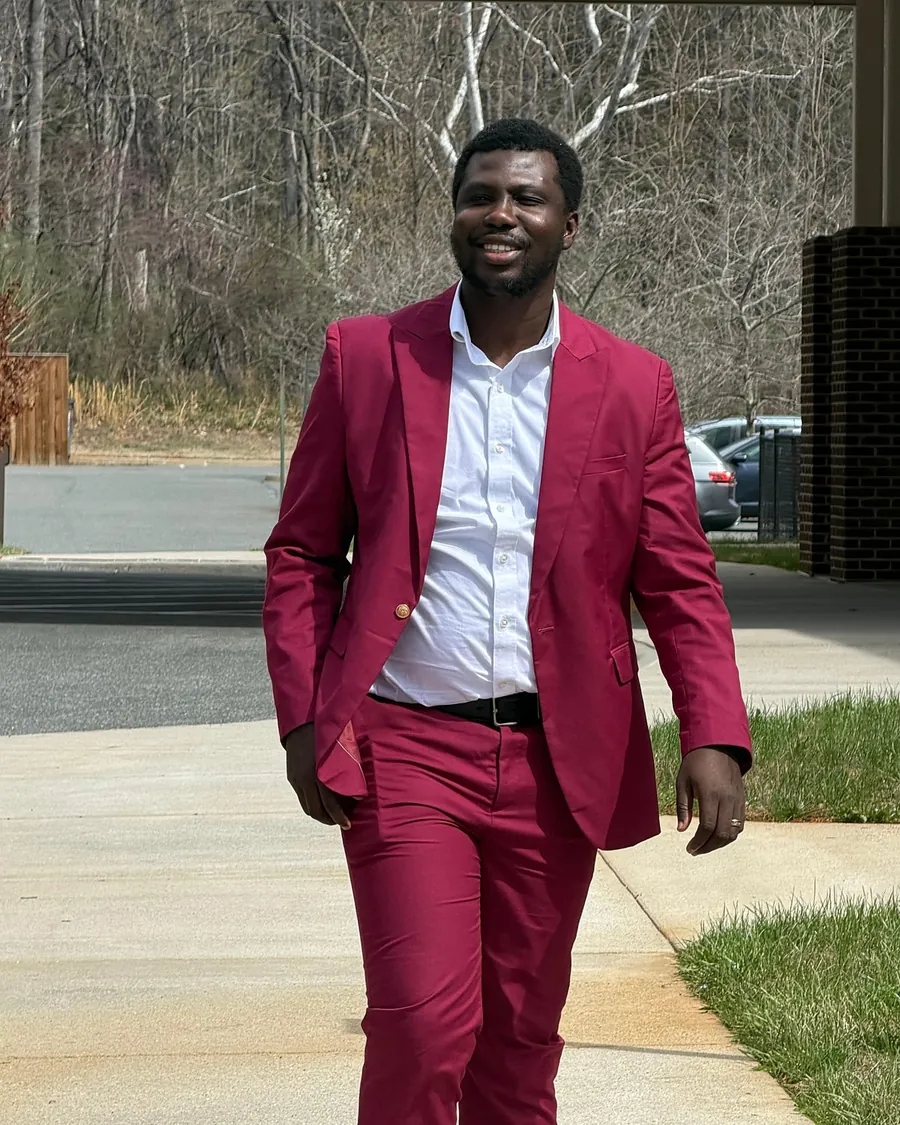
Written by Stephen Amanor Sackey — producer, mix engineer and music director, Virginia. More about the studio.
Studio news
Struggling to move forward in your music?
Guides from a working music director, written for the churches we actually work in: church sound, worship teams, free sheets for the desk, and the apps, with the free one first. A few letters a month at most, and every one has a link to stop.
You will get one email asking you to confirm. Your first app is 15% off when you join. Privacy.