Ask people in Accra, Lagos or Nairobi about noise, and churches come up quickly. In Kenya, the national environment authority has reportedly said religious institutions account for 60% of noise complaints (Nairobi News). In Nigeria, the federal environmental agency says most of the complaints it gets are about churches and mosques (NAN).
The sound team is usually the last to hear about it, and the first to be blamed. This post is for the people behind the desk. It sets out the limits as far as they are published, the cases that show the law is enforced, and the practical changes that keep worship full and loud inside the building while keeping the church out of court.
I am a sound engineer, not a lawyer. Check the current rules with your local assembly, the EPA or state agency before you rely on any figure here.
The limits
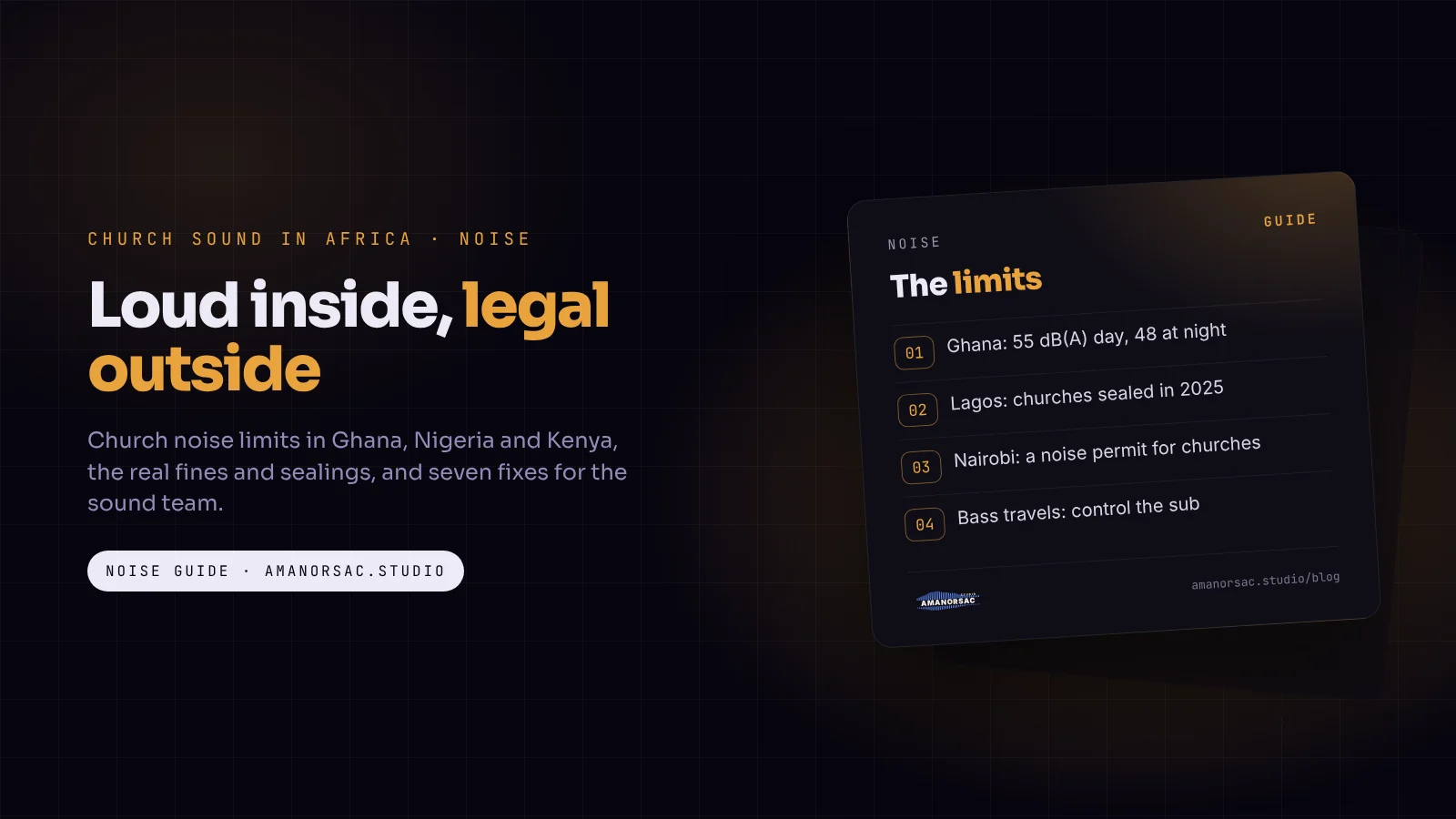
Ghana. The Ghana Standard GS 1222:2018 sets limits of 55 dB(A) during the day and 48 dB(A) at night for residential areas, and the Environmental Protection Agency has said churches must observe them (GNA). Other limits apply in commercial and mixed areas.
Nigeria (Lagos). Limits of 55 dB by day and 45 dB at night in residential areas were quoted when the Lagos State Environmental Protection Agency (LASEPA) sealed 53 churches, mosques and hotels in December 2015 (Citi FM). Nationally, the National Environmental Standards and Regulations Enforcement Agency (NESREA) has Noise Standards and Control Regulations from 2009 with limits for places of worship (NESREA).
Kenya. Noise is governed by the Environmental Management and Co-ordination (Noise and Excessive Vibration Pollution) (Control) Regulations, 2009. In Nairobi, the 2026 Finance Act sets a noise permit fee of KSh 5,000 a year for churches (Kenyans.co.ke).
What all of these have in common: they are about the noise that reaches the neighbourhood, not the level in your front row. That is good news for a sound team, because most of what makes a church loud outside can be fixed without making the service quieter inside.
How loud churches actually are
Researchers have measured. A study of 20 religious centres in Abeokuta found a mean of 85.48 dB(A), with churches louder than mosques and evening and night services the loudest (FUDMA Journal of Sciences). A study of six churches in south-west Nigeria recorded levels above 90 dB(A) (University of Ilorin).
Those are levels inside or near the service. Compare them with a night limit of 45 or 48 dB(A) in a residential area, and you can see why neighbours complain.
There is a second reason to care. The widely used occupational limit is 85 dB(A) over an eight-hour day, and the safe time halves for every 3 dB louder. A long service at 90 dB(A) and above, week after week, puts the hearing of your own musicians, singers and sound team at risk, as well as the neighbours' sleep.
The law is enforced
These are not empty rules.
- Accra, Ghana. The High Court ordered two churches in Haatso to pay GH¢20,000 each after the EPA measured 76 to 86 dB(A) against a 55 dB(A) limit (Citi Newsroom).
- Ga West, Ghana. The municipal assembly took between ten and fifteen churches to court in a single year (VOA).
- Lagos, Nigeria. LASEPA sealed a church in March 2025 after residents complained (Sahara Reporters), sealed three more churches in September 2025 (Gazette), and another in October 2025 (Tribune). Reopening can require a letter of guarantee from the residents' association (TheCable).
- Accra traditional season. Every year, Ga traditional authorities impose a ban on drumming and noise before the Homowo festival, and churches have clashed with it (OAPEN).
A sealed church cannot worship at all. Getting this right protects the ministry.
Loud inside, legal outside: what the sound team can do
Most church noise that reaches the street comes from a few fixable things.
1. Take the speakers off the roof and out of the windows
Horn speakers on the roof or pointed out of the building are the single biggest cause of complaints. They send the service across the neighbourhood on purpose. If the church wants people outside to hear, that is a decision for the leadership and the law, not the sound team, and a quieter speaker at the gate for latecomers is enough.
2. Point the speakers at the people, not the walls
Aim the main speakers down at the congregation, and keep their throw inside the building. Sound that hits the back wall, the windows and the open sides of the building goes outside. Tilting a speaker down so it covers the seats and stops short of the back wall makes the room clearer and the street quieter at the same time.
3. More small speakers, closer, instead of two big ones loud
Two huge speakers at the front, turned up until the back row can hear, are deafening in the front row and spill everywhere. Smaller speakers placed along the room (delay speakers) let you run each one quieter, so the overall level outside drops while everyone inside hears clearly.
4. Control the bass
Low frequencies go through walls, roofs and closed windows far better than high ones. The thump of the kick drum and the subwoofer is what neighbours hear three streets away. Do not let the subwoofer run the show:
- High-pass everything that does not need low bass (vocals, keys pads, guitars), so the sub only carries kick and bass.
- Turn the sub down at night and in the quiet worship section.
- Place subwoofers away from open sides and doors.
5. Close the building
Doors and windows open during the service are open channels to the street. Where the building allows it, close them during the loudest sections, and seal gaps. An open-sided building or a canopy needs extra care with speaker aiming and with the sub, because there is no wall at all.
6. Measure, at the boundary
Get a sound level meter, or at least a phone app as a rough guide, and do two measurements on a normal Sunday: one in the middle of the congregation and one at the church's boundary, near the nearest homes. Write them down. If the boundary reading is far above the limit, you know where to start, and you have a number to discuss with the leadership.
7. Night is different
Night limits are lower, and vigils, crusades and late services are when complaints peak. Plan a lower level for night services from the start, rather than turning down after the first knock on the door. Mixing an all-night vigil has a full plan for long night services.
Talking to neighbours and the leadership
The sound team is often caught between a pastor who wants it louder and a neighbour who wants it quieter. A few things help:
- Bring numbers, not opinions. "Our boundary reading is 75 dB and the night limit is 48" is easier to act on than "it is too loud".
- Offer a fix, not just a complaint. "If we take the roof horns down and turn the sub down after 9 pm, we can keep the same sound inside."
- Make a contact. A phone number neighbours can call during a service is better than a complaint to the assembly.
Questions people ask
What is the legal noise limit for churches in Ghana?
The EPA has said churches must observe GS 1222:2018, which sets 55 dB(A) by day and 48 dB(A) at night in residential areas. Other limits apply in commercial and mixed areas, so check with the EPA or your assembly.
Can a church be closed for noise in Lagos?
Yes. LASEPA has sealed churches for noise pollution several times, including in 2015 and three times in 2025.
How loud is too loud for a church service?
For the neighbourhood, whatever exceeds the local limit at the boundary. For the people inside, long services above 85 dB(A) put hearing at risk, and churches have been measured above 90 dB(A).
Why do neighbours hear the bass and drums most?
Low frequencies pass through walls and roofs far better than higher ones. Controlling the subwoofer and the kick drum makes the biggest difference outside.
Do churches in Nairobi need a noise permit?
Nairobi's 2026 Finance Act sets a noise permit fee of KSh 5,000 a year for churches. Check with the county for current requirements.
How can we stay loud inside without disturbing neighbours?
Take speakers off the roof, aim speakers at the congregation, use more smaller speakers instead of two loud ones, control the bass, close doors and windows, and measure at the boundary.
More on running sound in African churches: church sound in Africa.
Written by Stephen Amanor Sackey — producer, mix engineer and music director, Virginia. More about the studio.
Studio news
Struggling to move forward in your music?
Guides from a working music director, written for the churches we actually work in: church sound, worship teams, free sheets for the desk, and the apps, with the free one first. A few letters a month at most, and every one has a link to stop.
You will get one email asking you to confirm. Your first app is 15% off when you join. Privacy.