

Most muddy worship mixes are not an EQ problem. They are a level problem that EQ was asked to fix. The mix was built with plugins before it was built with faders, every channel went into its compressor hot, and then the engineer spent an hour cutting 300 Hz on everything and wondering why it still sounded like a blanket.
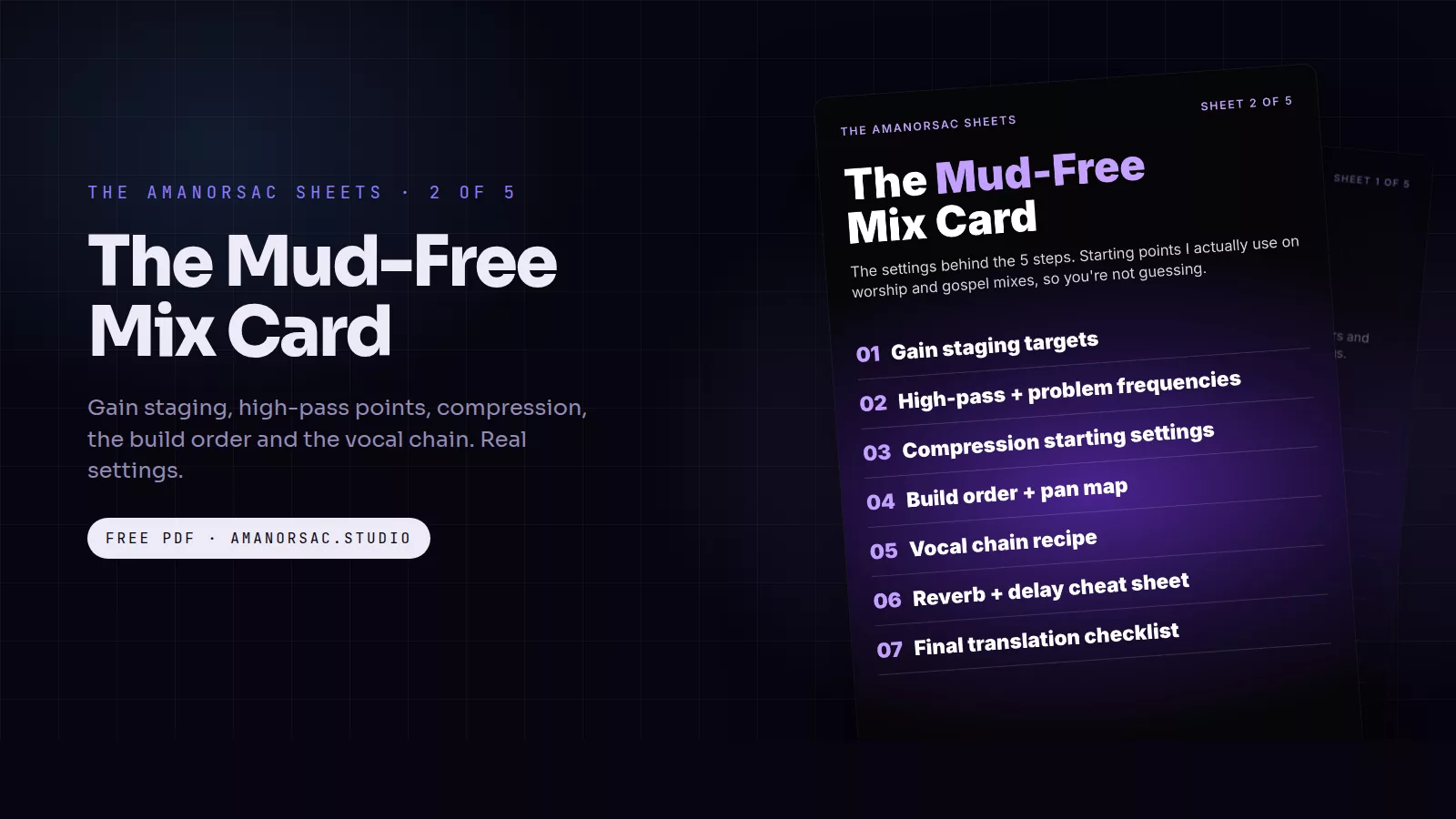
The Mud-Free Mix Card is the second of the five free sheets, and it is the settings behind the five steps I teach: the actual starting points I use on worship and gospel mixes, so you are not guessing. They are starting points. Your ears get the final say.
Every card in this post is free to save and share. Tap one to open it full size.
Gain staging comes before any plugin
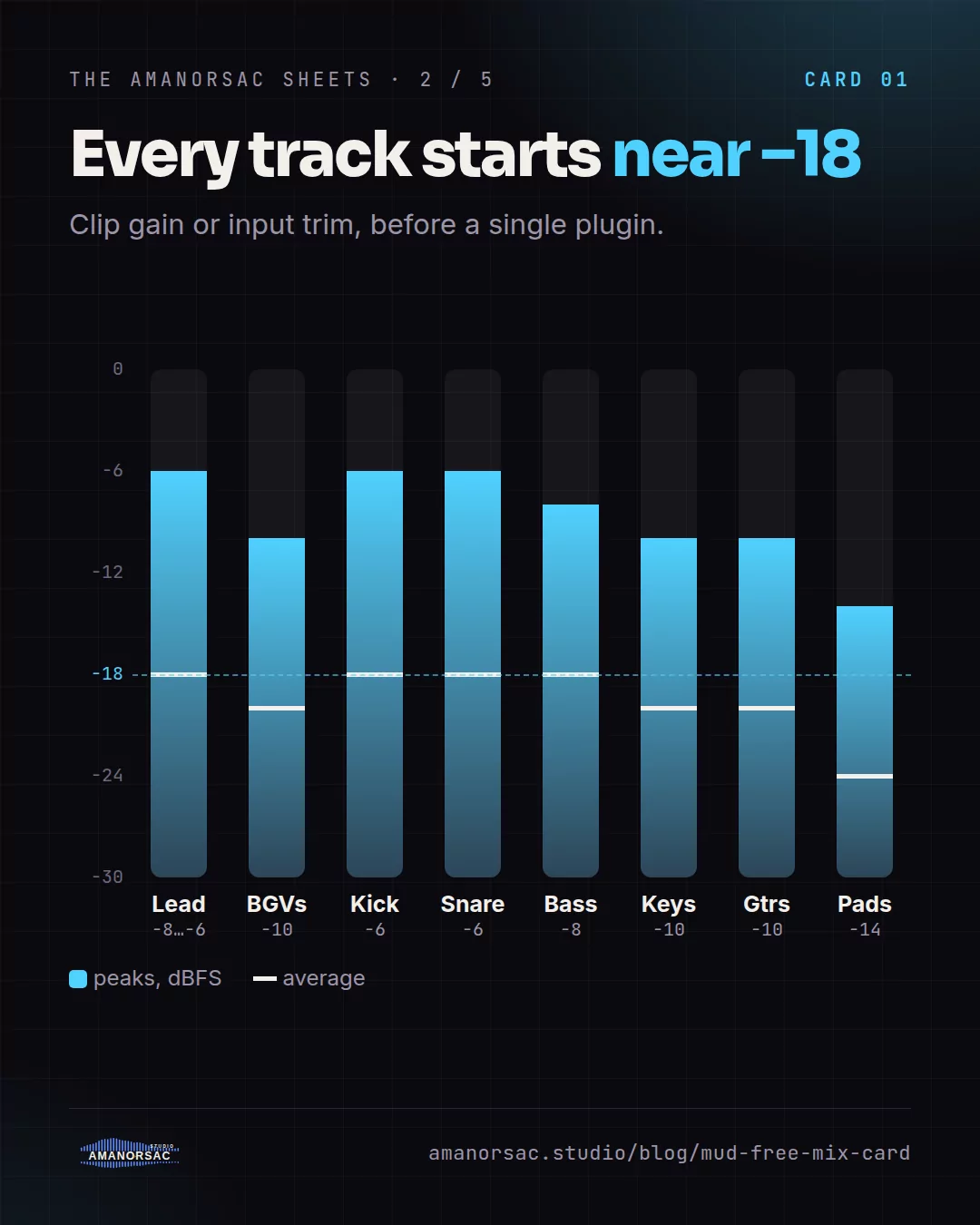
Set every track's level before you touch a single plugin, with clip gain or input trim, not the fader. The target for most sources is an average around minus 18 dBFS pre-fader, with peaks somewhere between minus 6 and minus 10. Lead vocal peaks at minus 8 to minus 6; ride the clip gain on loud lines. Kick and snare peak at minus 6; measure the hit, not the tail. Pads sit lower, peaking around minus 14, because they live behind everything else.
Why it matters: plugins, especially the analogue-modelled ones, behave differently with hot input. Around minus 18 average is where most of them are designed to sit. Get this right and your faders end up near zero, with room to move in both directions.
High-pass what does not need to be there
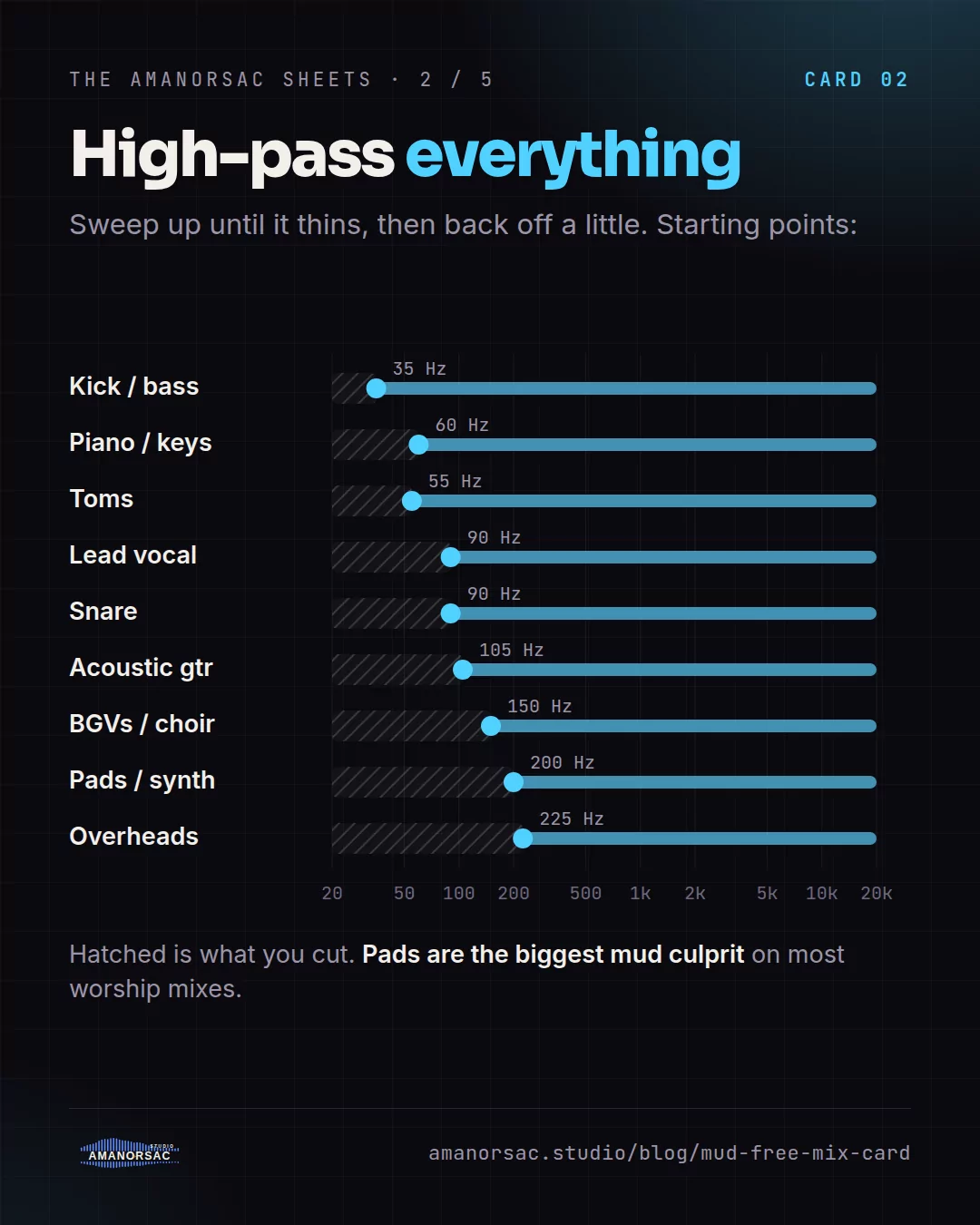
Every source gets a high-pass filter. Sweep it up until the source thins, then back it off a little. Kick and bass start at 30 to 40 Hz, and do not kill the weight. Lead vocal starts at 80 to 100 Hz, lower for men, higher for women. Backing vocals and choir start at 120 to 180 Hz, which is what lets the lead sit on top of them. Pads and synths start at 150 to 250 Hz, and they are the biggest mud culprit on most worship mixes. Overheads start at 150 to 300 Hz if the kick is mic'd.
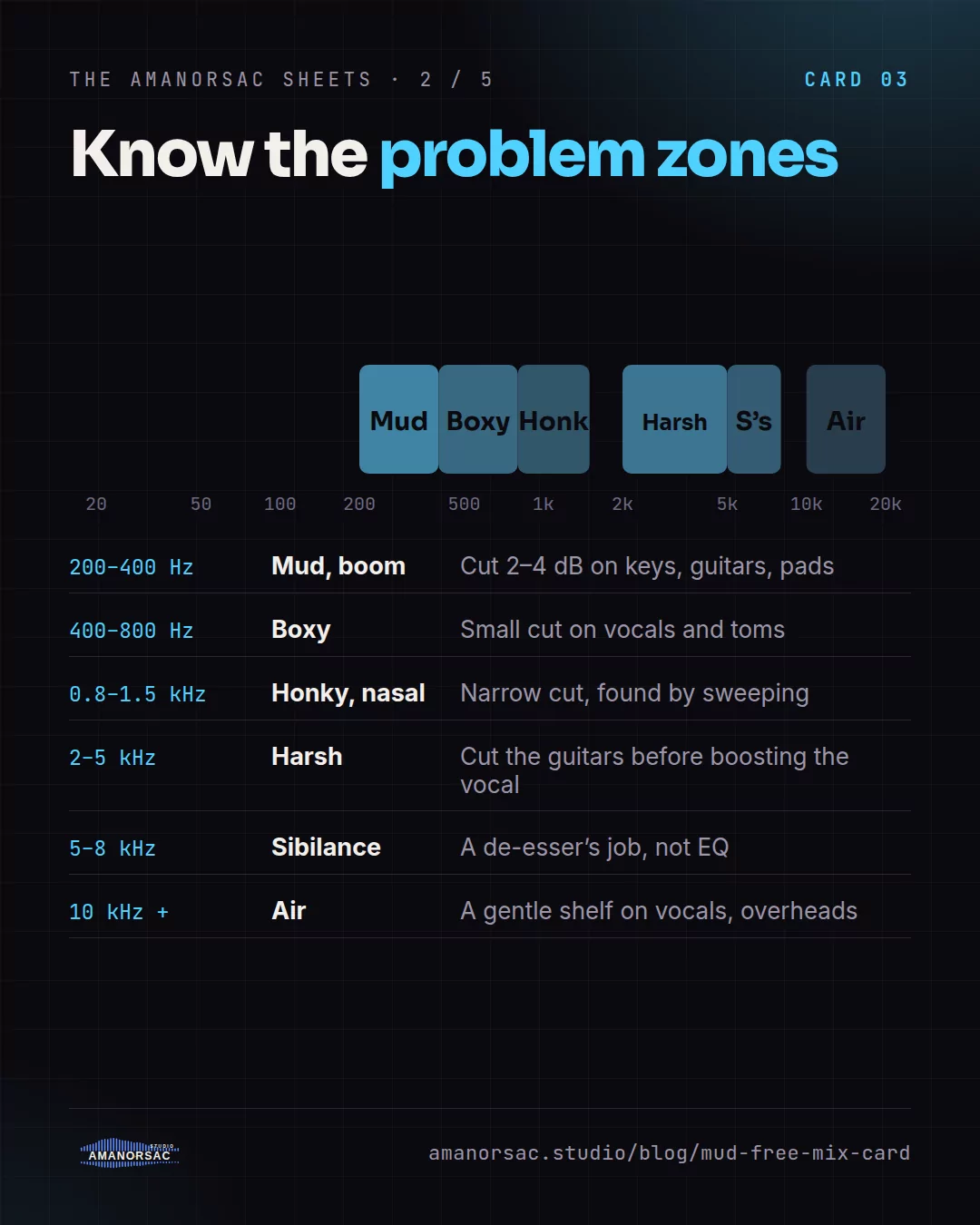
Then the problem zones. 200 to 400 Hz is mud and boom: cut two to four dB on keys, guitars and pads. 400 to 800 Hz is boxy and cardboard: a small cut on vocals and toms. 800 Hz to 1.5 kHz is honky and nasal: a narrow cut, found by sweeping. 2 to 5 kHz is harsh: cut it on the guitars before you boost it on the vocal. 5 to 8 kHz is sibilance, and that is a de-esser's job, not an EQ's. 10 kHz and up is air: a gentle shelf on vocals and overheads.
Compression: gain reduction is the number that matters
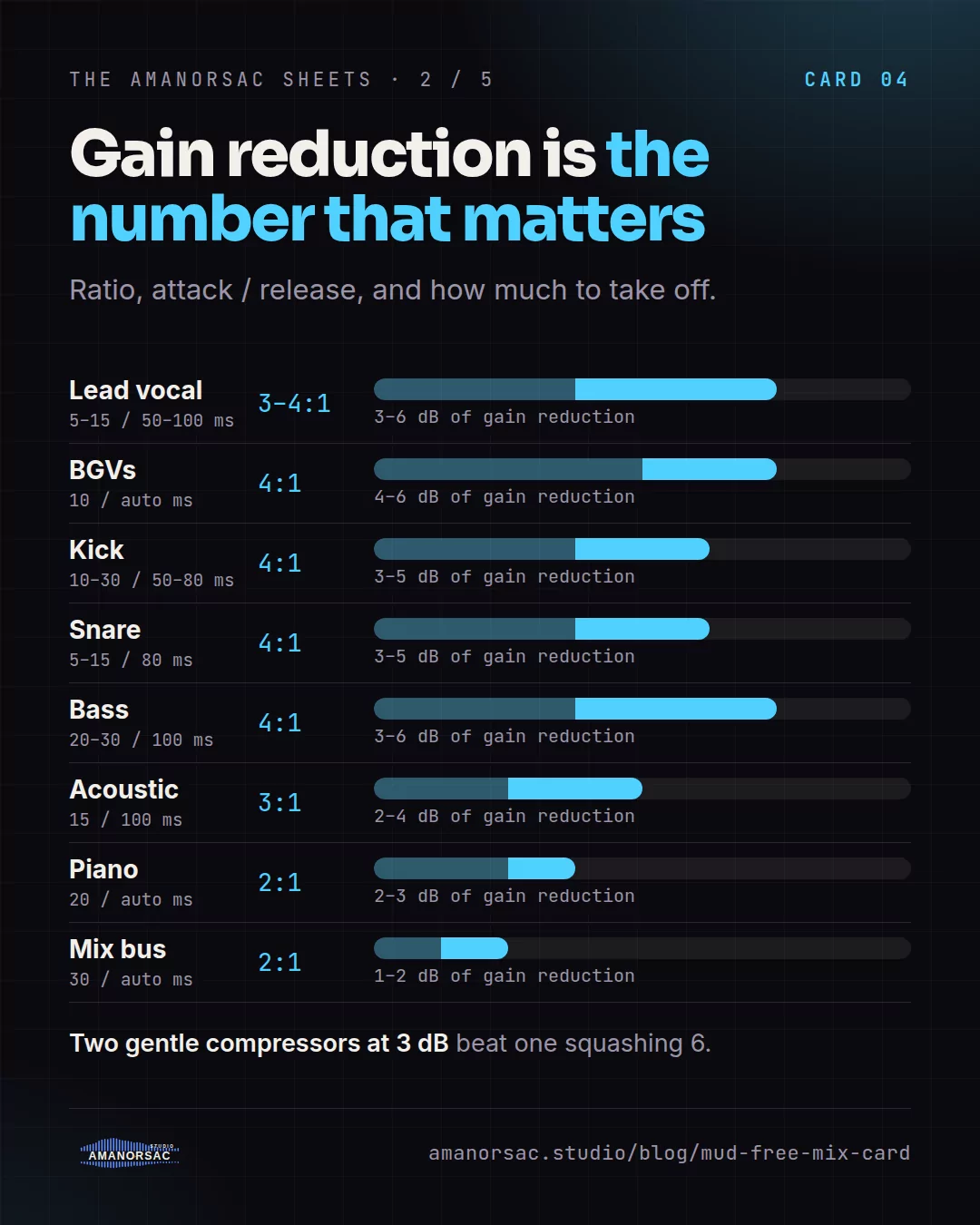
Lead vocal: 3 or 4 to 1, attack 5 to 15 milliseconds, release 50 to 100, three to six dB of gain reduction. Backing vocals: 4 to 1, 10 millisecond attack, auto release, four to six dB. Kick: 4 to 1, attack 10 to 30, release 50 to 80, three to five dB. Bass: 4 to 1, attack 20 to 30, release 100, three to six dB. Piano: 2 to 1, two to three dB. Mix bus: 2 to 1, 30 millisecond attack, auto release, one to two dB and no more.
A slow attack lets the hit through, so drums and bass get punchier. A fast attack grabs the front, so things get smoother and flatter. If it sounds small, or it breathes and pumps, back the gain reduction off by half. On vocals, two gentle compressors doing three dB each beat one squashing six.
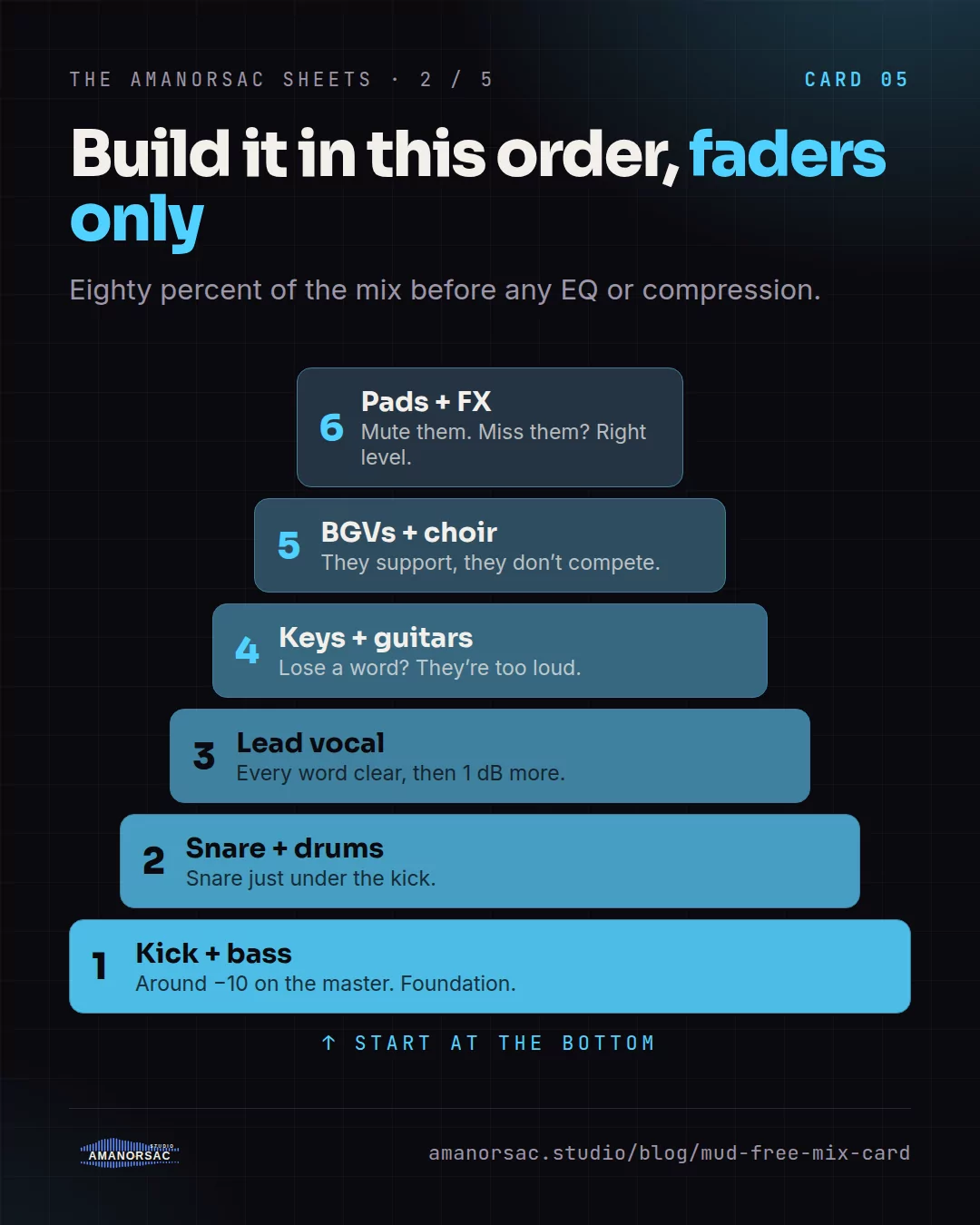
Build it in this order, with faders only
Aim for eighty percent of the mix before any EQ or compression. Kick and bass first, peaking around minus 10 on the master. That is the foundation. Snare and the rest of the drums next, with the snare just under the kick. Then the lead vocal: bring it up until every word is clear, then one dB more, because in worship the words are the point. Keys and guitars fill around the vocal, and if you lose a word they are too loud. Backing vocals and choir tuck under the lead. They support, they do not compete. Pads and effects go last and lowest. Mute them: if you miss them, they are at the right level.
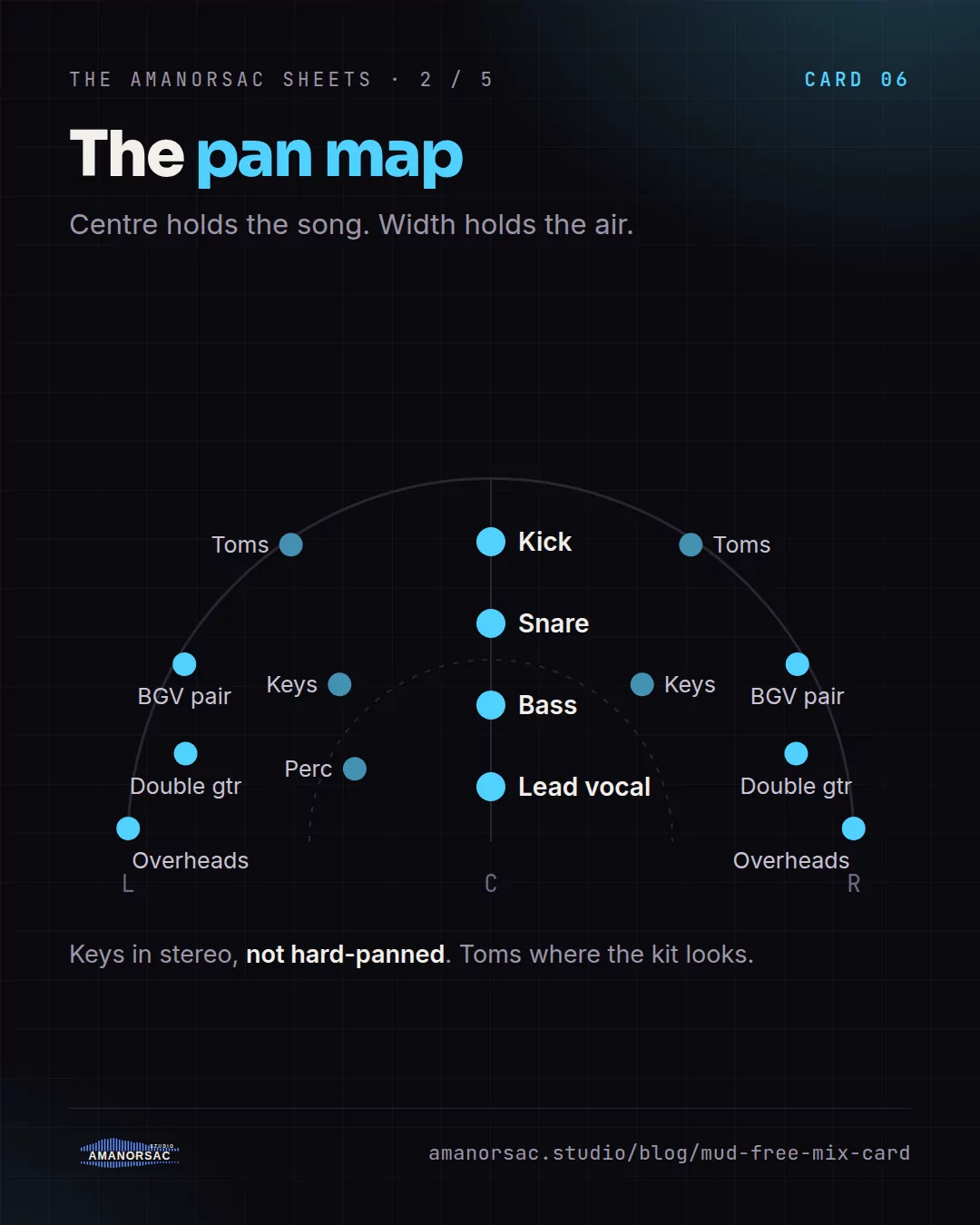
The pan map is simple. Kick, snare, bass and the lead vocal stay in the centre. Overheads, doubled guitars and backing vocal pairs go wide. Toms sit where the kit looks, keys sit stereo but not hard, percussion sits in between.
The vocal chain
The order matters as much as the plugins. Clean up first: clip gain the loud words down, cut the breaths that distract and keep the natural ones. High-pass at 80 to 100 Hz and notch any honk you hear. Compressor one is fast, 3 or 4 to 1, catching peaks with two to four dB. Compressor two is slower, 2 to 1, smoothing the body with two to three dB. De-esser at 5 to 8 kHz, just enough that the S's stop jumping out. Tone EQ last: a gentle shelf around 10 kHz for air, a small lift at 2 to 3 kHz for presence if it needs it. Reverb and delay go on sends, never on the vocal insert.
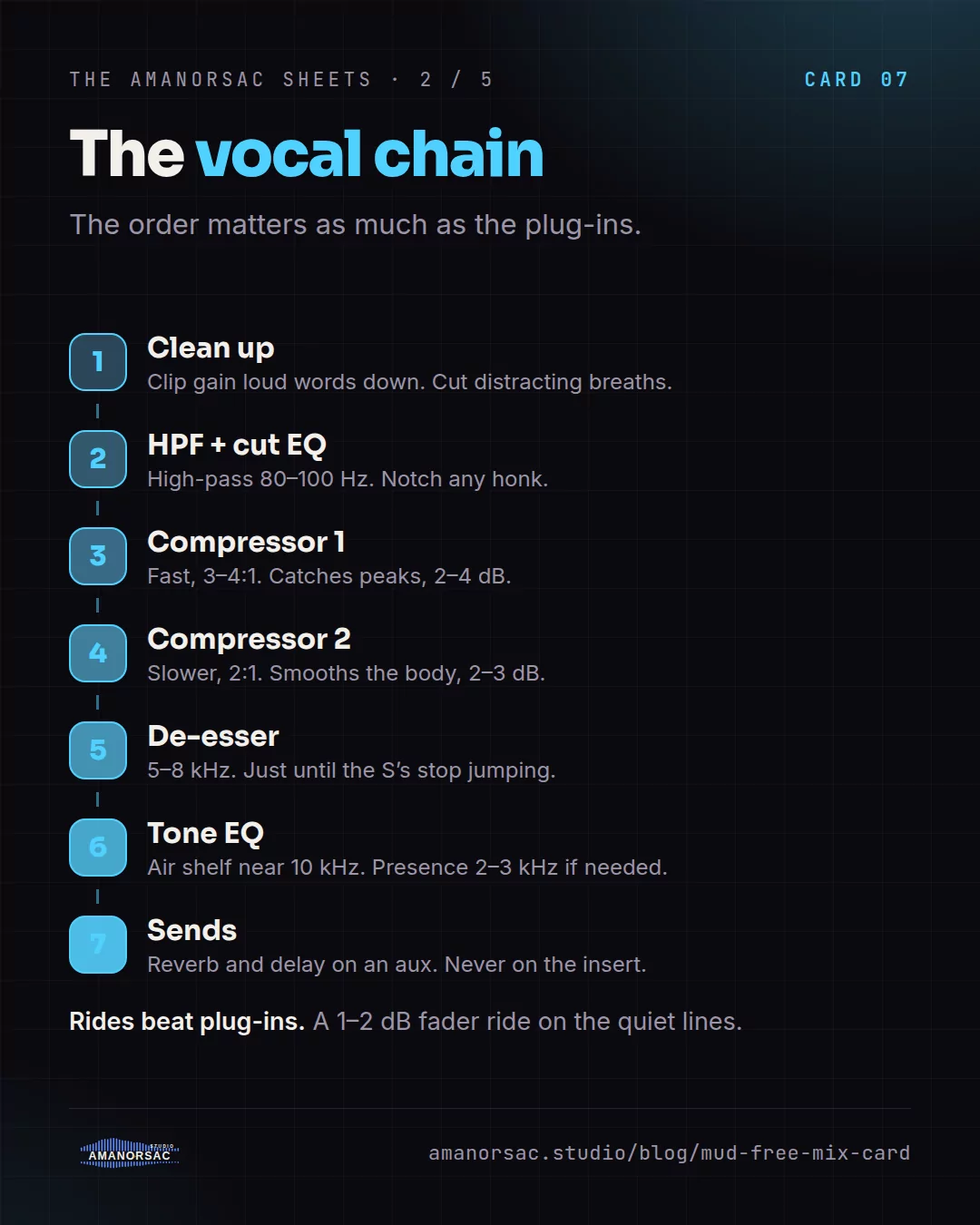
And rides beat plugins. Automate the fader through the song. A one or two dB ride on the quiet lines does more than any compressor.
Reverb and delay
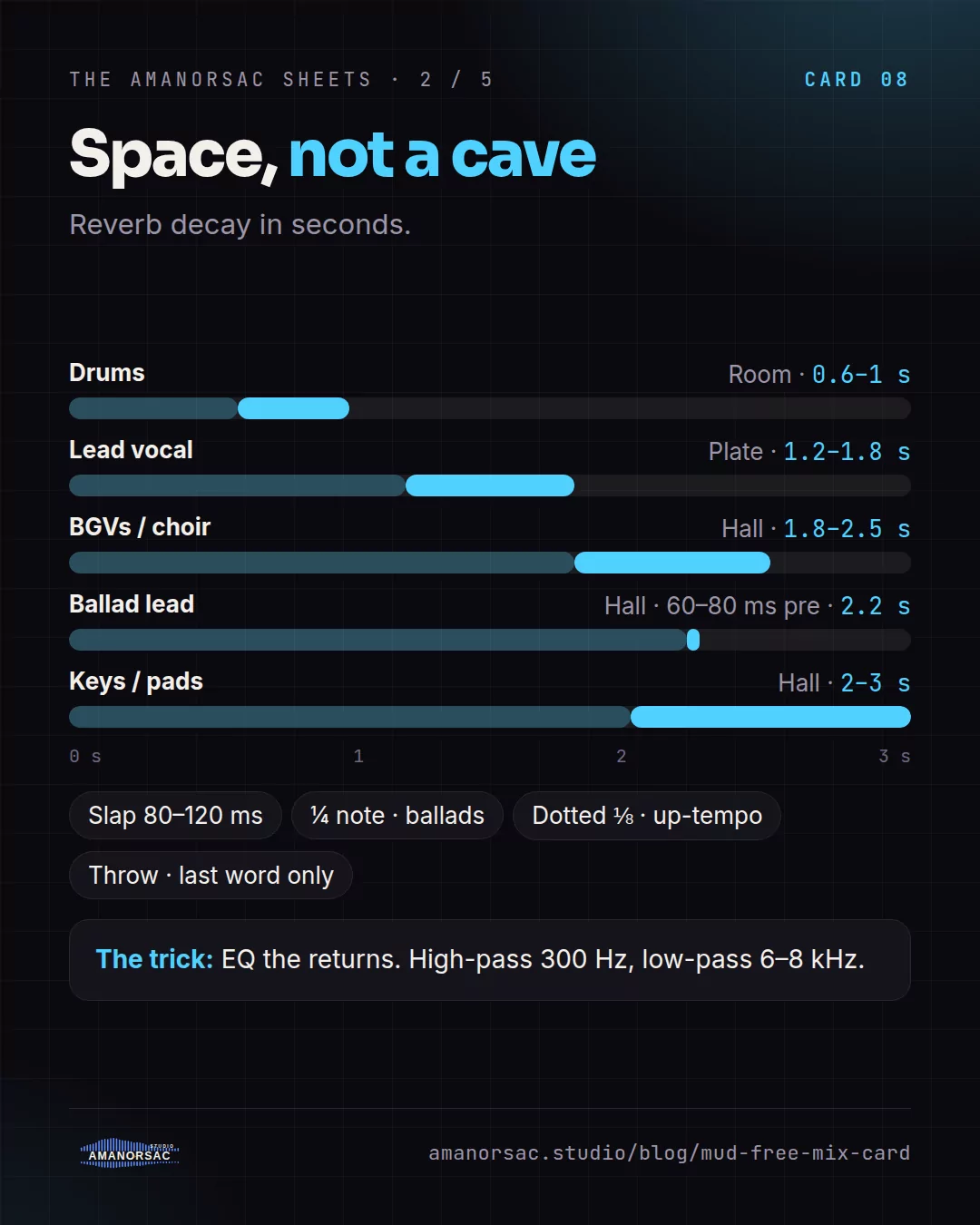
Space is what makes it feel like worship. Too much is what makes it feel like a cave. Lead vocal gets a plate, 1.2 to 1.8 seconds, with 20 to 40 milliseconds of pre-delay. Backing vocals and choir get a hall, 1.8 to 2.5 seconds. Drums get a room under a second. A ballad lead can take a 2.2 second hall with 60 to 80 milliseconds of pre-delay so the word lands before the space does.
Delays: a slap at 80 to 120 milliseconds thickens a lead vocal. A quarter note, tempo synced, 15 to 25 percent feedback, for ballad tails. A dotted eighth for up-tempo songs and guitars. A throw, automated on the last word only.
The trick that fixes most reverb problems: EQ the returns. High-pass at 300 Hz and low-pass at 6 to 8 kHz, and your reverb stops muddying the low end and fizzing the top.
Before you send it anywhere
Sum to mono. Is the vocal still clear, does anything disappear? Turn it right down: can you still hear the words and the kick? Play it on a phone speaker: is the bass still implied? Drive with it, because the car is where most people will hear it. Check it on earbuds for panning and harshness. A/B it against a song you love, matched in loudness, because louder always sounds better. Then sleep on it and listen first thing in the morning before you change anything.
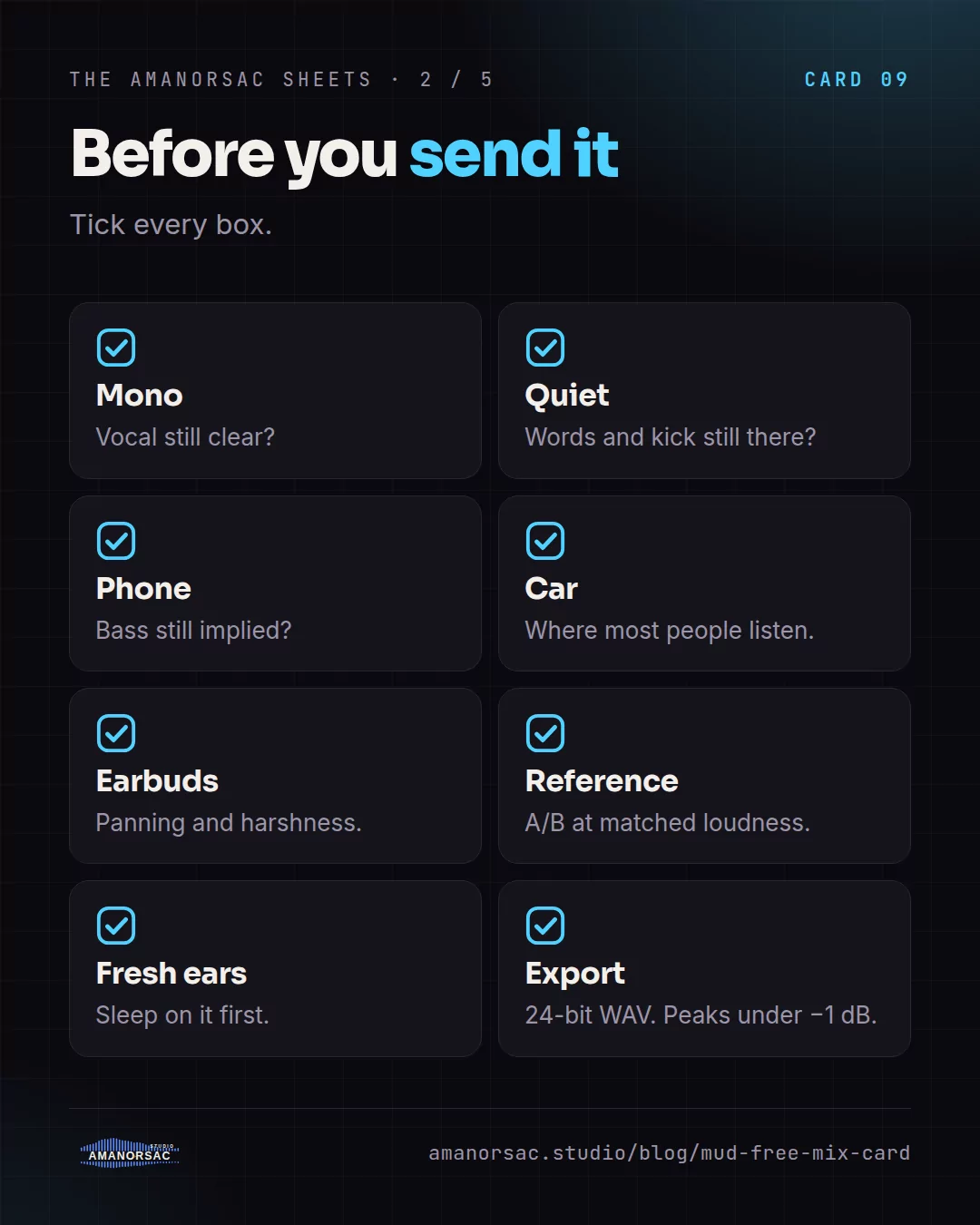
Export at 24-bit WAV at the session rate with peaks under minus 1 dB. For streaming, around minus 14 LUFS is a good reference.
Get the card
The Mud-Free Mix Card is nine pages: gain staging targets, high-pass and problem frequencies, compression starting points, the build order and pan map, the vocal chain, the reverb and delay cheat sheet and the final translation checklist. Pin it next to your screen.
Download the Mud-Free Mix Card (PDF)
Next in the series: The 7-Day Voice Reset, a day-by-day plan to sing stronger.
Written by Stephen Amanor Sackey — producer, mix engineer and music director, Virginia. More about the studio.