

The lights go off in the middle of the sermon. Ten seconds later the generator kicks in, the lights come back, and the PA comes back with a loud thump, a hum that was not there before, or not at all. In a lot of churches in Ghana, Nigeria and further afield, that is not a rare event. It is part of Sunday.
Most church sound guides are written for buildings where the power never goes off. This one is for the rest of us. It covers what bad power does to sound gear, what each protective box actually does, the order to switch things on and off, and why the system hums on the generator but not on the mains.
One thing first. Anything to do with wiring, earthing and generators must be done or checked by a qualified electrician. This post helps you understand the problem and ask the right questions. It is not a wiring guide.
What bad power does to sound gear
Three different things go wrong, and they need different fixes.
1. Outages. The power simply goes. A digital mixer that loses power mid-service has to boot again, which takes time, and powered speakers that lose and regain power at the same instant as the mixer can pop loudly.
2. Low voltage and spikes. Ghana and Nigeria run on 230 V at 50 Hz (Mennekes). But what arrives at the wall is not always 230 V. A Nigerian engineering paper describes supply that "could fall as low as 170 volts with several spikes", damaging appliances at both ends (Nigerian Journals Online). Amplifiers and powered speakers on a sagging supply run out of headroom, distort earlier, and work their power supplies harder.
3. Dirty generator power. A small or poorly maintained generator can wander in voltage and frequency, especially when a big load switches on. That shows up as hum, buzz, and amplifiers misbehaving.
And the outages are not a thing of the past. Ghana's grid failed on 29 July 2026 and again on 20 August 2026, with parts of Greater Accra facing outages of up to 15 hours for line repairs (Citi Newsroom, Metro TV). Nigeria's national grid collapsed around eleven or twelve times in 2024 (Channels TV). Plan for it.
Stabiliser, AVR, UPS, inverter, surge protector: what each one does
These boxes get mixed up all the time. Here is the plain version.
- Surge protector. Absorbs short spikes. Cheap and worth having on every extension board. It does nothing for low voltage or outages.
- Stabiliser (or AVR, automatic voltage regulator). Takes a supply that wanders, say from 170 V up to 250 V, and keeps the output close to 230 V. This is the box that protects you from sags and swells. Servo stabilisers are common in Nigeria and Ghana precisely because supply is unstable (Economic Confidential).
- UPS (uninterruptible power supply). A battery that takes over the instant the power fails. A good one also smooths the supply. It gives you minutes, not hours, which is exactly what the mixer needs to ride through the gap between the grid going and the generator coming on.
- Inverter. A battery system for longer backup, often with solar. The important word is pure sine wave. Cheaper "modified sine wave" inverters can make audio equipment buzz and are best kept away from amplifiers (Samlex).
What most churches actually need:
- A stabiliser feeding the whole sound system.
- A UPS on the things that must not reboot: the mixer, the stage box or digital snake, the laptop running tracks, the router for the iPad, and the streaming computer.
- Surge protection everywhere.
- Amplifiers and powered speakers on the stabilised supply but not on the small UPS. They draw far more than a small UPS can deliver.
Buy from a known dealer. Counterfeit protection products are real: police seized fake Sollatek units at Alaba market, and the brand owner said the fakes do not give the same protection (The Guardian Nigeria). A fake stabiliser is worse than none, because you think you are protected.
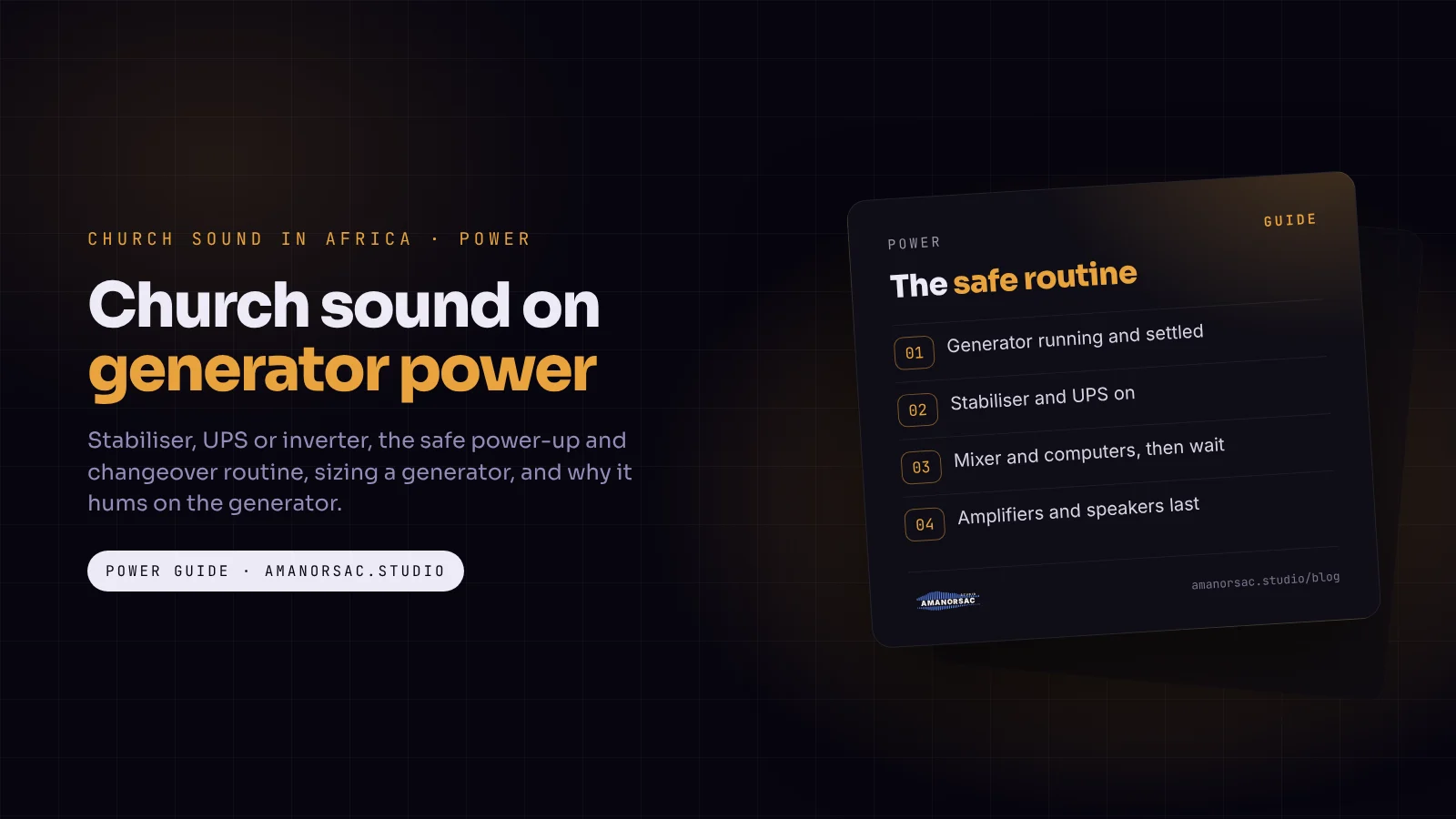
The safe routine: power up, power down, changeover
This one habit prevents most of the pops, blown drivers and dead amplifiers I have seen.
Power up, in this order:
- Generator running and settled for a minute, if you are on the generator (DIY Audio).
- Stabiliser and UPS on.
- Mixer, stage box, computers, router.
- Wait for the mixer to finish booting.
- Amplifiers and powered speakers last, one bank at a time.
Power down, the reverse: speakers and amplifiers first, then the mixer, then everything else.
Changeover from grid to generator (or back): this is where the damage happens. If you can, turn the amplifiers and powered speakers off before the switch, let the mixer and computers ride on the UPS, switch the source, let the generator settle, then bring the speakers back. Thirty seconds of silence is better than a blown speaker. Agree a hand signal with the person on the changeover switch so the sound team knows it is coming.
Never switch between grid and generator with the amplifiers running if you can avoid it. The speakers get a voltage spike and the mixer's output thump at the same moment.
Sizing the generator, the inverter or the solar
The mistake here is reading the speaker's "1000 W" sticker and doubling it.
- Size from the electrical input rating, printed on the back of the amplifier or powered speaker, or in the manual, not the marketing watts on the front (Cargen).
- Add it up, then oversize the generator by about one and a half to two times the total, and use thicker cable on long runs (SGS Engineering).
- The sound system is usually a small part of the load. In one Lagos solar case study, the sound system drew about 190 W for a three-hour service, out of a Sunday load of about 2.5 kWh; lights and fans were the rest (vendor figures, PowMr). Your system may be larger, but it is worth knowing where the power really goes before you buy a bigger generator.
Churches are moving to solar for exactly this reason. One Lagos church was spending about ₦300,000 a month on diesel before it installed solar (BusinessDay). If you go that way, insist on a pure sine wave inverter, and keep the panels clean: settled dust cut panel output by 28.7% over four months in a study in northern Ghana (KNUST).
Why it hums on the generator and not on the mains
Hum is a steady low tone, at the mains frequency and its multiples. Buzz is harsher, with more high frequencies in it. They usually have different causes (Live Sound International):
- Hum usually comes from a ground loop: equipment plugged into different sockets, on different circuits, with different earth paths, all joined together by audio cables.
- Buzz usually comes from unshielded or damaged cables, or from dimmers and cheap power supplies nearby.
On a generator, both get worse, because the generator's earthing is often different from the building's, or missing. Earthing is part of safety and also part of keeping noise out of audio (IPS).
What you can safely do yourself:
- Power all the sound gear from one point: one stabilised distribution board for the desk, the stage and the amplifiers, not sockets scattered around the building.
- Use the ground-lift switch on DI boxes for instruments and laptops. That breaks the audio loop without touching the mains safety earth.
- Use balanced cables (XLR or TRS) for every long run.
- Keep audio cables away from power cables, and cross them at right angles where they must cross.
- Test one thing at a time. Unplug inputs one by one until the hum stops. That tells you where it lives.
What you must never do: cut, tape over or break the earth pin on a plug to stop hum. That removes the protection that stops someone getting a shock from a faulty amplifier or a wet microphone. If the hum only appears on the generator, the generator's earthing and its neutral need checking by an electrician.
What kills speakers and amplifiers
Most dead speakers in churches did not die from the power cut itself. Burnt voice coils usually come from clipping and sustained overdrive: an amplifier pushed so hard its output squares off, feeding the speaker far more heat than it was built for. A failed amplifier that sends DC to the speaker can burn a coil too (Elliott Sound Products).
So the routine above and sensible levels protect your speakers together. If the amplifier's clip lights flash on every kick drum, the system is too small for the room or the gain structure is wrong. Turning up a desperate system on a sagging generator is how churches end up buying new speakers every year.
A one-page power plan for your team
Write this down and tape it next to the desk:
- Who switches between grid and generator, and how they warn the sound team.
- The power-up and power-down order.
- Which gear is on the UPS, and how long it lasts (test it once, on a weekday).
- Where the stabiliser is and what its display should read.
- The generator's fuel level before service, and who refuels it during long services and vigils.
- The electrician's phone number.
It takes ten minutes to write, and it turns a power cut from a crisis into a pause.
Questions people ask
Do I need a stabiliser for my church mixer?
If your supply sags or spikes, yes. A stabiliser feeding the whole sound system, plus a UPS on the mixer and computers, protects against most of what unstable power does.
What size UPS do I need for a church sound system?
Only big enough for the mixer, stage box, laptop, router and streaming computer, long enough to ride through the gap until the generator is running. Amplifiers and powered speakers should not be on a small UPS.
Can I run my church PA on an inverter?
Yes, if it is a pure sine wave inverter sized for the load. Modified sine wave inverters can make audio gear buzz.
Why does my church sound system hum on the generator?
Usually because the generator's earthing differs from the building's, or is missing, which makes ground loops worse. Power all the sound gear from one point, use DI ground lifts, and have an electrician check the generator's earth.
Should I switch off the speakers when the power changes over?
Yes, if you can. Turn amplifiers and powered speakers off before switching between grid and generator, let the mixer ride on the UPS, then bring the speakers back once the power has settled.
What size generator do I need for a church PA?
Add up the electrical input ratings of the amplifiers, powered speakers and everything else, not the speaker's advertised watts, then oversize by one and a half to two times.
More on running sound in African churches: church sound in Africa.
Written by Stephen Amanor Sackey — producer, mix engineer and music director, Virginia. More about the studio.
Studio news
Struggling to move forward in your music?
Guides from a working music director, written for the churches we actually work in: church sound, worship teams, free sheets for the desk, and the apps, with the free one first. A few letters a month at most, and every one has a link to stop.
You will get one email asking you to confirm. Your first app is 15% off when you join. Privacy.