
A worship team can only play as well as it can hear. When monitors are wrong, the band drifts out of time, singers go sharp, the music director's cues get lost, and everybody asks for "more of me" until the stage is louder than the room.
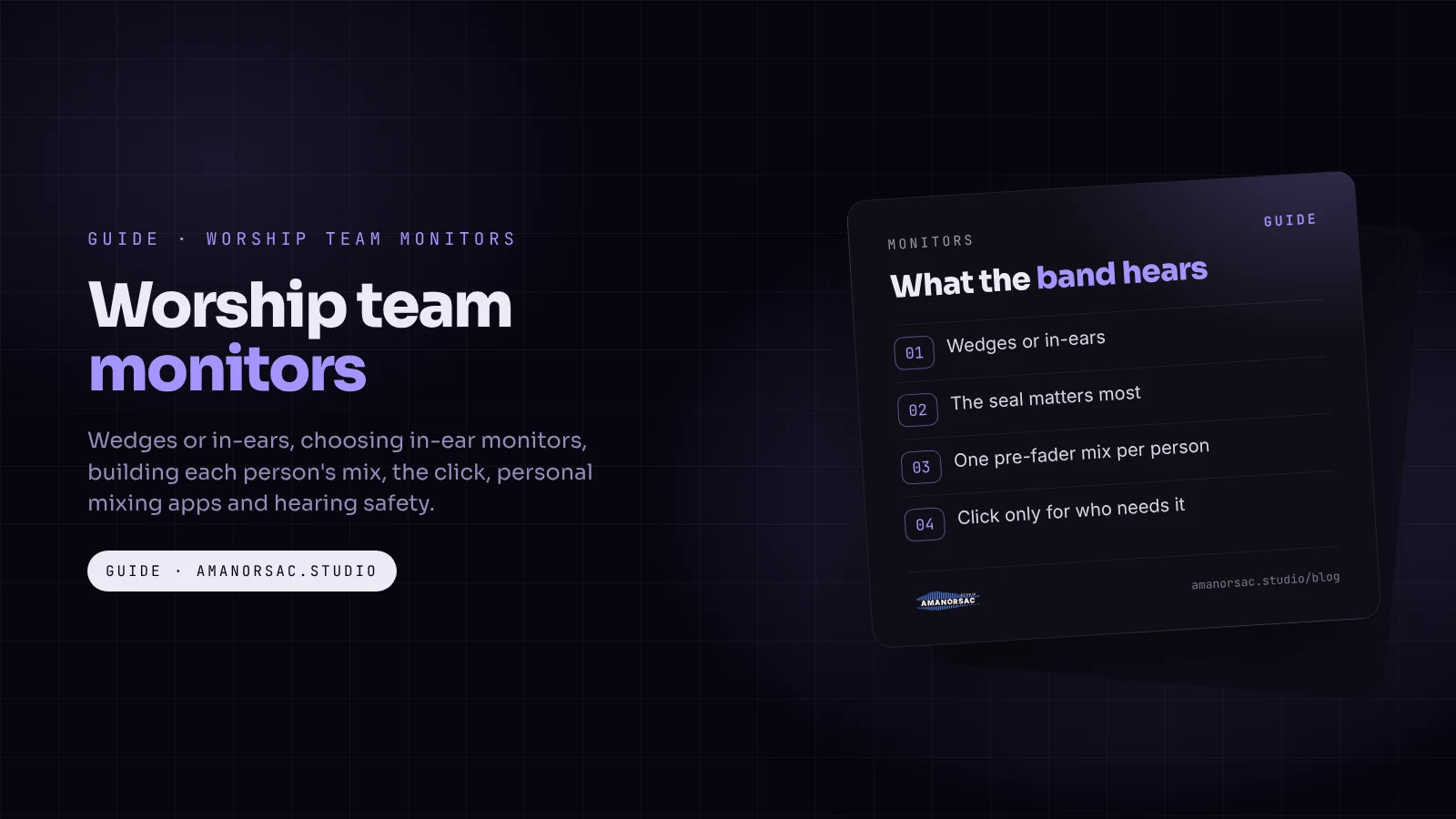
This guide covers the whole of it: wedges or in-ears, choosing in-ear monitors, building each person's mix, the click, letting musicians mix themselves, and protecting their hearing. Each section gives the essentials and links to the full post.
Wedges or in-ears?
Wedges are the floor speakers that point back at the band. They are simple, everyone can share one, and nobody feels cut off from the room. But they add to the stage volume, they feed back into nearby microphones, and on a busy stage each musician ends up hearing every wedge at once.
In-ear monitors put each person's mix straight into their ears. Stage volume drops, feedback from monitors disappears, and each person can hear exactly what they need. The cost is that each person needs their own mix (a mix bus on the desk), their own earphones, and a pack or wired connection, and the team has to get used to the sealed sound.
Many churches do both: in-ears for the band and lead singers, a wedge for the choir and the preacher.
Choosing in-ear monitors
The spec that matters most on a loud stage is the seal. An earphone that seals well blocks the stage, so the mix can be run quieter, which is better for hearing and for sound. Cables break, so buy a model whose cable you can replace.
- In-ear monitors for a worship team: eight models compared on isolation, cables and what feeds them.
Building each person's mix
Most in-ear trouble is a mix nobody planned: everyone asks for "a little of everything" and gets a wall of sound. Each seat needs different things. The drummer needs the click and the bass. A singer needs much more of their own voice than they expect.
- Worship team in-ear mixes: 3 mistakes that wreck them: what each seat needs, why singers go sharp, and fifteen minutes that fix Sunday.
The basics on the desk:
- One mix bus per person, set to pre-fader, so front-of-house moves do not change their mix.
- Buses named after people, not numbers.
- A limiter on every in-ear output.
- Stereo mixes if you have the buses, so everyone can run quieter.
- One or two ambient microphones pointed at the congregation, sent quietly to the in-ears.
Let the musicians mix themselves
An engineer building eight monitor mixes during soundcheck is a bottleneck. Digital desks can hand each musician control of their own mix from a phone or tablet, and nothing they do touches the main mix.
- On a Behringer X32 or Midas M32, our free MixMyIEM app gives each person their own mix: they pick their name and move a few big faders.
- On a Midas MR18, the free MX-Mix app does a similar job for its six monitor mixes. The MR18 guide covers the setup.
The click and the cues
The click keeps a band in time, but only the people who need it should hear it: usually the drummer, bass, keys and the music director. Many singers sing better without it. Cues from the music director ("bridge", "last chorus", "down") go in the same ears.
- PerformLive keeps the click and cues on their own outputs, so they reach the band's ears and never the congregation.
- The music director's guide covers cueing a band.
Hearing safety
In-ears are only safer than wedges if they seal and are run at a sensible level. The danger is the slow creep: each person asks for a little more, then a little more. Keep both earphones in, always. One ear out means the other ear gets turned up to compete.
If someone keeps asking for "more of everything", their mix is crowded, not quiet. Take things out before you turn things up.
Questions people ask
Are in-ear monitors better than wedges for church?
For the band and lead singers, usually yes: lower stage volume, less feedback and a mix for each person. Wedges still suit choirs and preachers who need to hear the room.
How many mix buses do I need for in-ears?
One per person who has their own mix, or two per person for stereo. Musicians who need the same thing can share a mix.
Can musicians control their own in-ear mix from a phone?
Yes, on most digital desks. On an X32 or M32, MixMyIEM lets each musician pick their name and set their own mix without touching the main mix.
Should the whole band hear the click?
No. Usually the drummer, bass, keys and music director. Many singers are better without it.
Why do in-ears sound cut off from the room?
Because a good seal blocks the room. One or two ambient microphones pointed at the congregation, sent quietly to everyone's in-ears, fix it.
Written by Stephen Amanor Sackey — producer, mix engineer and music director, Virginia. More about the studio.
Studio news
Struggling to move forward in your music?
Guides from a working music director, written for the churches we actually work in: church sound, worship teams, free sheets for the desk, and the apps, with the free one first. A few letters a month at most, and every one has a link to stop.
You will get one email asking you to confirm. Your first app is 15% off when you join. Privacy.