

In many African churches the sermon is preached in two languages at once. The preacher says a phrase in English, the interpreter says it in Twi, Ga, Ewe, Yoruba, Igbo, Hausa or Swahili, and back and forth for an hour. In multicultural churches abroad it happens too, in French, Portuguese, Spanish or Lingala.
Almost everything written about church interpretation assumes something else: a translator in a booth, speaking into headsets the congregation wears. I could not find a single guide for what most of us actually do, which is two people side by side on the stage, both through the main speakers, taking turns.
That setup has its own problems. Two different voices, often at two very different volumes. A preacher who gets louder as the sermon builds, and an interpreter who has to match them. Two open microphones next to each other at the front of the stage. And a sermon that takes twice as long as it would in one language (Missionexus), so whatever you set at the start has to hold for a long time.
Here is how I would set it up.
The goal: one sermon, not two voices fighting
The congregation should hear one continuous message. That means three things:
- The two voices at the same loudness. If the interpreter is quieter, half the room loses every second phrase.
- The two voices with a similar tone. Not identical, but no jump from a booming voice to a thin one.
- Only one microphone loud at a time, as far as you can manage it. Two open mics next to each other doubles the chance of feedback and makes both voices sound hollow.
Choosing the microphones
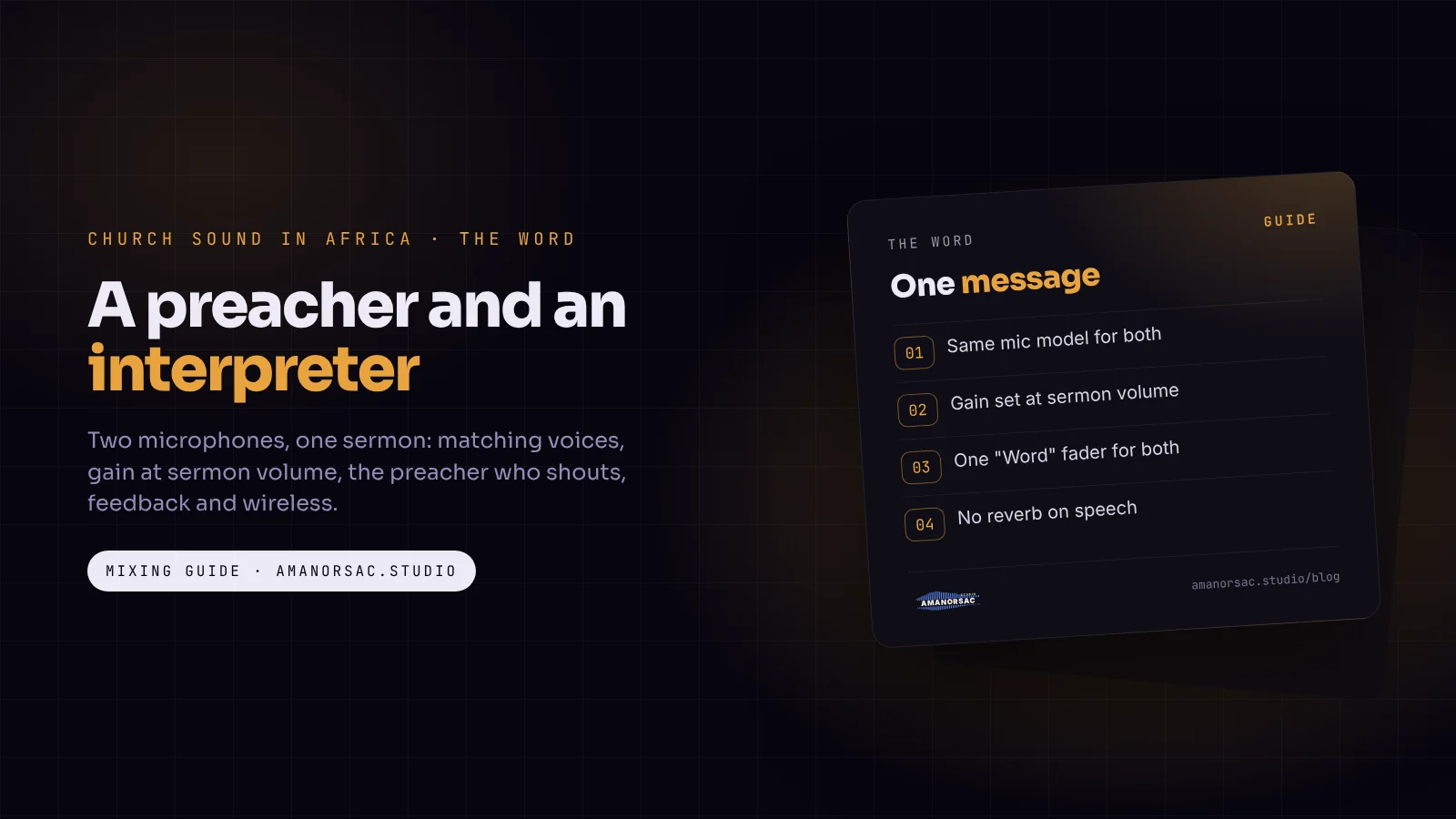
Give both people the same kind of microphone. If the preacher has a headset and the interpreter has a handheld, they will never sound alike, because they sit at different distances from the mouth.
The best options, in order:
- Two headsets of the same model. Constant distance from the mouth means a constant level, however the preacher moves, and much better gain before feedback than a lapel mic.
- Two handheld dynamic mics of the same model. Simple and robust. The weakness is that the interpreter often holds the mic too low, or waves it while gesturing.
- A lapel for the preacher and a handheld for the interpreter. Common, and the hardest to match. Lapel mics sit far from the mouth and pick up more of the room, so they feed back sooner.
Avoid sharing one microphone between the two. It looks simple, but the passing back and forth loses the first syllable of every phrase.
Gain and level: set them together
Set each person's gain while they speak at sermon volume, not at "testing, one two" volume. Ask them both to read a few lines the way they will preach at the loudest point. Many preachers start quietly and finish near a shout, and the interpreter has to match the preacher's energy, which often means matching their volume.
Then:
- Put both channels on one group or DCA, labelled "Word". One fader for the whole sermon, so you can bring the message up or down without upsetting the balance between the two voices.
- Balance them so they sound the same loudness in the middle of the room, not on the desk meters. Walk to the middle and listen.
EQ: make two voices sound like one message
- High-pass both at around 100 Hz for men and around 120 to 150 Hz for women. That removes rumble and the boom of a mic held too close. Shure suggests starting points around 80 Hz for male voices and 140 Hz for female voices (Shure).
- Match the tone. If one voice sounds boomy and the other thin, cut a little low-mid (around 200 to 400 Hz) from the boomy one rather than boosting the thin one. Cuts are safer for feedback than boosts.
- Clarity in the same place. A small lift around 2 to 4 kHz helps words cut through. Apply it to whichever voice is less clear, not to both by default.
- No reverb on speech. The room adds its own. Reverb on a sermon turns words into mush, and with two languages, the echo of one phrase lands on top of the next.
Compression: the preacher who shouts
Raised voices are part of preaching in many African churches, and a good preacher moves from a whisper to a shout in one sentence. You do not want to flatten that. You want to stop the shout from hurting people and stop the whisper from disappearing.
- A ratio of about 3:1 to 4:1, a medium attack and release, and a threshold low enough to show 3 to 6 dB of reduction on the loud lines.
- The same settings on both channels, so they react the same way.
- If the preacher's shouts still distort, the gain is too high. Turn the gain down and make it up with the fader. A compressor cannot fix a channel that is clipping at the input.
Keeping two open mics from feeding back
Two microphones at the front of the stage, often with monitor wedges pointed at them, is a feedback trap. What helps:
- Keep the wedges out of the mics' line. Point them at the preacher's chest, behind the mic's back, not into the front of it.
- Use the "one up, one down" habit for headsets and handhelds. As each person speaks, their channel is up; the other is pulled down a few dB. On a digital desk you can do this smoothly by hand. It sounds fussy, but after ten minutes of a sermon you start to feel the rhythm of the phrases.
- Do not leave both channels full up and walk away. That is when it rings.
- Ring out the pulpit area before service: bring both mics up past where they will be used, find the frequencies that ring first, and cut them narrowly on the monitor and main EQ. How to stop feedback in church covers the full method.
If your desk has an automatic mic mixer or a "gain sharing" feature, it can do the ducking for you, lowering the mic that is not being spoken into. Test it carefully before using it on a sermon: a poorly set automixer cuts off the first word of every phrase.
Wireless: the two-channel problem
Most interpreters and preachers use wireless mics. Two systems at the front of the stage, close to each other, need the right frequencies.
- Run a frequency scan on the receivers before service, so the two systems are not on frequencies that clash.
- Fresh batteries in both, every service. An interpreted sermon is twice as long, and the interpreter's transmitter is the one nobody remembers to check.
- Wireless frequencies differ by country. Check that your system's band is permitted where you are (Shure). How to check a fake SM58 has more on wireless bands in Ghana, Nigeria and Kenya.
Recording and streaming the interpreted sermon
The live stream and the recording need both voices too, often louder than they are in the room.
- Send the "Word" group to the stream mix, and add a little compression on the stream bus, so the quieter phrases still come through on a phone speaker. Why church live stream audio sounds bad shows how to build a stream mix.
- If you record multitrack, record the preacher and interpreter on separate tracks. Later you can make an English-only and a local-language-only version of the message for the church's audio archive or podcast.
Before the service: a five-minute routine
- Both mics the same type, fresh batteries, frequencies scanned.
- Both people read a loud passage at sermon volume. Set gain.
- High-pass, match the tone, compression the same on both.
- Both channels on one "Word" fader.
- Walk to the middle of the room and listen to them take turns.
- Agree a signal with the interpreter for "I cannot hear the preacher": a touch of the ear works. If the interpreter cannot hear the preacher, the whole sermon falls apart, so give the interpreter a little of the preacher in the monitor if the stage is loud.
Questions people ask
How do you mix a preacher and an interpreter?
Give them the same type of microphone, set both gains at sermon volume, put both channels on one fader, match their tone with EQ, and keep only the person speaking fully up.
Should the interpreter use the same microphone as the preacher?
The same model, yes. Sharing one physical microphone between them loses the start of every phrase.
Why is the interpreter quieter than the preacher?
Usually because the interpreter's gain was set at a normal speaking voice while the preacher's was set at full volume, or the interpreter holds the mic too low. Set both at sermon volume.
How do I stop feedback with two microphones at the pulpit?
Point the wedges behind the microphones, ring out the pulpit area before service, and pull down the microphone that is not being spoken into.
Should I add reverb to the sermon?
No. The room adds its own, and reverb makes interpreted phrases blur into each other.
Can the interpreter hear the preacher on a loud stage?
Give the interpreter a little of the preacher's microphone in a wedge or in-ear if the stage is loud. If the interpreter misses a phrase, the congregation misses it too.
More on running sound in African churches: church sound in Africa.
Written by Stephen Amanor Sackey — producer, mix engineer and music director, Virginia. More about the studio.
Studio news
Struggling to move forward in your music?
Guides from a working music director, written for the churches we actually work in: church sound, worship teams, free sheets for the desk, and the apps, with the free one first. A few letters a month at most, and every one has a link to stop.
You will get one email asking you to confirm. Your first app is 15% off when you join. Privacy.