
You have a choir of forty, three microphones and a band that plays loud. The choir sounds thin, the wedges howl when you push the choir faders, and the people at the back cannot hear the sopranos at all.
Search for help and most roads lead to one manufacturer article that is well over a decade old. It is not wrong, but it was written for a robed choir singing hymns over an organ, not a praise choir standing next to a drum kit, and not a mass choir of a hundred and fifty with four microphones between them.
This is the guide I would give a volunteer today: how many mics for your choir, which type, exactly where they go, why they feed back, and how to set the choir up on the desk so it sits in the mix instead of fighting it.
Why is a choir so hard to mic?
A lead singer holds the microphone about three centimetres from their mouth. A choir mic sits around 75 centimetres from the nearest singer, and further from the back row.
That distance is the whole problem. Every time you double the distance from a voice, the level at the microphone drops by about 6 dB. Going from 3 cm to 75 cm is twenty-five times the distance, which works out to roughly 28 dB less voice at the choir mic than at the lead singer's mic. To make the choir as loud as the lead, you need that 28 dB back as gain on the desk.
But the microphone also hears the speakers, the wedges, the drums and the room, and all of those get turned up by the same 28 dB. That is why choir mics feed back first, why they pick up so much band, and why the honest answer to "can we make the choir louder" is sometimes no.
So the job is not to make a choir as loud as a lead singer. It is to capture the choir's blend cleanly, lift it a little in the room, and keep everything else out of those microphones.
How many microphones does a choir need?
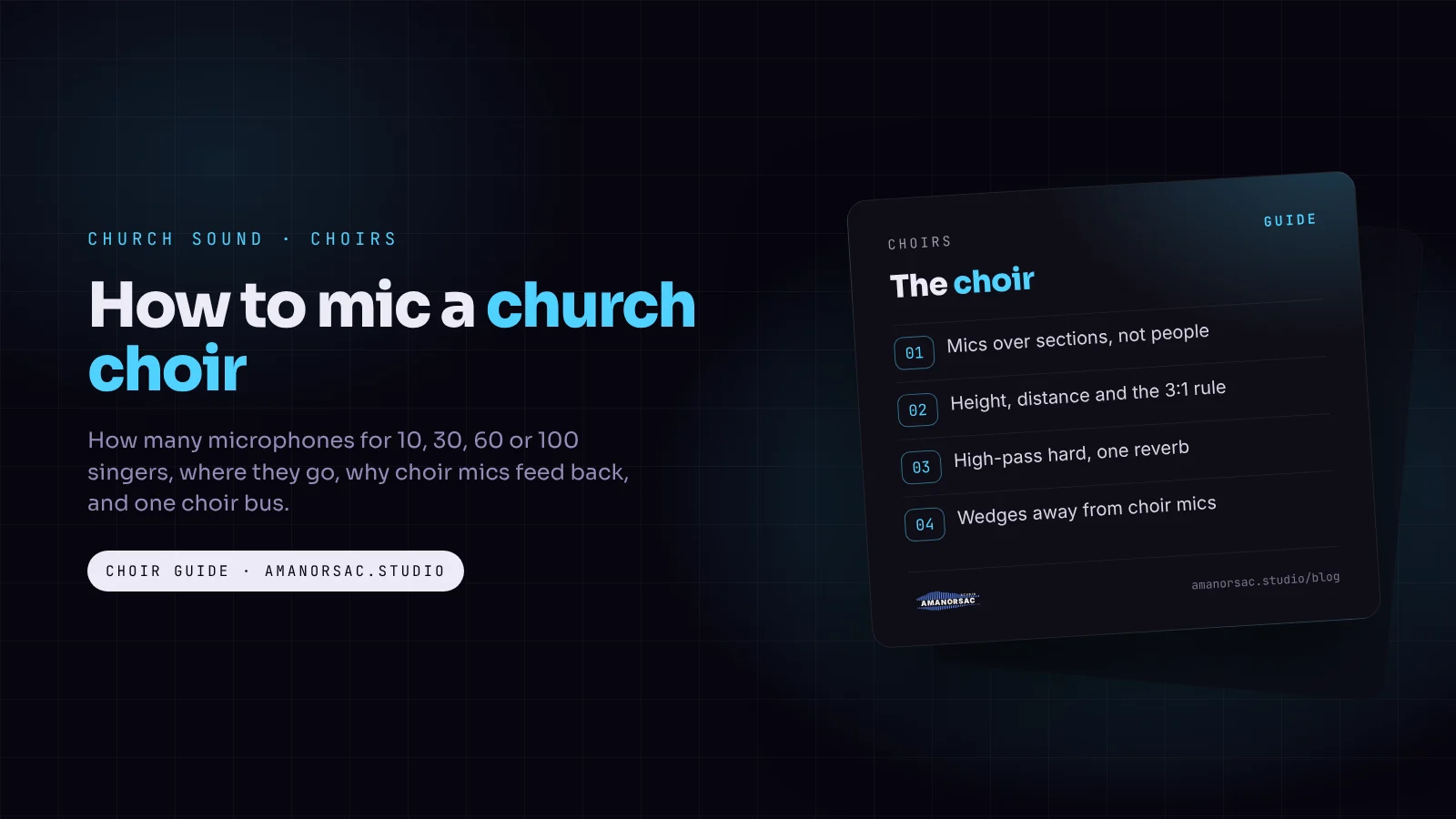
There is no exact formula, but there is a working rule. One cardioid area microphone, placed well, covers a section about two and a half to three metres wide: roughly twelve to twenty singers standing in two or three rows.
Here is where I start:
- 10 singers: one mic, or two if they stand wide.
- 30 singers: two to three mics, one per section: left, centre, right.
- 60 singers: four to five mics. Two or three levels of risers help a lot here.
- 100 or more: six to eight mics. Accept that you are reinforcing the choir, not capturing every voice.
Two things matter more than the count.
First, fewer open mics is better. Every time you double the number of open microphones at the same gain, you lose about 3 dB before feedback. Eight choir mics are not four times better than two; they are more room, more band and less headroom.
Second, arrange the singers for the mics. If the choir stands in one long line across the front, no number of mics will sound good. Ask the choir director for shorter rows, stacked deeper, with taller singers at the back.
Which microphone: condenser or dynamic?
The loudness of your stage decides.
Small-diaphragm condensers, when the stage is controlled
A small-diaphragm condenser is a pencil-shaped microphone that needs phantom power (the 48V button on the desk channel). It hears detail at a distance and sounds natural on a group of voices. Hanging choir mics are almost always this type. Choose cardioid, which means it hears mostly what is in front of it and rejects what is behind it.
This is the right choice when the band is moderate and the choir is the main event: hymn choirs, choirs singing with piano or organ, and the four-part harmony choirs of Kenyan churches, which grew from translated missionary hymns and the makwaya choirs carried on radio from the 1940s (Afropop Worldwide). That sound is about blend, and condensers capture blend.
Dynamic microphones, when the stage is loud
When the drums are acoustic, the bass amp is on stage and the praise section is properly loud, a condenser 75 cm from the choir hears more band than choir. Turn it up and you get a louder drum kit and a squeal.
Then use dynamic microphones (the SM58 type) much closer: one on a stand between every two to four singers, about 15 to 30 centimetres from their mouths. You lose some natural blend, but you gain a choir you can hear over the band. Four or five well-placed dynamics often beat two expensive condensers that mostly pick up the drummer.
A word on buying. Counterfeit microphones are common in some markets, and Shure says a counterfeit cannot be serviced under its warranty (Shure). A genuine SM58 weighs 298 g and fakes are usually lighter (Behind the Mixer). Buy from an authorised dealer where you can, and weigh anything you are unsure about.
Where exactly do choir mics go?
This is how I place area mics for a choir in two or three rows.
- Distance. About 60 to 90 centimetres (two to three feet) in front of the front row. Closer and you only hear the front row; further and you hear the room.
- Height. About 60 centimetres above the heads of the front row, so the mic sees over them to the middle and back rows.
- Aim. Point it at the middle or back row. The front row is already closest and loudest.
- Width. Each mic covers about two and a half to three metres. Place them so their coverage just meets.
- Spacing: the 3:1 rule. Keep the mics at least three times as far from each other as they are from the singers. At 75 cm from the choir, that means at least 2.25 metres apart. When two mics pick up the same voice at slightly different times, the sound goes hollow and phasey, like singing down a tube. The 3:1 spacing keeps that small enough not to hear.
- Behind the mic. A cardioid hears least directly behind it. Make sure that is where the loud things are: the main speakers, and especially any wedge.
Hanging mics follow the same numbers: in front of and above the choir, aimed at the back rows, out of the line of the main speakers. Then listen to each mic alone in headphones while the choir sings. You will hear straight away if a section is missing.
Why do our choir mics feed back?
Feedback is a loop: sound from a speaker goes into a microphone, comes out of the speaker louder, goes back in, and builds until it howls. Choir mics do it first because they are far from the voices, need a lot of gain, and several are open at once.
What helps, in order:
- Get the mics as close to the choir as the shape allows. Halving the distance gives you about 6 dB more voice for the same gain.
- Keep wedges and speakers behind the mics, in the cardioid's dead spot.
- Mute the choir mics when the choir is not singing. A mute group does it in one press.
- Do not chase level. If the fader is already high, the answer is placement, not another 3 dB.
- Ring out the system. If one note keeps ringing, a narrow cut at that frequency buys a little room. My post on how to stop feedback in church walks through it on an X32 or MR18.
How should I EQ a choir?
Less than you think. A choir mic hears a section, the room and the band, so heavy EQ makes it sound processed fast.
- High-pass first. Shure suggests starting near 80 Hz for male voices and around 140 Hz for female voices (Shure). On a choir mic the low end is mostly rumble, bass and kick, so I usually sit around 120 to 150 Hz, lower for a men's section.
- Cut the mud. A gentle cut between 200 and 400 Hz cleans up the boxy sound that builds when several distant mics are open.
- Do not boost the top. Adding 5 kHz so the choir "cuts" also boosts cymbals, sibilance and the frequencies that feed back. If the choir is dull, move the mic.
- Tame harshness. If a strong soprano section turns shrill, a small cut around 2 to 4 kHz takes the edge off.
- Compress lightly, on the bus. A choir is already a natural blend. I put 2:1 with two or three dB of reduction on the choir bus and leave the channels alone.
The Mud-Free Mix Card has starting points for the rest of the band, so the choir has space to sit in.
How do I set the choir up on the desk?
Treat the choir as one instrument, not as six channels.
- Pan the mics to match where they stand. A moderate spread, not hard left and right, so it still works for people at the sides.
- Route all choir mics to one choir bus, or put them on one DCA (a single fader that controls a group of channels). One fader for the whole choir is what you need when it comes in and out of a song.
- Use one reverb for the whole choir. Send every choir channel to the same reverb at roughly the same level, so the sections sound like one room. A hall of about two seconds suits most songs; use less if the room is already live.
- Ride the bus, not the channels. Set the section balance in rehearsal, then move only the choir bus or DCA during the service.
- Save it as a scene or snapshot. The MR18 guide shows how snapshots and DCAs work on one of the most common church desks.
Should the choir have monitor wedges?
As little as possible. A wedge pointed at a choir is pointed at the choir microphones, so every dB in the choir wedge is a dB less before feedback.
The choir needs pitch and time: the keys or piano, and often the lead singer. They do not need to hear themselves through a speaker; they are standing together, which is how a choir has always heard itself. So keep the choir mics out of the choir wedge completely, place the wedge low and to the side, and consider side-fills, which point across the choir rather than into it.
If the band moves to in-ear monitors, the stage gets quieter and the choir mics hear less band. That is one of the biggest choir-sound improvements a church can make. My in-ear buying guide covers the gear, and MixMyIEM, our free app, lets each musician set their own in-ear mix from a phone on a Behringer X32 or Midas M32, which leaves you free to listen to the choir.
What about big African choirs with only a few mics?
Many churches in Ghana, Nigeria, Kenya and South Africa have choirs far bigger than the mic count: a mass choir on a special Sunday, a women's fellowship group singing from the front pews, a youth choir that grew faster than the budget. With too many singers and too few mics, this is what I do.
- Reinforce, do not capture. A hundred voices are already loud in the room. Keep the choir fader lower than you think and let the room carry most of it.
- Put the mics on the parts that get lost. Sopranos usually carry; altos and tenors often disappear. Give the scarce mics to them.
- Stack the choir deeper. Four mics cover a hundred people standing six deep far better than two long lines.
- For a fellowship group in the pews, use one or two mics on tall stands in the aisle, aimed into the group, not a handheld passed from hand to hand.
- Cut the open mic count. Mute the pulpit and band vocal mics while the mass choir sings.
Aim for blend, not force. In isicathamiya, the South African a cappella tradition, the blended sound of the group is valued over individual power (Wikipedia). Methodist singing bands in Ghana began so that Fante speakers who could not read could sing in their own language (University of Ghana); a group like that sings from memory as one body, and a couple of well-placed mics serve it better than a handheld each.
How do I mix call and response between a lead and the choir?
A lead calls a line and the choir answers. It is everywhere in African church music, and in live gospel recording: South Africa's Spirit of Praise records live with rotating soloists in front of the choir (Wikipedia).
- Give the lead a handheld dynamic mic, close to the mouth. Never ask a soloist to sing into a choir mic.
- Ride the choir bus with the music. Lead calls: choir down a few dB. Choir answers: choir up. Once you hear the pattern you can follow it with one hand.
- Keep a spare handheld or two on stands for soloists who step out of the choir, and mute them when nobody is using them.
For getting a lead and a choir to sound full without turning to mud, read mixing gospel vocals.
Common choir miking mistakes
- A condenser for every two singers. Lots of open gain, lots of feedback, a phasey sound.
- Mics at the front row's mouth height. The front row blocks everyone behind them. Go higher.
- Mics too close together. Break the 3:1 rule and the choir sounds hollow.
- Choir mics in the choir wedge. The fastest way to feedback.
- Boosting the top so the choir cuts. Move the mic instead.
- Choir mics left open during the sermon. They hear the room and the pastor's echo. Mute them.
- Expecting the choir to be as loud as the lead. The distance makes that impossible without feedback. Aim for presence.
Questions people ask
How many microphones do I need for a choir of 30?
Usually two or three cardioid area mics, one per section, placed 60 to 90 cm in front of and above the front row. Space them at least three times as far apart as they are from the singers.
What is the best microphone for a church choir?
A cardioid small-diaphragm condenser when the stage is reasonably quiet. If the band is loud, dynamic mics close to small groups of singers often work better, because distant condensers pick up the drums.
How far should choir mics be from the singers?
Start around 60 to 90 cm in front of the front row and about 60 cm above their heads, aimed at the middle or back row.
Why do my choir mics keep feeding back?
Choir mics are far from the voices, so they need much more gain than a vocal mic, and that gain also boosts the speakers they hear. Move them closer, keep wedges behind them, mute unused mics and ring out the stubborn frequencies.
What is the 3:1 rule for choir mics?
Keep the mics at least three times as far from each other as each mic is from the singers. It stops two mics catching the same voice at different times, which makes a choir sound hollow.
Should a choir have monitor speakers?
Only a little, with keys and lead vocal, never the choir mics themselves. Place the wedge where the choir mics cannot hear it, or use side-fills.
How do I mic a big choir with only a few microphones?
Stack the singers deeper, give the mics to the parts that get lost, and treat them as reinforcement for a sound the room already carries. Mute every mic you are not using.
More on running sound for a church service in the church sound guide.
Written by Stephen Amanor Sackey — producer, mix engineer and music director, Virginia. More about the studio.
Studio news
Struggling to move forward in your music?
Guides from a working music director, written for the churches we actually work in: church sound, worship teams, free sheets for the desk, and the apps, with the free one first. A few letters a month at most, and every one has a link to stop.
You will get one email asking you to confirm. Your first app is 15% off when you join. Privacy.