
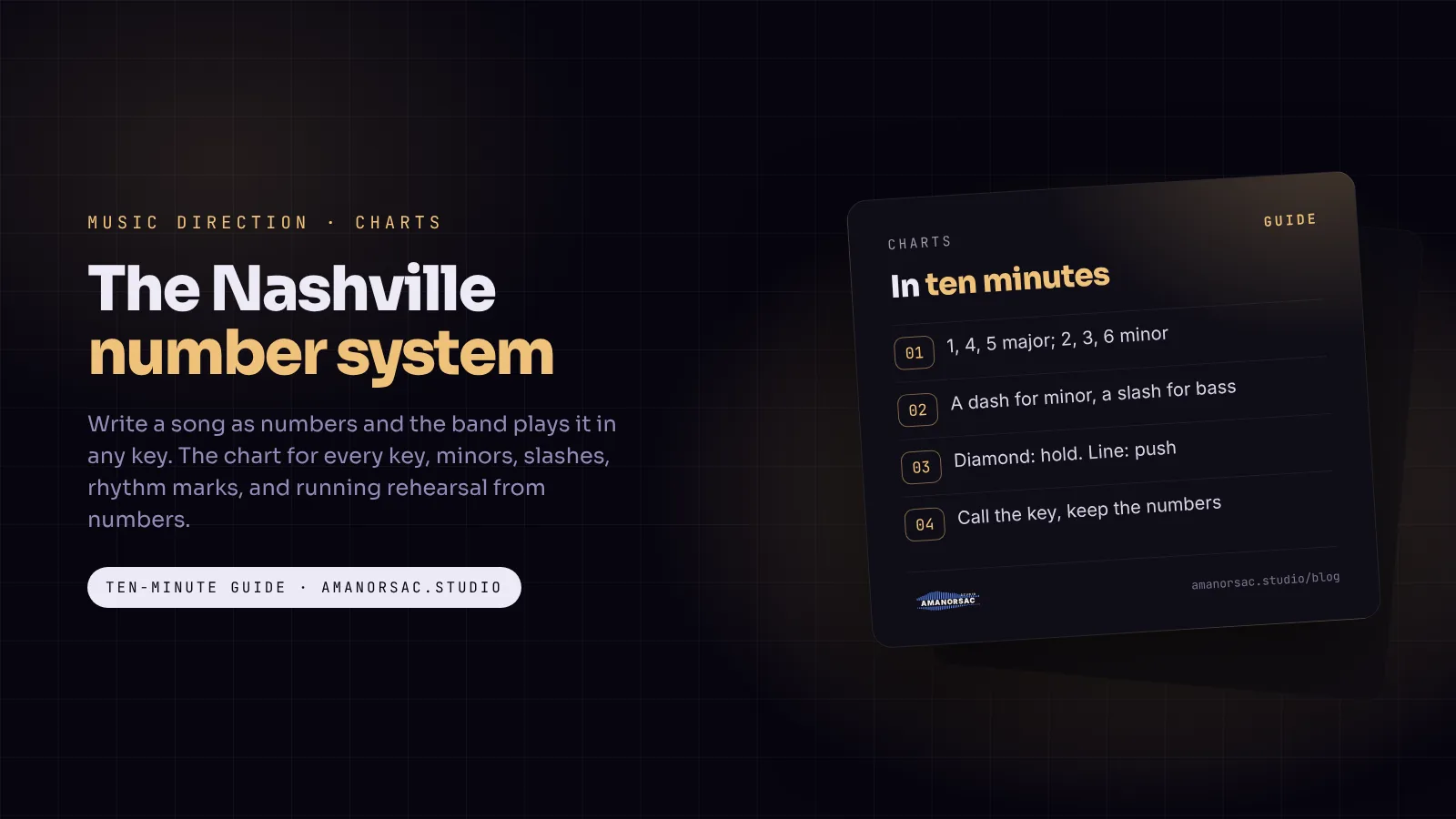
The worship leader says "let us take it in B flat today", and half the band reaches for a phone. The other half just plays. The difference is the Nashville number system, and it is the single most useful ten minutes a worship musician can spend. This is the whole of it.
The idea
Every major key has seven chords, built on its seven notes. Number them. In C the notes are C D E F G A B, so C is 1, D is 2, E is 3, F is 4, G is 5, A is 6 and B is 7. In G the notes are G A B C D E F sharp, so G is 1, A is 2 and so on.
A chord written as a number is the same chord in every key. "1 4 5" is C F G in C, G C D in G, and Bb Eb F in B flat. Write the song as numbers once, and the band can play it in whatever key the singer's voice wants today.
The chart for every key
Read it as: key, then the chords for 1, 2, 3, 4, 5, 6 and 7.
- C: C, Dm, Em, F, G, Am, Bdim
- Db: Db, Ebm, Fm, Gb, Ab, Bbm, Cdim
- D: D, Em, F#m, G, A, Bm, C#dim
- Eb: Eb, Fm, Gm, Ab, Bb, Cm, Ddim
- E: E, F#m, G#m, A, B, C#m, D#dim
- F: F, Gm, Am, Bb, C, Dm, Edim
- Gb: Gb, Abm, Bbm, Cb, Db, Ebm, Fdim
- G: G, Am, Bm, C, D, Em, F#dim
- Ab: Ab, Bbm, Cm, Db, Eb, Fm, Gdim
- A: A, Bm, C#m, D, E, F#m, G#dim
- Bb: Bb, Cm, Dm, Eb, F, Gm, Adim
- B: B, C#m, D#m, E, F#, G#m, A#dim
Notice the pattern that never changes. In a major key, 1, 4 and 5 are major. 2, 3 and 6 are minor. 7 is diminished. So in Nashville charts a plain number means major, and the minors are so predictable that many charts do not even mark them. Most worship charts do mark them, with a small m or a dash, and that is the habit I teach, because volunteers should not have to remember.
How a chart is written
One number per bar. "1 4 6- 5" is four bars: one bar of 1, one of 4, one of the 6 minor, one of 5. If two chords share a bar, underline them or put them in brackets: "(1 4)" is two beats each.
Minor is a dash or a small m after the number: "6-" or "6m". Seventh is a 7: "57" is the dominant seventh on 5, G7 in C. Major seventh is "1maj7" or a small triangle. Suspended is "sus": "4sus" or "5sus4".
Slash chords put the bass note after a slash, also as a number: "1/3" is the 1 chord with the 3 in the bass, C over E in C. The gospel walk-up in Twelve gospel chord progressions is written "1 1/3 4" and reads the same in every key.
The flat seven, the modern worship chord, is "b7": Bb in C. The 4 minor is "4-": Fm in C.
Rhythm marks. A diamond around a number means hold the chord and let it ring. A line over two numbers means push, play the second chord a half beat early. A dot after a chord means stop short. You will see these written by hand on every Nashville chart and they take a Sunday to learn.
Sections are labelled: V for verse, C for chorus, B for bridge, PC for pre-chorus, I for intro, T for tag. "C x2" means play the chorus twice.
A worship song in numbers
Here is a typical modern worship chorus, four bars repeating:
1 5 6- 4
In C that is C G Am F. In G it is G D Em C. In E, which is where many congregations actually sing comfortably, it is E B C#m A. The chart did not change; the key did. A verse might be 1 1/3 4 4 and a bridge 6- 4 1 5. Three lines, and the whole song is on an index card.
Running rehearsal from numbers
Call the key, then count. "Verse, in E, one two three four." The band reads the same numbers whatever key you call.
Change key without stopping. If the leader moves the song up a step for the last chorus, say the new key and keep the numbers. The music director's hand signals for that are in The music director guide.
Teach the ear-trained musician the numbers first. Many church musicians in Accra and Lagos play entirely by ear, and brilliantly. Numbers are the bridge between them and the reader: the ear player already hears 1, 4 and 5, they just never had names for them. Give them the names and the two halves of the band can finally talk.
Keep the master chart in numbers, print the key for the singers. Singers want letters, because they are looking for their starting note. Musicians want numbers. Keep both, and never let a letter chart become the only copy.
What numbers do not tell you
Numbers give you the chords. They do not give you the voicing, the inversion the record used, or the feel. That is where listening comes in, and where a keyboardist's hands make the difference between a chart played right and a song that sounds like the record. The twelve progressions post covers the voicings; the numbers get you to the right chord in time.
Questions people ask
What is the Nashville number system?
A way of writing chords as numbers from 1 to 7 based on their position in the key, so a chart works in any key. 1 is the home chord, 4 and 5 the other majors, 2, 3 and 6 the minors, 7 the diminished.
Why do worship teams use numbers instead of chord names?
Because worship songs change key to suit the singer, often on the day. A number chart plays in any key without rewriting; a letter chart has to be transposed.
How do you write a minor chord in Nashville numbers?
With a dash or a small m after the number: 6- or 6m is the minor chord on the sixth note, A minor in the key of C.
What does a slash mean in a number chart?
The bass note. 1/3 is the 1 chord with the third in the bass, C over E in C. 5/7 is the 5 chord over its third, G over B.
Is the Nashville number system the same as Roman numerals?
Nearly. Roman numerals come from music theory classes and use capitals for major and lower case for minor. Nashville numbers use plain figures and marks, because they were made to be read fast on a music stand.
Written by Stephen Amanor Sackey — producer, mix engineer and music director, Virginia. More about the studio.
Studio news
Struggling to move forward in your music?
Guides from a working music director, written for the churches we actually work in: church sound, worship teams, free sheets for the desk, and the apps, with the free one first. A few letters a month at most, and every one has a link to stop.
You will get one email asking you to confirm. Your first app is 15% off when you join. Privacy.