The sermon is the longest single thing your system does on a Sunday, and the one people came for. The band gets forty minutes. The preacher gets forty-five, alone, on one microphone, and if that microphone is wrong the whole morning is wrong. This is the choice I get asked about more than any other, so here is the whole answer in one place.
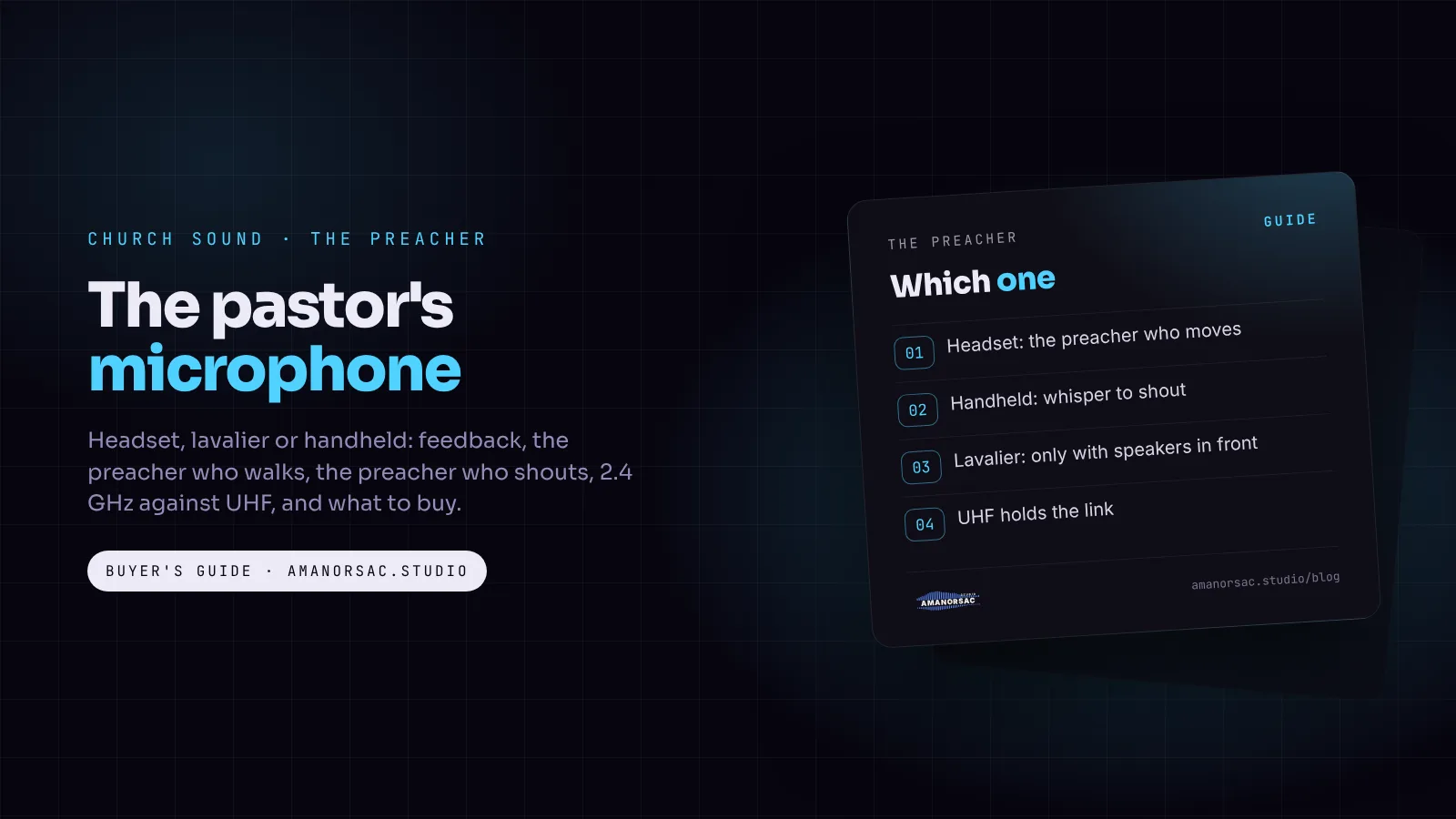
There are three kinds. A handheld the preacher holds or leaves on a stand. A lavalier, the small clip-on at the collar. A headset, the thin boom that sits beside the mouth. Each one solves a different problem and creates a different one, and the right choice depends on how your preacher preaches, not on what the church down the road bought.
The one rule under all of it
Distance decides everything. A microphone an inch from the mouth hears the voice loud and the room quiet. A microphone a foot away hears the voice quiet and the room loud, so you turn it up, and now it hears the speakers too. That is feedback, and it is why the lavalier is the hardest of the three to run and the headset is the easiest. The handheld sits in between: close when held well, far when it drifts to the chest mid-sentence.
Everything below follows from that rule.
Handheld: the most forgiving sound, the least forgiving habits
A good handheld has the best sound of the three for the money. A Shure SM58 or a Sennheiser e835 on a stand, or their wireless versions, give you a full voice with the room kept out, and the preacher can lean in for the quiet line and pull back for the loud one, which is a kind of compression nobody has to set.
The problem is habit. Preachers who gesture put the microphone where the hand goes. Preachers who read put it on the lectern and walk away from it. Preachers who shout eat it, and a dynamic handheld handles shouting better than anything else you can buy, which is a point in its favour in a church where the sermon climbs.
Choose a handheld when the preacher stays near a lectern, when the voice goes from a whisper to a shout, or when more than one person preaches and you do not want to fit a headset to each of them. Give it a stand with a boom and set the stand before the service, not during.
Lavalier: invisible, and the most feedback you will ever fight
The lavalier is the microphone churches buy because it looks like television. On television there is no loudspeaker in the room. In a church there is, and the lavalier is six to eight inches from the mouth, pointed at the ceiling, hearing the speakers nearly as well as it hears the preacher.
It also moves. The preacher turns to the left, the microphone stays on the collar, and the level drops by half. A beard brushes it. A jacket lapel covers it. Every one of those is a Sunday morning with your hand on the fader.
It can work. It works best in a room with the speakers well in front of the platform, with the gain set carefully once, with a high-pass filter and a notch or two, and with a preacher who does not move much. If that is your room and your preacher, it is a fine choice and the least visible one. If your preacher walks and your speakers are behind the platform, it will fight you every week.
Headset: the one I fit when I am asked to make the problem go away
A headset puts the capsule an inch from the corner of the mouth and keeps it there. Turn, walk, kneel, shout, lean on the pulpit: the distance never changes, so the level never changes and the feedback margin is the best of the three. The sound team gets its hands back.
The cost is comfort and vanity. A headset has to fit, and a cheap one slides, pinches or shows. The good ones are thin and nearly disappear, and the preacher forgets it after a month. Fit it so the capsule sits a finger's width from the corner of the mouth, never in front of it, or every "p" will pop.
Choose a headset when the preacher moves, when the room has feedback trouble, when the speakers are behind or beside the platform, or when the sound team is volunteers who cannot ride a fader for forty-five minutes. In an African church with a preacher who paces the whole platform and an interpreter beside them, this is the one. The interpreter gets one too, same model, so the two voices match. There is a whole guide to that pairing in Mixing a preacher and an interpreter.
Wireless: 2.4 GHz or UHF
Lavaliers and headsets need a body pack, so they are nearly always wireless, and here you have a second choice.
2.4 GHz systems share the band with every Wi-Fi router and phone in the building. They need no licence anywhere in the world, which is why they sell well in Ghana and Nigeria. They are fine for one or two channels in a small room. Past four channels, or in a building full of phones, they drop out, and a dropout in the middle of a sermon is unforgivable.
UHF systems use the television bands. They carry more channels, reach further and hold the link through a crowd. They need a frequency that is clear where you are and, in some countries, a licence. In the US the allowed bands changed when the 600 MHz spectrum was sold, so a second-hand American UHF system may now be illegal to switch on. Buy the band for your country, from a dealer who knows it. Is my SM58 fake? covers the wireless model names that do not exist, which is the other trap in that market.
Digital UHF systems such as Shure's SLX-D and Sennheiser's EW-D give you cleaner audio and rechargeable packs. Rechargeable packs are not a luxury in a church. Two batteries a Sunday, fifty-two Sundays, is money gone and a dead pack waiting to happen.
What to buy
A small church, one preacher, a tight budget. A wired dynamic handheld on a boom stand. Nothing to charge, nothing to drop out, and the best sound in the list. If the preacher must move, one 2.4 GHz headset system, and keep the router away from the platform.
A medium church with a preacher who walks. One UHF headset system with a rechargeable pack, and a wired handheld on the pulpit as the spare. The spare is not optional. The morning the pack dies you will be glad of it.
A large church, several preachers, an interpreter. Two matched UHF headset systems in the same band, a handheld for the guest preacher who will not wear one, and a frequency plan written down and taped inside the rack.
Whatever you choose, set the gain once at sermon volume, not at soundcheck volume, and write it down. The sermon starts quiet and ends loud, and the gain has to survive the end.
Questions people ask
Which microphone is best for a pastor?
A headset for a preacher who moves, a handheld for a preacher who stays near the pulpit or whose voice goes from quiet to a shout, and a lavalier only in a room where the speakers are well in front of the platform.
Why does the pastor's lapel mic keep feeding back?
Because it is six to eight inches from the mouth, so it needs more gain than a headset or a handheld, and that gain picks up the speakers. Move the speakers forward, high-pass the channel, and consider a headset.
Is a 2.4 GHz wireless microphone good enough for church?
For one or two channels in a small room, yes. In a building full of phones, or past four channels, it will drop out. UHF holds the link.
How many wireless microphones can we run?
It depends on the band and the system. Most 2.4 GHz systems manage four to eight in a clean room, far fewer with heavy Wi-Fi. UHF systems coordinate more, if the frequencies are planned.
Do we need a licence for a wireless microphone?
In the United States, not for the allowed bands at low power. In Ghana the NCA licenses the spectrum and dealers sell within it. Ask the dealer for the band that is legal where you are, and avoid second-hand American units in the old 600 MHz band.
Written by Stephen Amanor Sackey — producer, mix engineer and music director, Virginia. More about the studio.
Studio news
Struggling to move forward in your music?
Guides from a working music director, written for the churches we actually work in: church sound, worship teams, free sheets for the desk, and the apps, with the free one first. A few letters a month at most, and every one has a link to stop.
You will get one email asking you to confirm. Your first app is 15% off when you join. Privacy.