
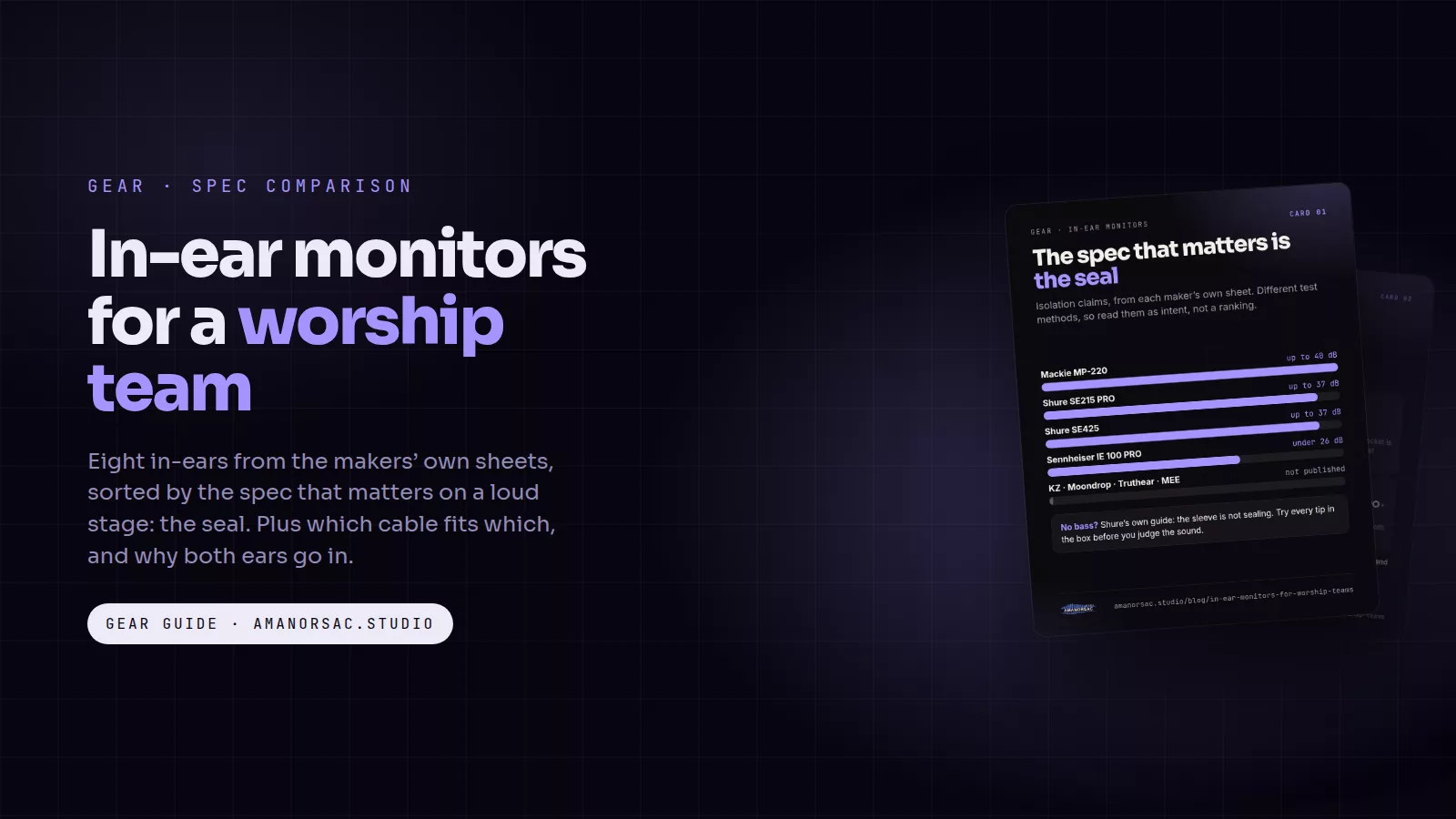
Walk past any worship band and you will see it: one earpiece in, one dangling. I did it for years. The ear that is out hears the drums and the room, the ear that is in gets turned up to compete, and by the end of the set both ears have had more than they should. In-ears were meant to fix exactly that, and they only do it when they seal.
This is the in-ear post I send to teams who ask what to buy. It is sorted by what matters on a loud stage, with every spec read from the maker's own page or manual, and the models whose makers do not publish specs left out.
The cards in this post are free to save and share. Tap one to open it full size.
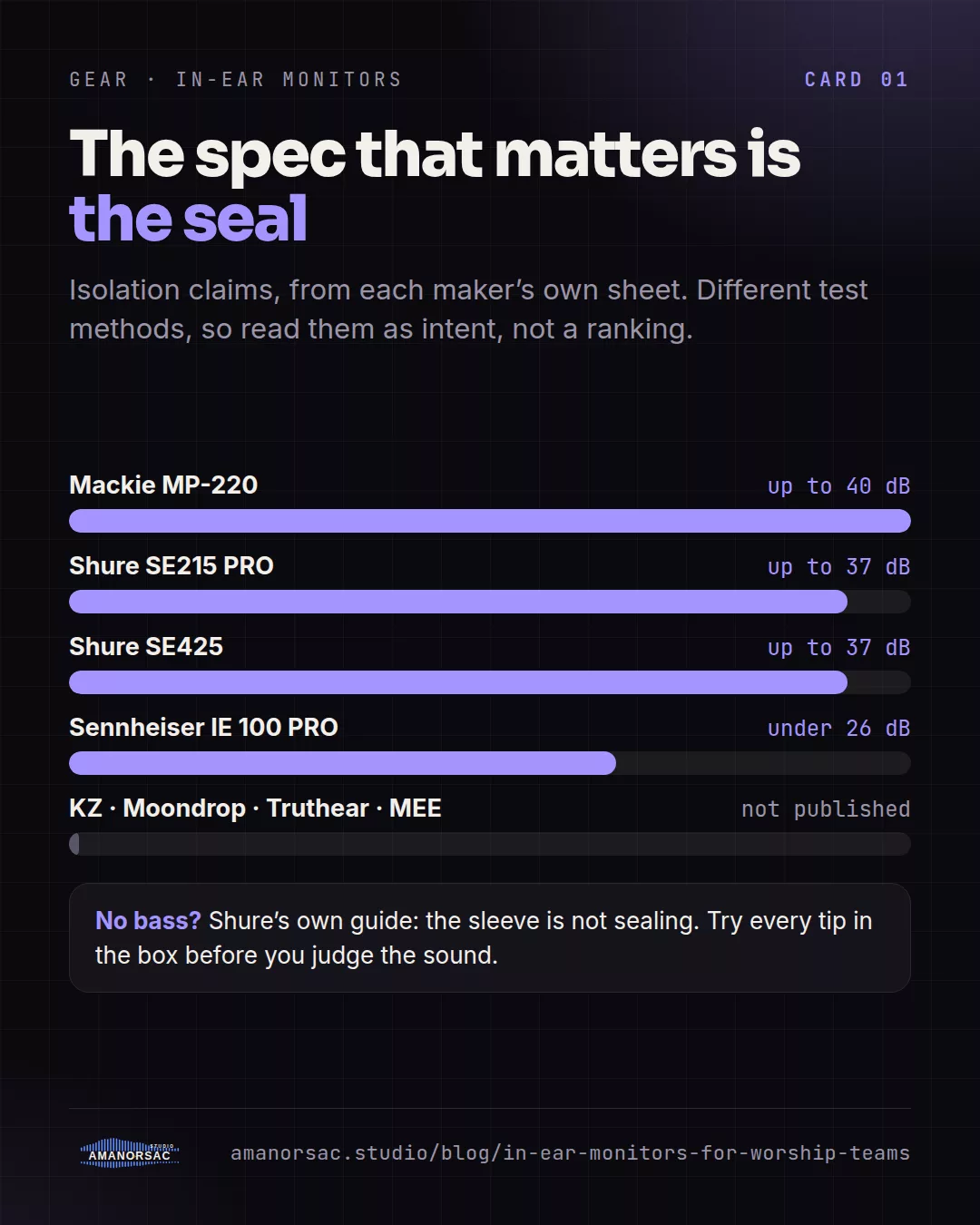
The spec that matters is the seal
Makers love frequency-response lines, 16 Hz on one, 22 Hz on another. On a stage, none of that is audible. What you hear is how much of the room gets in. That is isolation, and it decides how loud you have to run the mix to hear yourself.
Shure claims up to 37 dB of attenuation for the SE215 and SE425, Mackie up to 40 dB for the MP-220, and Sennheiser prints under 26 dB for the IE 100 PRO. KZ, Moondrop, Truthear and MEE audio do not publish a figure. Those numbers are the makers' own claims with no common test method, so do not rank by them, but they tell you which companies designed for a stage and which designed for a train.
The seal also makes the sound. Shure's own user guide puts it plainly: if the earphone seems to lack bass, the sleeve is not sealing. Before you judge any in-ear, try every tip in the box, foam included.
Why it is a health question, not a sound question
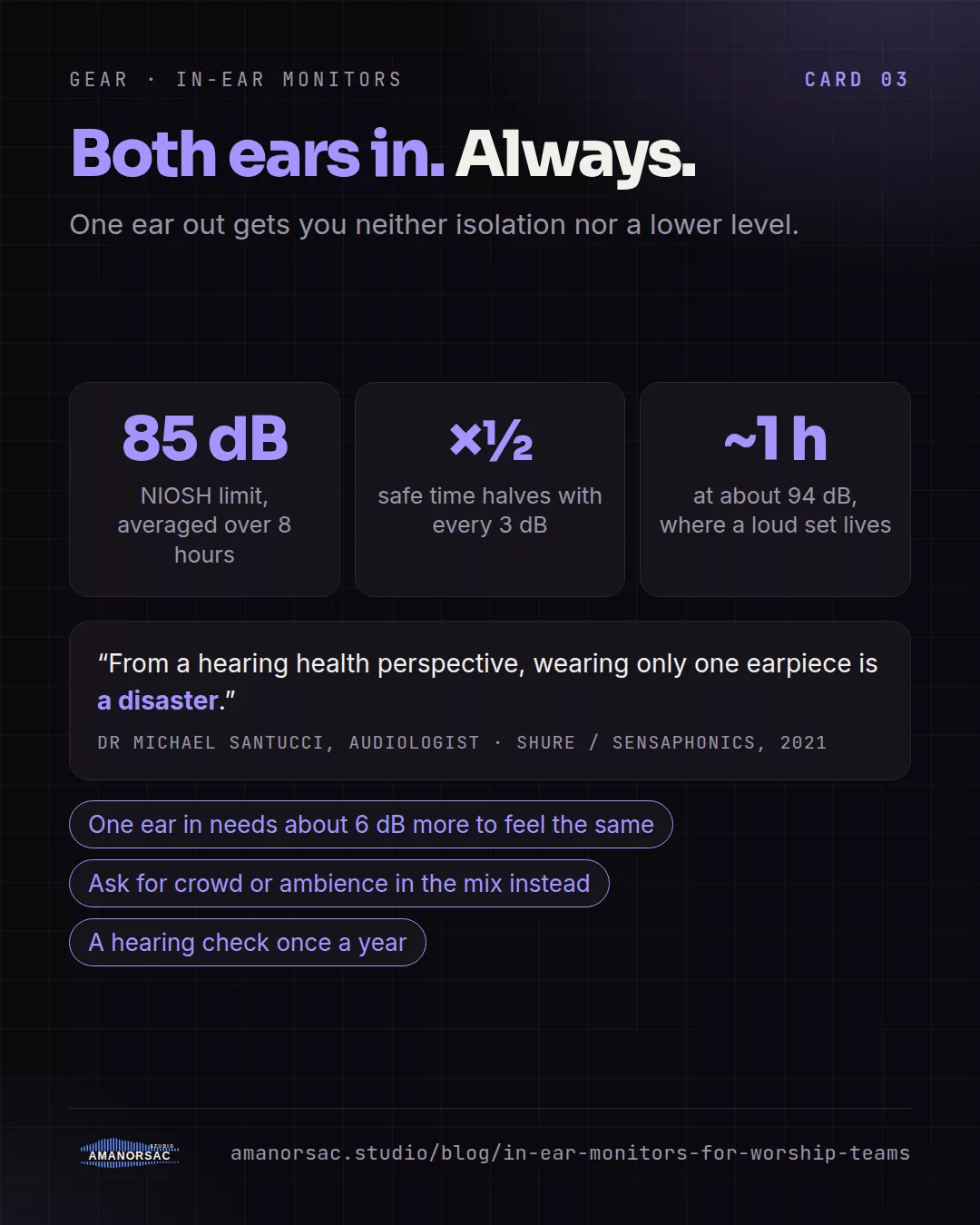
NIOSH, the US occupational health institute, puts the safe limit at 85 dB averaged over eight hours, and every 3 dB above that halves the time. At around 94 dB a musician is at risk after about an hour, and a loud worship set is there. NIOSH's own note on in-ears says their value is that bringing the mix straight to the musician means the stage does not have to be as loud.
That value disappears with one ear out. Dr Michael Santucci, the audiologist who founded Sensaphonics, said it for Shure in 2021: from a hearing-health perspective, wearing only one earpiece is a disaster. With one ear in you need the mix about 6 dB louder to feel the same level, and the open ear is still on the stage. Both ears in, then ask the engineer for a little crowd or ambience in the mix if the room feels too far away.
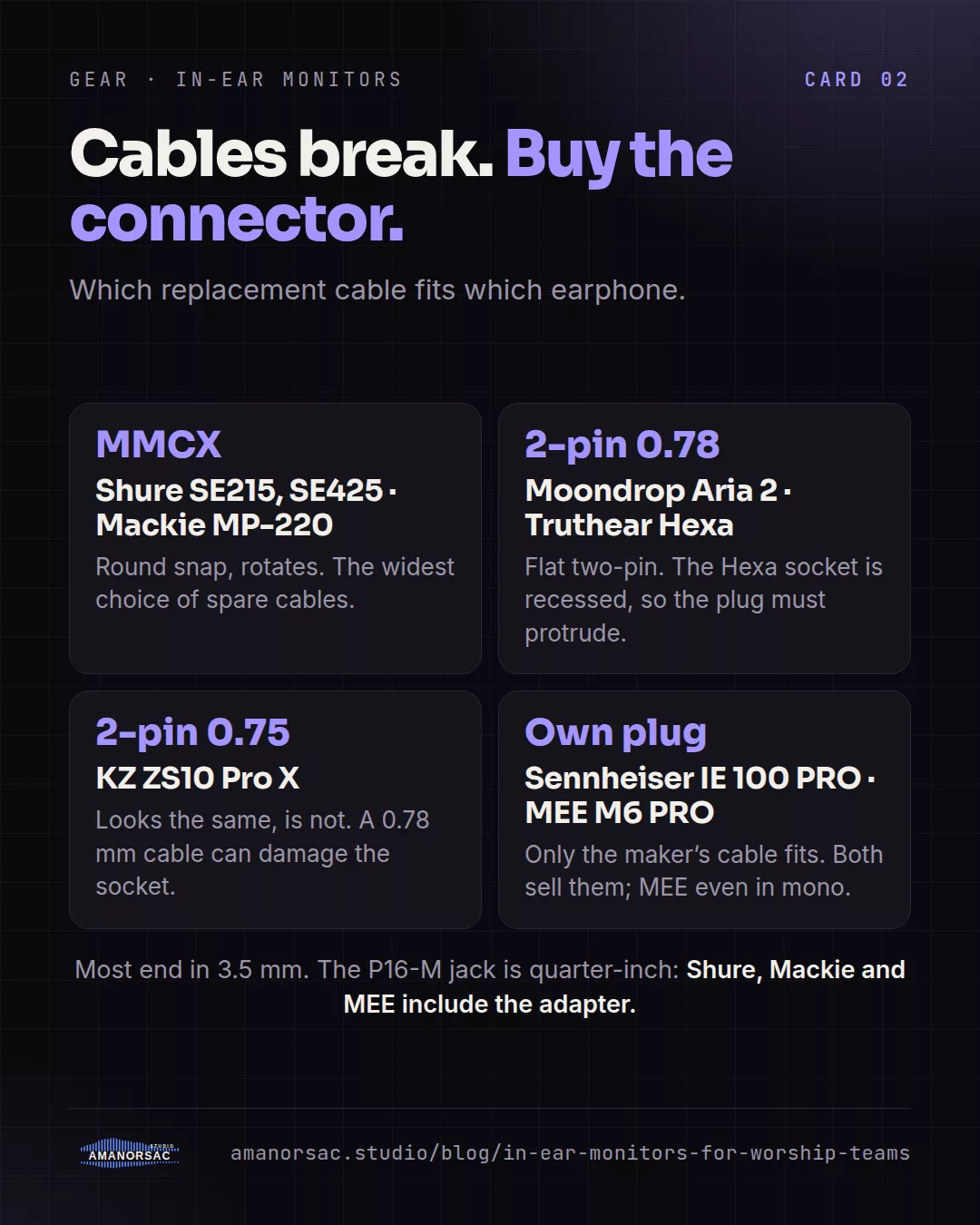
Cables break. Buy the connector, not just the earphone
The cable fails before the earphone does, always, usually at the plug and usually on a Sunday. What you need to know before you buy is which cable fits:
- MMCX, the round snap connector that rotates: Shure SE215 and SE425, Mackie MP-220. Widest choice of replacement cables.
- 2-pin, 0.78 mm: Moondrop Aria 2 and Truthear Hexa. Also widely available, though the Hexa's socket is recessed, so the replacement plug has to be the protruding kind.
- 2-pin, 0.75 mm: KZ ZS10 Pro X. Looks the same, is not the same. A 0.78 mm cable can damage the socket.
- Proprietary: Sennheiser's IE PRO connector on the IE 100 PRO, and MEE audio's locking connector on the M6 PRO. Only the maker's cable fits, and both makers sell them, MEE even in a mono version for a mono aux feed.
The models, from each maker's own sheet
- Shure SE215 PRO. One dynamic driver, 17 ohms, 107 dB per mW, up to 37 dB of isolation, MMCX, a 64-inch cable, foam and flex sleeves in three sizes, two-year warranty. The default stage in-ear for a reason. Shure sells the EAC64 and EAC46 replacement cables.
- Sennheiser IE 100 PRO. One 10 mm dynamic driver, 20 ohms, loud at 115 dB from one volt, 20 Hz to 18 kHz, under 26 dB of isolation by Sennheiser's own sheet, 1.3 m cable on the proprietary IE PRO connector. Light, comfortable, less sealed.
- KZ ZS10 Pro X. One dynamic driver plus four balanced armatures, 29 ohms, 0.75 mm 2-pin, 120 cm cable, three sizes of silicone tips, no isolation figure. The cheapest way to hear what a hybrid does; buy foam tips with it.
- Moondrop Aria 2. 33 ohms, very sensitive at 122 dB per volt, so a noisy headphone amp will hiss; 0.78 mm 2-pin with both 3.5 mm and 4.4 mm plugs in the box; no isolation figure. Built for listening more than for a stage.
- Truthear Hexa. One dynamic plus three balanced armatures, 20.5 ohms, 120 dB per volt, recessed 0.78 mm 2-pin, seven pairs of tips including one foam. Well regarded for the money; no isolation figure.
- Shure SE425. Two balanced armatures, 22 ohms, 109 dB per mW, 20 Hz to 19 kHz, up to 37 dB of isolation, MMCX, a case and a quarter-inch adapter in the box. The step up for a lead singer who wants detail and the same seal.
- Mackie MP-220. Two dynamic drivers, 16 ohms, up to 40 dB of isolation, MMCX, foam, silicone and double-flange tips in three sizes, hard case, quarter-inch adapter. One catch from the spec sheet: 88 dB per mW is by far the lowest sensitivity here, so it wants a strong headphone amp. From a P16-M it is fine; from a phone it is quiet.
- MEE audio M6 PRO, 2nd gen. One 10 mm dynamic driver, 16 ohms, 100 dB per mW, IPX5 sweat rating, a 51-inch cable and a headset cable in the box, MEE's locking connector with cheap replacement cables in several lengths. The value pick for a whole team.
Two I looked at and left out: the Westone Pro X10, because Westone's current page only states the driver, the 25 dB average isolation and the tips, and it shows as sold out; and the 7Hz Zero:2, because there is no 7Hz website to check against, only the distributor's.
What feeds them
If your mixer has Ultranet, the Behringer P16-M personal mixer is what most churches already own: sixteen channels over one Cat5 cable, per-channel volume, pan and EQ, sixteen presets, a quarter-inch headphone jack. Behringer has marked it legacy; the P16-HQ replaces it and Behringer says it is identical in form, fit and function. If you have no Ultranet, the Behringer P2 is a metal belt pack with a locking combo input: plug an aux send into it, set the switch to mono so both ears get signal, and you are monitoring. Behringer's page does not state its battery or output power, so I will not either.
Most of the in-ears above end in a 3.5 mm plug and the P16-M jack is quarter-inch. Shure, Mackie and MEE put an adapter in the box; the others do not, so add one to the order.
Which one for which seat
- A whole team on a budget: MEE M6 PRO, and a spare cable each.
- Lead vocal: Shure SE425, or SE215 if the budget says so.
- The drummer: Mackie MP-220 or SE215, the two with the biggest isolation claims, on a P16-M.
- A keys player who also records at home: Truthear Hexa, with foam tips for the stage.
- The singer who hates the plugged feeling: Sennheiser IE 100 PRO, knowing it seals less.
The Live Recording Run Sheet has the in-ear starting mixes by seat, and the Musician Body Check has the safe listening times.
Specs were read from Shure, Sennheiser, KZ, Moondrop, Truthear, Mackie, MEE audio and Behringer's own pages and manuals in October 2026; the hearing figures are from NIOSH and the 2021 Shure and Sensaphonics guidance. Makers change things; if you spot a change, tell me and I will fix it.
Written by Stephen Amanor Sackey — producer, mix engineer and music director, Virginia. More about the studio.