
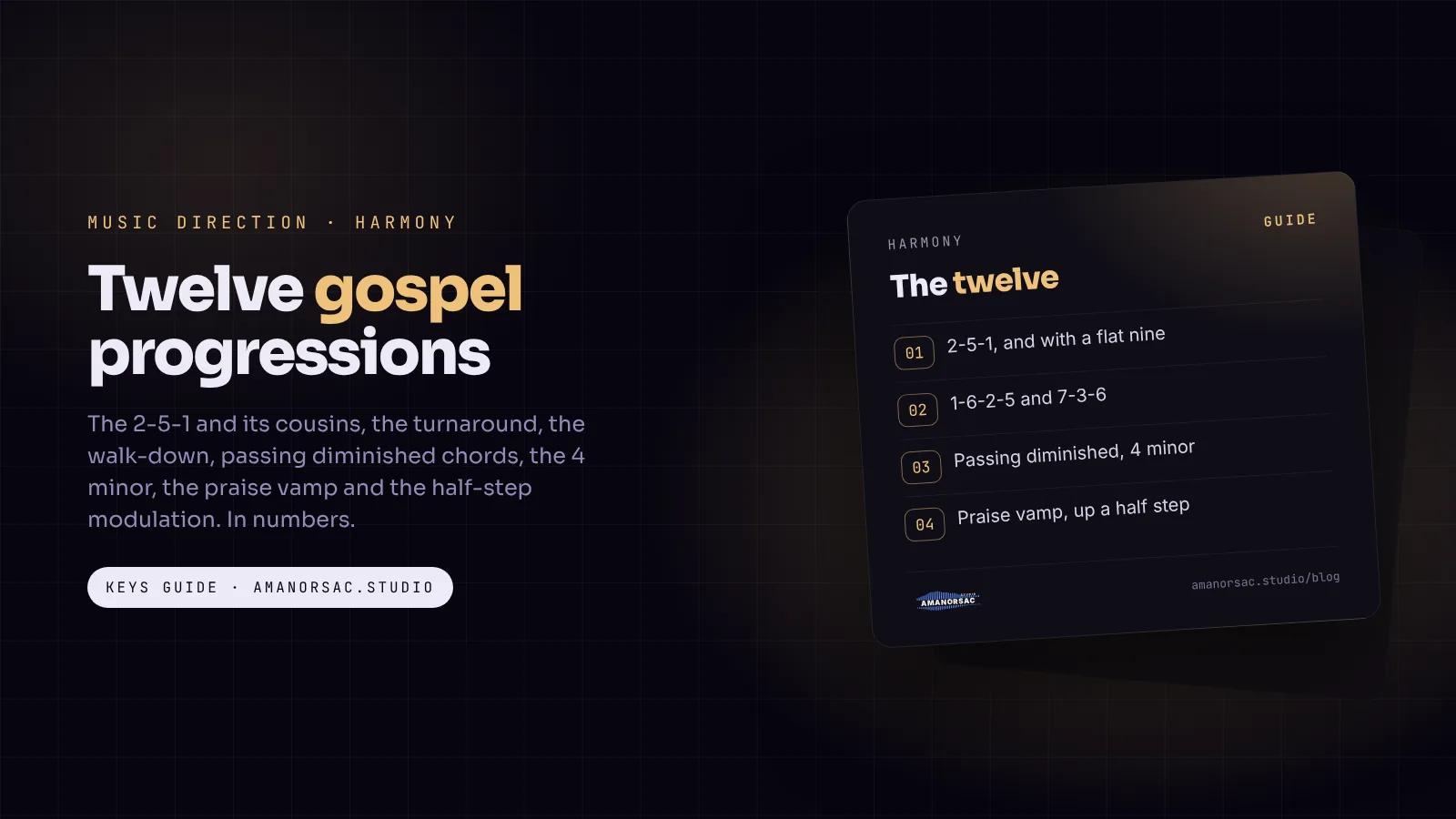
Gospel harmony sounds complicated from the pew and is mostly twelve moves. Learn the moves in numbers, not in one key, and you can follow a leader who changes key mid-song, play a hymn like a record and build a praise break on the spot. This is the list I teach keyboardists first, in the order I teach it.
Everything is written in the Nashville number system, where 1 is the home chord, 5 is the dominant and so on. If that is new, read The Nashville number system for worship teams first; it takes ten minutes. Examples are given in C so you can try them straight away. A dash between chords means one beat each unless I say otherwise.
1. The 2-5-1
Dm7 - G7 - Cmaj7 in C. The engine of gospel, jazz and most hymn endings. The 2 is a minor seventh, the 5 a dominant seventh, the 1 a major seventh when you want it to glow and a plain triad when the congregation is singing.
Voicing: keep the top note still or moving by step. From Dm7 (F-A-C over D) go to G7 (F-B-D over G), then to Cmaj7 (E-G-B over C). Two notes move, two stay. That is what makes it sound smooth instead of jumpy.
2. The 2-5-1 with a flat nine
Dm7 - G7b9 - Cmaj7. The same move with one note changed: the ninth of the 5 chord lowered a half step, A flat instead of A in C. Gospel players reach for this on the last line of a hymn. The flat nine pulls hard into the 1.
3. The 1-6-2-5 turnaround
C - Am7 - Dm7 - G7, and round again. Four chords that take you back to the top of a verse, under a vamp, under an altar call, for as long as the leader needs. Make the 6 a dominant, A7, and the pull into the 2 doubles.
4. The 7-3-6 walk-down
Bm7b5 - E7 - Am7 in C. Instead of going straight from 1 to 6, go through the 7 and the 3. It is the sound of a gospel ballad turning the corner into the second half of a verse. The 7 is half-diminished, the 3 a dominant with a flat nine if you want extra ache, the 6 a minor seventh.
5. The 3-6-2-5-1
Em7 - Am7 - Dm7 - G7 - C. The long way home, and the standard way to end a chorus with weight. Each chord is a fifth below the last, which is why it feels inevitable. On the last chorus, play it in half time and let the choir hold.
6. The passing diminished
C - C#dim7 - Dm7 - G7. Between the 1 and the 2, a diminished chord on the note in between. It is the most recognisable sound in gospel piano, and it works between any two chords a whole step apart: between 2 and 3 (D#dim7), between 4 and 5 (F#dim7, which is really a 5 with a flat nine in disguise).
Voicing: play the diminished chord in the right hand with the bass note in the left, and let the next chord resolve a half step up.
7. The chromatic bass walk-up to the 4
C - C/E - F. Then, the gospel version: C - E7/G# - Am - C7/G - F. Hymn playing lives on this. The bass climbs under the melody while the right hand holds the hymn. Learn to do it slowly under "Blessed Assurance" and you will hear every gospel pianist you have ever admired.
8. The 4 to 4 minor
F - Fm - C. The 4 chord dropping to its minor before coming home. The most emotional two chords in church music, and the simplest. Put the flat six on top of the Fm, A flat in C, and resolve it down to G on the C chord. That one moving note is the whole feeling.
9. The 1 over 3, 4, 5 praise vamp
C/E - F - G - C, over and over, fast. The chords of a praise break, with the 1 chord in first inversion so the bass walks E-F-G-C. Add the 2-5-1 at the top of each round for the turn. The drummer will thank you for keeping the bass walk clean.
10. The flat seven
C - Bb - F - C. Borrowed from the mixolydian mode, the flat seven is the praise-and-worship chord of the last twenty years. It sounds open and modern against the gospel chords above, and modern worship songs use it constantly. Learn to hear it coming: it is almost always followed by the 4.
11. The tritone substitute
Dm7 - Db7 - Cmaj7. Instead of G7, play the dominant a tritone away, D flat seven. The bass walks down by half steps, D, D flat, C, and the right hand barely moves, because Db7 and G7 share their two most important notes. This is the chord that makes a hymn ending sound like a record.
12. The modulation up a half step
On the last chord of the old key, play the 5 of the new key. To go from C to D flat, land the 2-5-1 in D flat: Ebm7 - Ab7 - Db. Or the simpler gospel way: hold the 1, slide the bass up a half step to the 5 of the new key under a dominant chord, and let the choir rise with you. Do it once in a song, on the last chorus. Twice is a key change too many.
Leaders call this with a raised hand or a shouted "up". If you are the music director, agree the signal in rehearsal, and read The music director guide for the rest of the hand signals.
How to practise them
One progression a day, in every key, with a metronome. Five minutes. Go round the circle of fifths so the hard keys get the same time as C. Record yourself once a week on the phone and listen in the car. Within two months the twelve are under your hands and you stop thinking about chords and start listening to the leader, which is the point.
If you are learning on a laptop, Chordlight 88 lights the chords on screen as you play them and records the take as MIDI, which makes the every-key drill a game instead of a chore.
Questions people ask
What are the most common gospel chord progressions?
The 2-5-1, the 1-6-2-5 turnaround, the 7-3-6 walk-down, passing diminished chords and the 4 to 4 minor. Those five cover most of what you hear in a gospel service.
What is a 2-5-1 progression?
The chord on the second note of the scale, then the fifth, then the first. In C: Dm7, G7, C. It is the strongest way to arrive at the home chord and the backbone of gospel and jazz harmony.
What are passing chords in gospel?
Chords placed between the chords of a song to connect them, most often diminished sevenths between chords a whole step apart, and chromatic bass notes that walk from one chord to the next.
How do gospel pianists change key?
Usually up a half step on the last chorus, by playing the 2-5-1 of the new key on the last bar of the old one, or by sliding the bass up a half step under a dominant chord while the choir rises.
Why learn progressions in numbers instead of chord names?
Because the song will not stay in one key. A progression learned as 2-5-1 is the same in every key; learned as Dm7-G7-C it is only in C. Numbers are how church musicians follow a leader who changes key.
Written by Stephen Amanor Sackey — producer, mix engineer and music director, Virginia. More about the studio.
Studio news
Struggling to move forward in your music?
Guides from a working music director, written for the churches we actually work in: church sound, worship teams, free sheets for the desk, and the apps, with the free one first. A few letters a month at most, and every one has a link to stop.
You will get one email asking you to confirm. Your first app is 15% off when you join. Privacy.