

Almost every worship team I've worked with switches to in-ears at some point, expecting instant clarity and instead gets a band that feels disconnected, a vocalist who sings sharp, and a sound tech who's suddenly doing twice the work for half the trust. In-ears rarely cause that on their own. How the team set them up almost always does.
Mistake #1: Everyone wants "everything, loud"
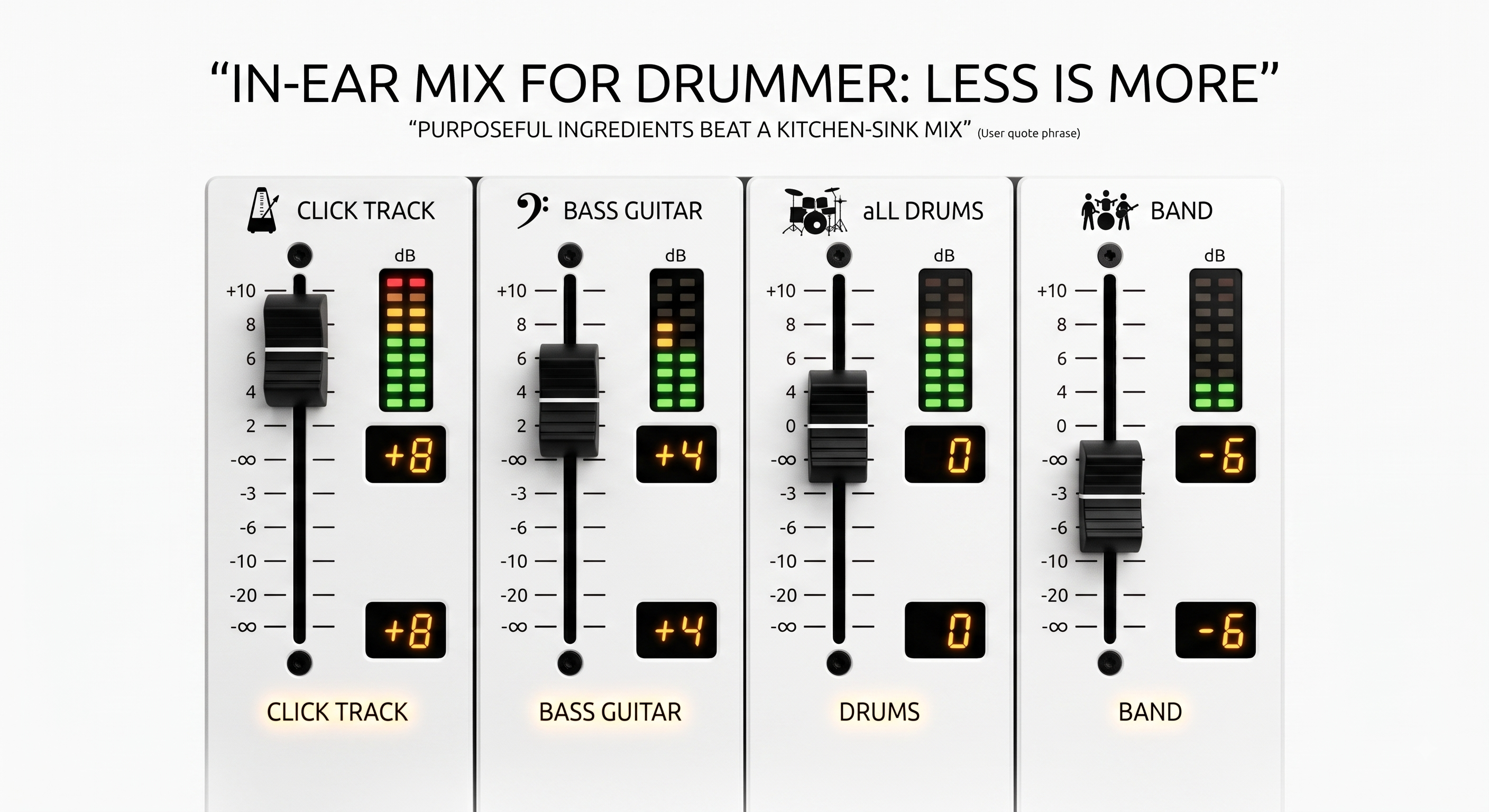
The most common request I hear in-ear is "just give me a little of everything." That instinct feels safe, but it's exactly what makes in-ear mixes muddy and fatiguing. A better approach is asking each musician what they actually need to do their job; the drummer needs click and bass to stay locked, the acoustic player might mostly need vocals and a touch of themselves, the vocalist needs their own voice forward with just enough band to stay in the pocket. Fewer, more purposeful ingredients beat a kitchen-sink mix every time i.e less is more .
Mistake #2: No reference of "self" in the mix
Singers who go sharp or flat on in-ears are often missing enough of their own voice in the mix to actually hear their pitch. Open-back or vented in-ears help because they let a little room sound in naturally, but even with sealed ears, every vocalist needs a healthy amount of themselves — not buried under the band, not screaming over it. If pitch problems show up the moment someone switches to in-ears, check their own vocal level before you assume it's a "them" problem.
Mistake #3: Treating the click track like a metronome, not a bandmate
A click that just ticks along at a flat volume, with no dynamic shape, is one of the fastest ways to make a live performance feel stiff. The band should be able to feel the song breathe: a slight drop into a bridge, a lift into the chorus, and a rigid click fights against that and feels unnatural. Where possible, build clicks with some dynamic awareness difficult huh? or spend real rehearsal time until the team actually trusts it. A team that resents the click and IEMs will rush it, take it out of their ears, or quietly turn it off, and then you've lost the one thing holding a big room's timing together.
In-ears reward teams that rehearse with intention. Spend fifteen minutes before a real practice just dialing in personal mixes track by track, and you'll spend a lot less time firefighting on a Sunday morning. Most of what gets blamed on the gear is really a conversation nobody had.
Written by Stephen Amanor Sackey — producer, mix engineer and music director, Virginia. More about the studio.