A church keyboard is not a studio keyboard. In a studio you have time, a mouse and a second take. On a Sunday you have a worship leader who changes key with a nod, a pad that has to be under the prayer before anyone notices, and an organ sound that has to come in on the chorus without a gap. The instrument that does that is a different animal from the one with the most sounds in the brochure.
I have played church keys in Accra and in Virginia, and directed bands where the keyboard was the whole harmony section. These are the things that mattered on those Sundays, and the instruments that have them.
The five things that matter
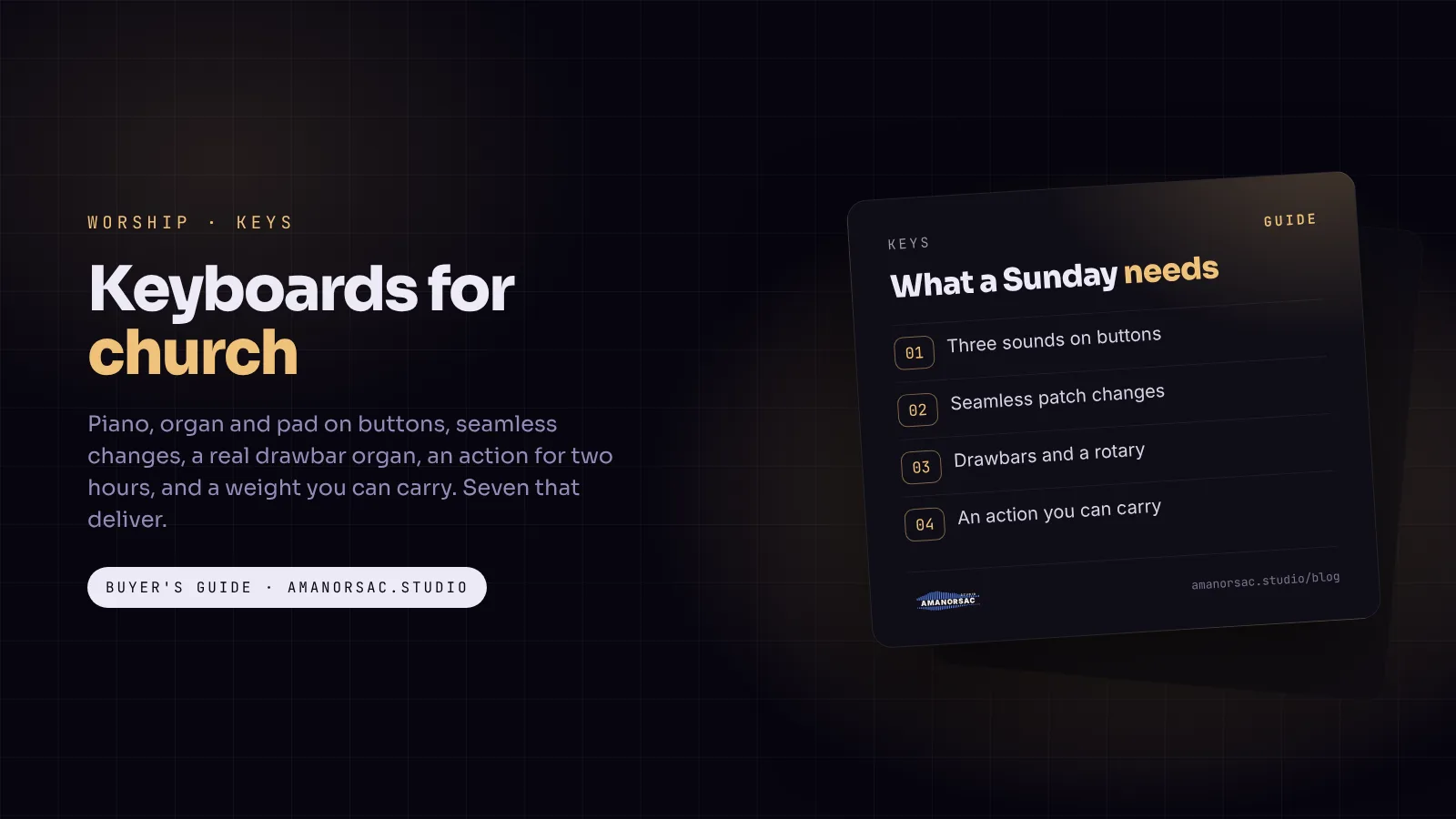
Three sounds, instantly. Piano, organ and pad cover ninety per cent of a service. The instrument has to switch between them, or layer them, without a pause and without looking down. A stage piano with dedicated buttons beats a workstation with a menu, every time, however good the workstation's sounds are.
Seamless changes. When you change patch, the note you are holding must not cut off. Nord calls it seamless transitions, Yamaha and Roland have their own names, and the cheap boards do not have it at all. Without it, every patch change is a hole in the music.
A real organ. Gospel lives on the organ. Drawbars, a rotary speaker you can speed up with a button or a pedal, and percussion that clicks. A sampled organ with one speed is not an organ, it is a recording of one.
An action you can play for two hours. A hammer action for the pianist, a waterfall or semi-weighted action for the organist, and in most churches one person doing both. Try before you buy if you possibly can. Weight matters too: an 88-key hammer action is 18 to 20 kilograms, and somebody carries it.
Splits and layers you can set in the car park. Bass in the left hand for the Sunday the bassist does not come. Pad under the piano for the worship set. The faster you can set those, the more useful the instrument is.
The seven
Nord Stage 4
The one in most big church videos, and for a reason. Three engines, piano, synth and organ, each with its own section of the panel, so you layer and split by pressing buttons, not by scrolling. The organ has physical drawbars on the Compact model and LED drawbars on the others, with a rotary speaker simulation that is the best in this list. Seamless transitions are built in. The piano library is downloadable, so you can swap the grand for an upright for the hymn. The 88 has a triple-sensor hammer action, the 73 the same, and the Compact a semi-weighted waterfall action that organists love. It is the most expensive instrument here, and the red one on the stage is also the first thing a thief notices, which is worth a thought in some of our churches.
Yamaha YC88
Yamaha built the YC series for exactly this job. The organ section has nine physical drawbars and Yamaha's VCM modelling, with a rotary that speeds up on a button, and the pianos come from the CP line below. The YC88 has a graded hammer action with wooden keys, the YC73 a balanced hammer action, and the YC61 a waterfall semi-weighted action for the organist. It is lighter than the Nord 88 and considerably cheaper, and the one I would point most gospel churches to first.
Yamaha CP88
The CP88 is the YC88's piano-first sibling. The same action, the same one-to-one front panel with no menus, three sections you switch and layer with buttons, and seamless changes. The organ is sampled rather than modelled and has no drawbars, which is the trade. If your church is piano and pad, with organ on another instrument or nobody playing organ at all, the CP88 is the better piano of the two.
Roland RD-2000 EX
Roland's stage piano for people who want the most piano and the most control. Two sound engines, including a modelled piano that never repeats a sample, the PHA-50 hybrid wood and plastic action that many pianists rate the best under a real grand, and eight zones with physical faders for controlling layers and external instruments. The organ is good but it is not the point. Choose it if the pianist leads and the organ comes from a second board or a plugin.
Korg Nautilus 88
The workstation in the list. Nine sound engines, a sequencer, sampling, a touch screen, and sounds that go far beyond piano, organ and pad: strings, brass, synths, choirs, the lot. For a church that runs tracks, builds its own pads and wants one board that does everything, it is strong. For a volunteer keyboardist who needs piano on button one and organ on button two, the touch screen is a menu, and that is the catch. Set Pads of your main sounds and never leave them during the service.
Yamaha CK88
The surprise of the list. A graded hammer action, three sections with their own buttons, drawbar organ control from the faders, speakers in the body so it works in a small room with nothing else, and a battery compartment so it plays through a power cut. It weighs a little over 13 kilograms. For a church plant, a youth service, a rural church on a generator or a keyboardist who carries their own instrument on a trotro, this is the one, and the one I would buy for the second service room.
Roland RD-88
Roland's light stage piano. The PHA-4 hammer action from its home pianos, a good piano, usable organ and pads, speakers built in, and about 13 kilograms. Fewer buttons than the CK88 and a little more menu, but a very good action for the money. A fine first serious keyboard for a church that is moving on from a home digital piano.
What I would buy for three churches
A small church, one keyboardist, a tight budget. The Yamaha CK88. Piano, organ and pad on buttons, speakers if the system fails, a battery if the power does. Add a sustain pedal and a stand that does not wobble.
A medium church with a gospel band. The Yamaha YC88, or the YC73 if the pianist is happy with a lighter action and the organist wants it closer to a Hammond. A volume pedal and an expression pedal for the rotary.
A large church with two keyboardists. A Nord Stage 4 for the pianist, who gets the pianos and the pads, and a Nord Stage 4 Compact or a YC61 for the organist, who gets the drawbars under their hands. Two instruments, two people, no fighting over patches.
Whatever you buy, save your service set as a programme bank before Sunday and back it up to a stick. The keyboard that gets reset to factory on a Saturday night is a story every church has.
Questions people ask
What is the best keyboard for church?
For most churches, a stage piano with piano, organ and pad on dedicated buttons: the Yamaha YC88 is the strongest all-rounder for the money, the Nord Stage 4 the best if the budget allows, and the Yamaha CK88 the best cheap one.
Do I need 88 keys for church?
A pianist does. An organist or a pad player is often happier with 73 or 61 lighter keys. Many churches run an 88 for the pianist and a smaller board for organ and synth.
Weighted or unweighted keys for worship?
Weighted, or hammer action, for piano playing. Semi-weighted or waterfall for organ. If one person does both, a graded hammer action is the compromise most settle on.
What keyboard do gospel churches use?
The Nord Stage and the Yamaha YC series are the two most seen, because both have real drawbar organs with a rotary speaker you can speed up live. Many gospel organists add a dedicated organ or clonewheel.
Can a keyboard run on a generator or a battery?
The Yamaha CK88 runs on eight AA batteries, which carries a service through a power cut. On a generator, keep the keyboard on the stabiliser and the UPS with the mixer. Church sound on generator power has the routine.
Written by Stephen Amanor Sackey — producer, mix engineer and music director, Virginia. More about the studio.
Studio news
Struggling to move forward in your music?
Guides from a working music director, written for the churches we actually work in: church sound, worship teams, free sheets for the desk, and the apps, with the free one first. A few letters a month at most, and every one has a link to stop.
You will get one email asking you to confirm. Your first app is 15% off when you join. Privacy.