


Most of the mixes I hear from church engineers were made on headphones, in an office, after everyone went home. There is nothing wrong with that. The problem is which headphones, and what the engineer thought "flat" meant when they bought them. This post is the eight pairs I'd put in front of a worship or gospel mixer, with every number read from the maker's own page, and the two things nobody tells you: open or closed, and ohms.
The cards in this post are free to save and share. Tap one to open it full size.
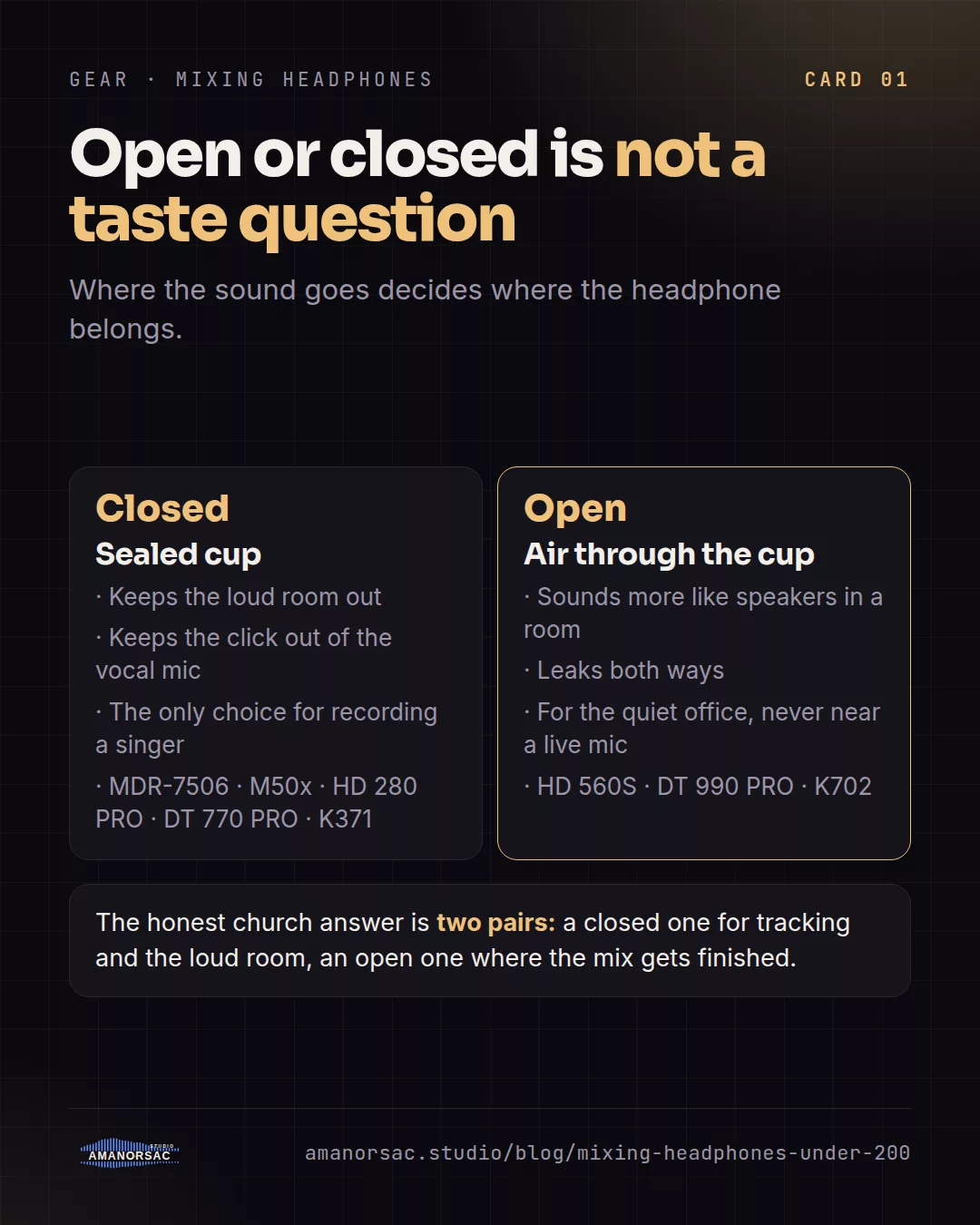
Open or closed is not a taste question
A closed-back headphone has a sealed cup. Less of the room gets in, and less of the headphone gets out. That second part is why closed is the only choice for recording a singer: the click and the backing track in an open pair leak straight into the vocal mic. Sound On Sound has been saying it since 1994 and beyerdynamic's own FAQ says the same about its open models.
An open-back headphone lets air through the cup. It sounds more like speakers in a room, which is why people mix on them, and it leaks in both directions, which is why they never belong in the same room as a live choir mic.
So the honest answer for a church is usually two pairs: a closed one for tracking and for the loud room, an open one for the quiet office where the mix gets finished.
Ohms, or why it is quiet on your phone
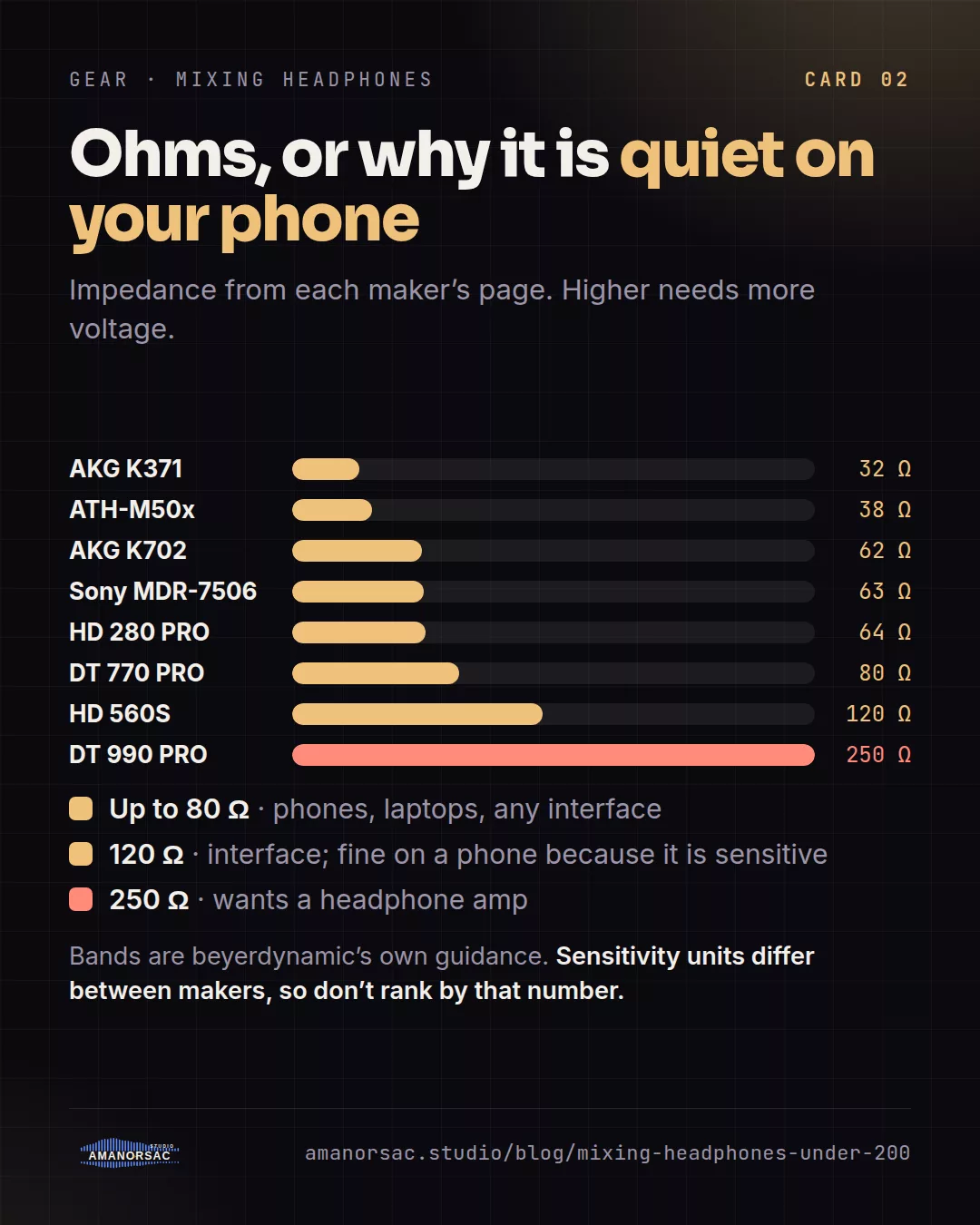
Impedance is the number in ohms. beyerdynamic's own guidance is the simplest: 16 to 32 ohms for phones and laptops, 32 to 80 ohms for audio interfaces, and 250 ohms and up for a proper headphone amplifier. The higher the impedance, the more voltage a headphone needs to get loud. Sensitivity decides how loud it goes for a given voltage, and makers print it in different units, so do not rank two brands by that number.
What it means in practice: the AKG K371, ATH-M50x, HD 599, MDR-7506, K702 and HD 280 PRO are loud from anything. The DT 770 PRO at 80 ohms is happy on an interface. The DT 990 PRO at 250 ohms wants an amplifier; on a phone, or on a weak interface output, it is quiet.
What flat means for a vocal mix
Every maker says their headphone is accurate. Read what they actually say. Sennheiser calls the HD 560S a neutral reference. AKG says the K371 is tuned to its reference response target. beyerdynamic's own copy says the DT 990 PRO has a mild bass and treble lift. Audio-Technica calls the M50x a tracking headphone first.
For a vocal mix that has to work on a phone speaker and in a car, a flat pair with a little less bass is safer than a flattering one. You will mix the vocal where it belongs and the low-mids will not surprise you later. Whatever pair you choose, learn it on records you know and check the translation checklist before you send anything.
The closed five
- Sony MDR-7506. 63 ohms, 40 mm drivers, 10 Hz to 20 kHz, a three-metre coiled cable that is not detachable, folds flat, about 230 g. A broadcast and studio fixture since 1991 by Sony's own account. Bright on top, which is a strength for hearing sibilance and a reason to mix the vocal's top end a little brighter than it sounds here.
- Audio-Technica ATH-M50x. 38 ohms, 45 mm drivers, 15 Hz to 28 kHz, three detachable cables in the box, folds flat, 285 g, replaceable pads. Audio-Technica's best-selling pro headphone. Sound On Sound heard a gentle scoop with a lift in the bass, so it flatters a mix; great for tracking, cross-check the low end.
- Sennheiser HD 280 PRO. 64 ohms, 8 Hz to 25 kHz, a coiled cable, folds, 285 g, replaceable pads, and the pair Sennheiser markets for recording, mixing and monitoring. The sealed feel is the point: it keeps a loud room out.
- beyerdynamic DT 770 PRO, 80 ohm. The version beyerdynamic itself labels "universal studio". 5 Hz to 35 kHz, about 18 dB of isolation by its own sheet, velour pads you can replace, a three-metre straight cable that is fixed, does not fold, around 345 g. The 32-ohm version is for phones, the 250-ohm one for amplifiers; buy the 80.
- AKG K371. 32 ohms and very sensitive, so it is loud from a phone; 50 mm drivers, 5 Hz to 40 kHz, 255 g, folds, and a detachable mini-XLR cable with three lengths in the box. The one closed pair here with a published reference tuning target.
The open three
- Sennheiser HD 560S. 120 ohms but sensitive enough to run from an interface or even a phone dongle, 6 Hz to 38 kHz, velour pads, a detachable cable, 280 g. Sennheiser's words: neutral reference, accurate bass. If one pair here is for finishing a vocal mix in a quiet room, it is this one.
- beyerdynamic DT 990 PRO, 250 ohm. 5 Hz to 35 kHz, replaceable velour pads, a coiled cable that is fixed, a spring-steel headband that does not fold. beyerdynamic's own copy says mild bass and treble boost, and 250 ohms means it needs an amplifier or a strong interface output. Comfortable for long sessions; not the flat one.
- AKG K702. 62 ohms, 45 mm drivers, 10 Hz to 39.8 kHz, 235 g, a self-adjusting headband and a detachable mini-XLR cable. AKG's reference model for mixing and mastering, with the light bass that "reference" usually means. Loud from anything.
One I looked at and left out: the Audio-Technica ATH-R70x, 470 ohms, which Audio-Technica Japan lists as discontinued and which has been replaced by the R70xa. And the Sennheiser HD 599 is a lovely open pair for listening, but Sennheiser sells it for home enjoyment, not for monitoring, so it is not on the list.
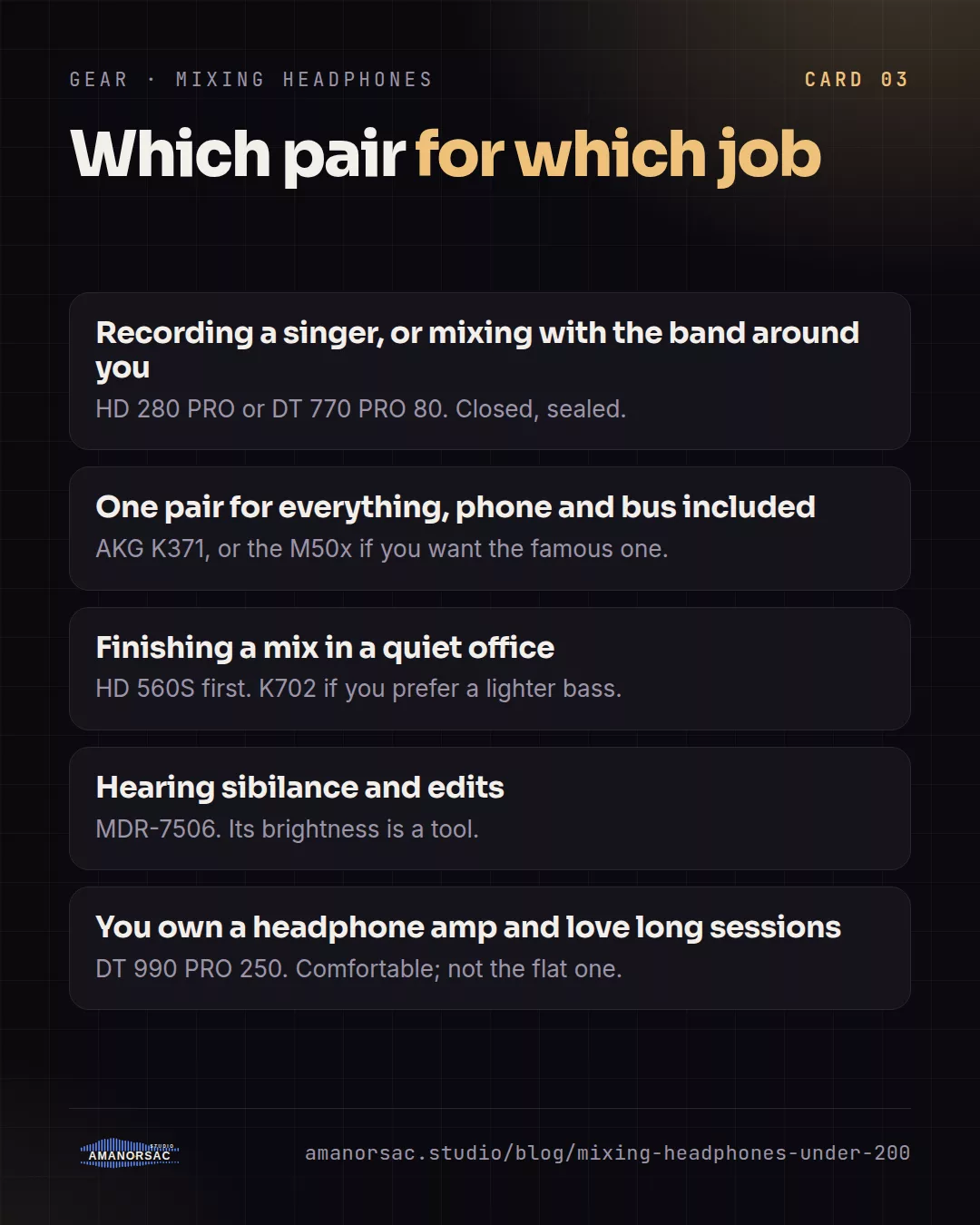
Which pair for which job
- Recording a singer, or mixing in the sanctuary with the band around you: HD 280 PRO or DT 770 PRO 80.
- One pair for everything, including the phone and the bus: AKG K371, or the M50x if you want the famous one.
- Finishing a mix in a quiet office: HD 560S first, K702 if you prefer a lighter bass.
- Hearing sibilance and edits: MDR-7506. Its brightness is a tool.
- You already own a headphone amp and love long sessions: DT 990 PRO 250.
Specs were read from Sony, Audio-Technica, Sennheiser, beyerdynamic and AKG's own pages and spec sheets in October 2026, with Sound On Sound for the listening notes. Sony and AKG block automated reading of their pages, so those two rows were checked against their published spec sheets as reproduced by their dealers. Makers change things; if you spot a change, tell me and I will fix it.
Written by Stephen Amanor Sackey — producer, mix engineer and music director, Virginia. More about the studio.