
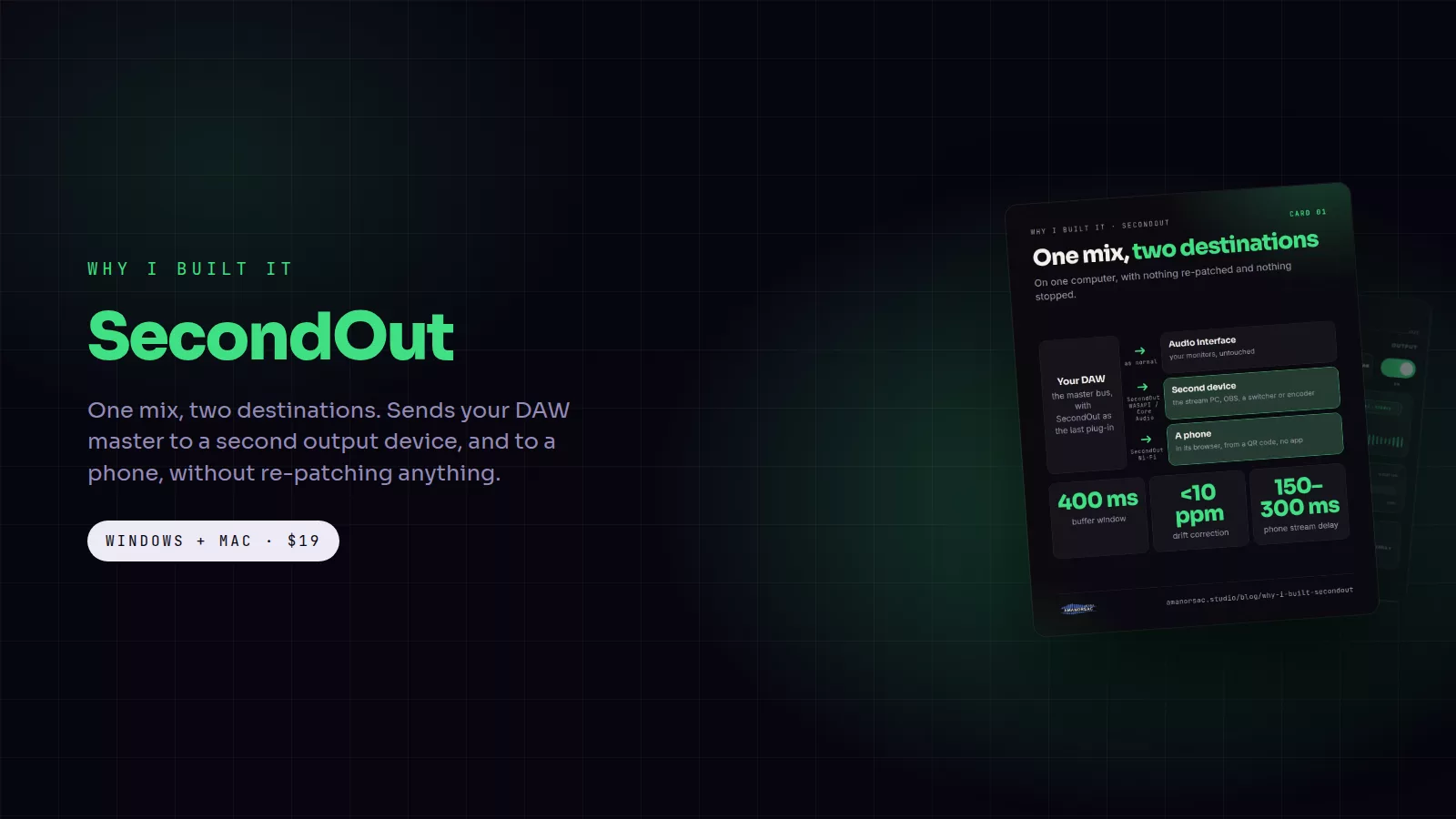
Every Sunday the same problem walked up to the media desk. The room mix comes out of the DAW through the audio interface. The stream needs the same mix, on the streaming computer, at the same time. On Windows, ASIO drivers lock an interface to one program, so the moment the DAW owns it, nothing else can open it. Not OBS, not a second console, not the switcher. You either stop your session or you start re-patching cables during the welcome. SecondOut is the plug-in I wrote so I would never do that again.
The cards in this post are free to save and share. Tap one to open it full size.
What it does
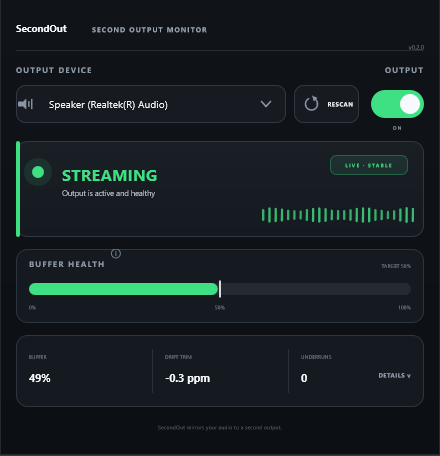
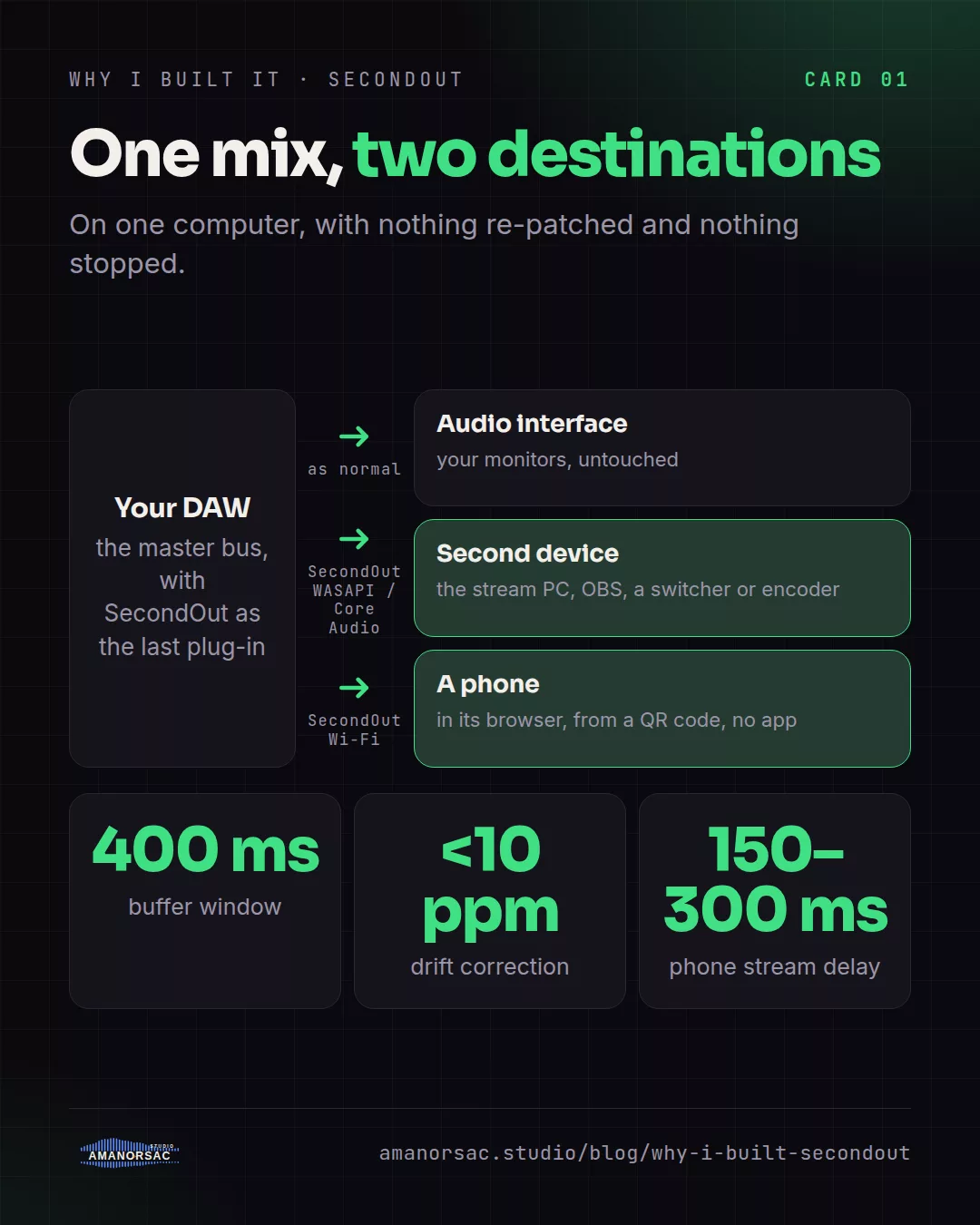
SecondOut sits on your master bus like any other plug-in and sends that exact mix to a second output device, without touching your main interface. Your monitors carry on through your interface as normal. SecondOut opens its own connection to the second device, on Windows through WASAPI in shared mode so it never fights anything for the device, and on the Mac through the system's own audio.
Your DAW and the second device run on separate clocks that drift apart, so a servo loop adjusts the resampling by tiny fractions every second and keeps the buffer centred. The buffer window is about 400 ms and the drift correction holds under 10 ppm, which means a two-hour service stays locked. On an interface with more than two outputs you choose the exact pair, and you can run several copies at once, each to its own destination.
Since 1.3.3 it can also stream the mix to a phone. Switch on Phone stream, scan the QR code, tap Listen, and the mix plays in the phone's browser over the same Wi-Fi with no app and no internet. The delay is roughly 150 to 300 ms, so it suits checking a mix from the back of the room. It is not for lip-sync or in-ear monitoring, and it is off until you switch it on.
The problem it solves
One mix, two destinations, on one computer, with nothing re-patched and nothing stopped. Church media desks, broadcast feeds to a switcher or encoder, a podcast session into OBS through a virtual cable, a safety recording on a second device away from the main chain.
What else is out there
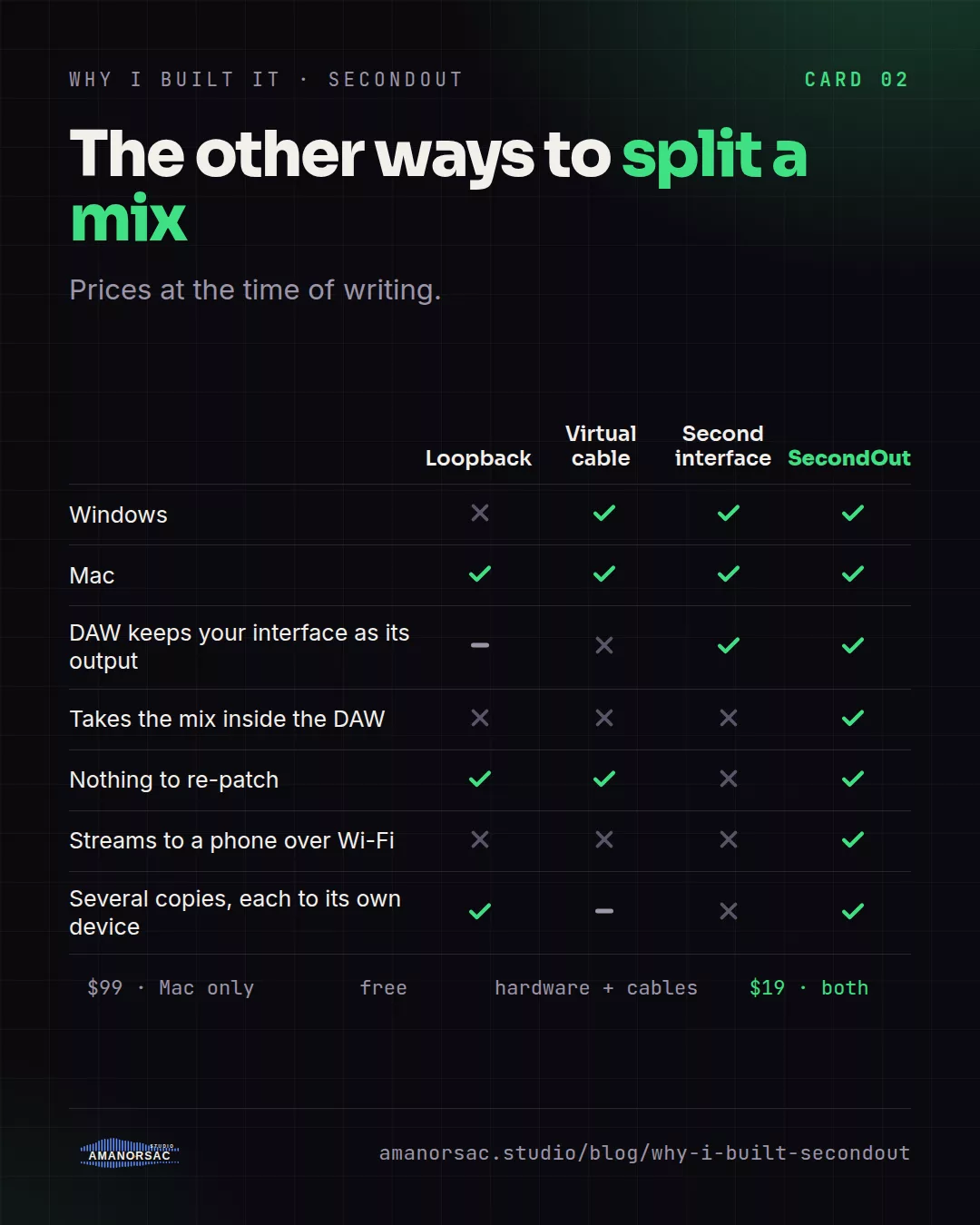
On the Mac, Rogue Amoeba's Loopback is the well-known routing tool, at $99 at the time of writing, and it is Mac only. On Windows, a virtual audio cable such as VB-Cable is free, but it only helps if the DAW outputs to the cable, which means giving up your interface as the DAW's output. A second interface and a hardware split works and costs hardware and a re-patch. SecondOut takes the mix inside the DAW, before the driver sees it, and leaves everything else alone. $19, both platforms.
The honest limits
It is a second output, not a low-latency monitor path; the 400 ms window is what makes the drift correction inaudible. The phone stream is for walking the room, not for performers.
Who it is for
Church media and stream teams. Anyone feeding a switcher or encoder from a DAW. Podcasters who want the session in OBS without exclusive-mode conflicts. Engineers who want a parallel safety recording.
Price and licence
$19, once, as a VST3 and a standalone app for Windows 10 and 11 and macOS 11 and later. Lifetime licence with a year of updates, one key for up to two devices, managed from My Apps. Signed on Windows and notarized on the Mac. It is also part of the Studio Bundle.
Written by Stephen Amanor Sackey — producer, mix engineer and music director, Virginia. More about the studio.