

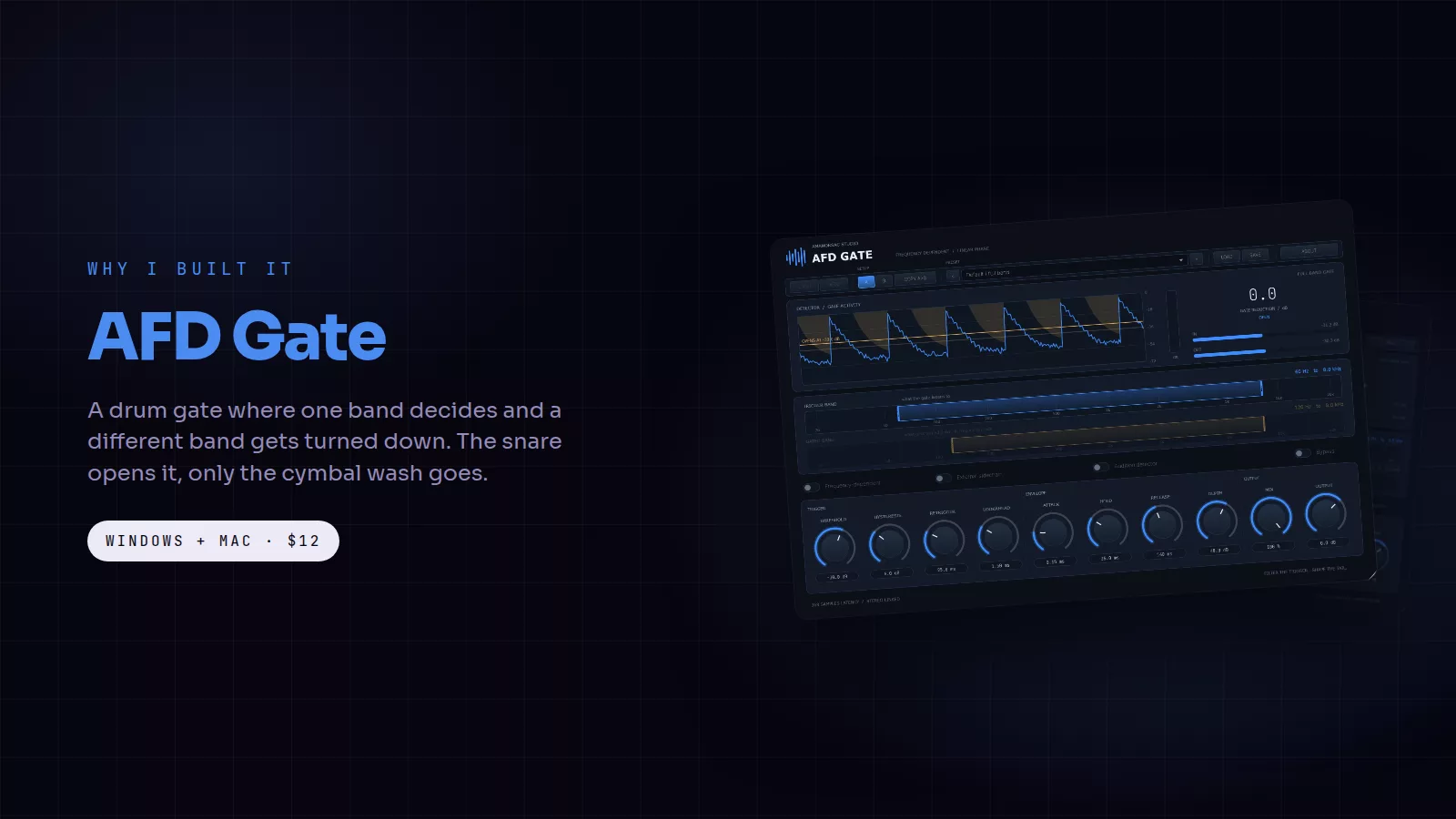
Most gates make their decision using the whole signal, and then turn down the whole signal. On a close-miked drum kit that is the wrong tool. The snare mic hears the hi-hats. The tom mics hear everything. A gate that ducks the whole channel takes the room with it, and you end up with a kit that sounds assembled rather than played. AFD Gate, the Amanorsac Frequency Dependent Gate, splits that one decision into two.
The cards in this post are free to save and share. Tap one to open it full size.
What it does
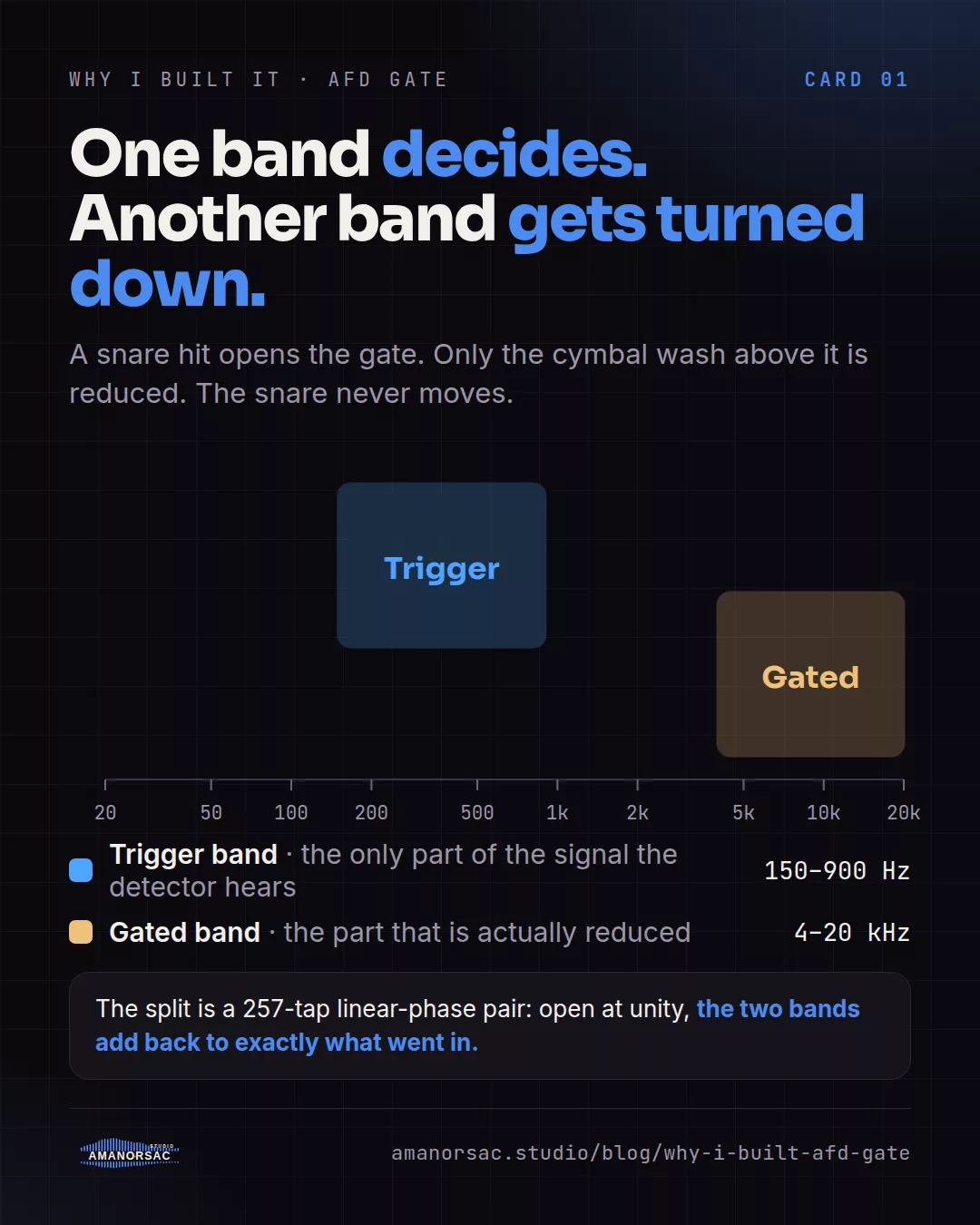
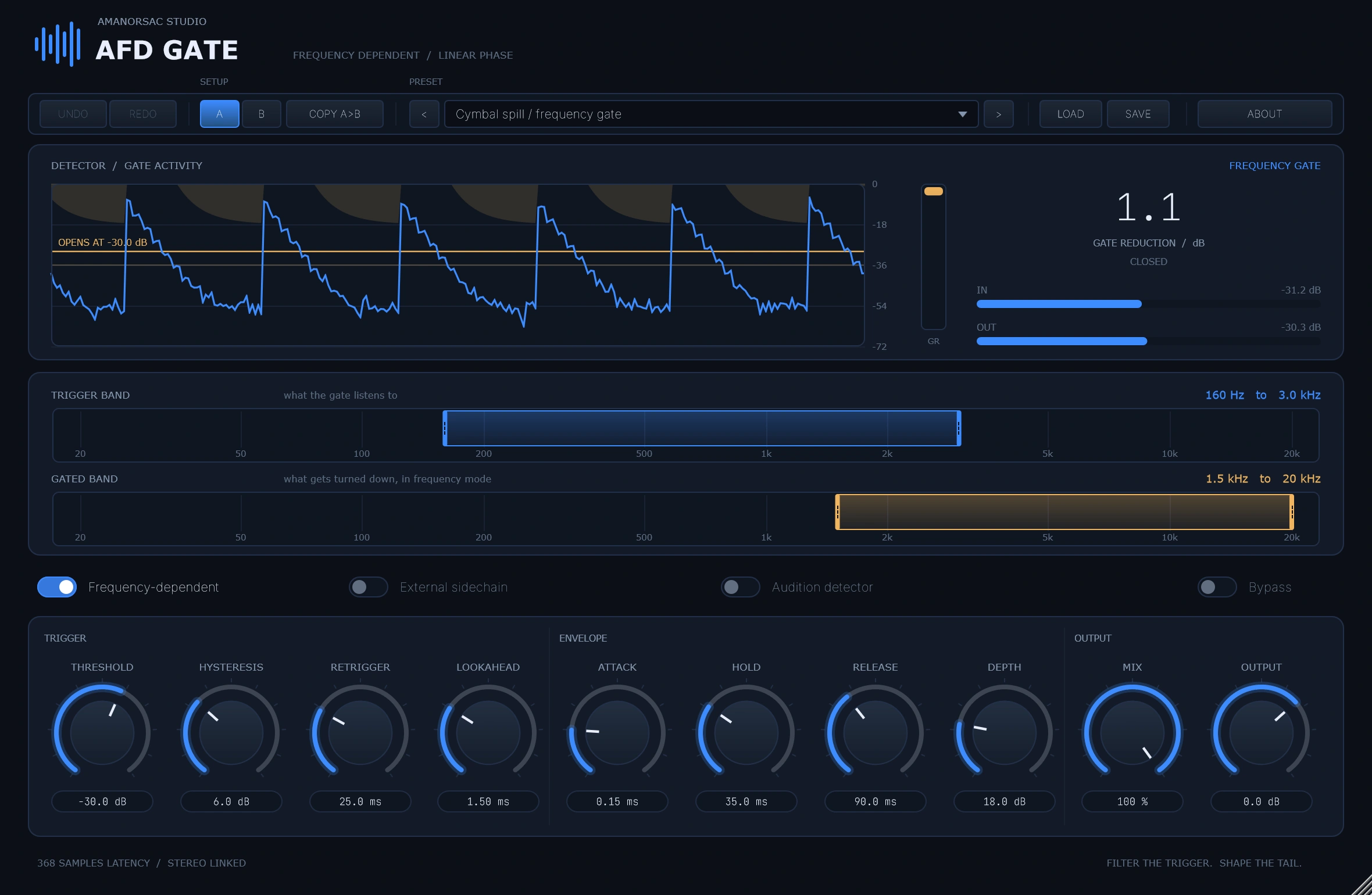
One band decides when the gate opens. A different band decides what gets turned down. So a snare hit can open a gate that only cuts the cymbal wash above it, and the body of the snare never moves. The trigger band in blue is the only part of the signal the detector hears. The gated band in amber is the part that is actually reduced. Drag an edge to move one end, drag the middle to slide the whole band, double-click to reset.
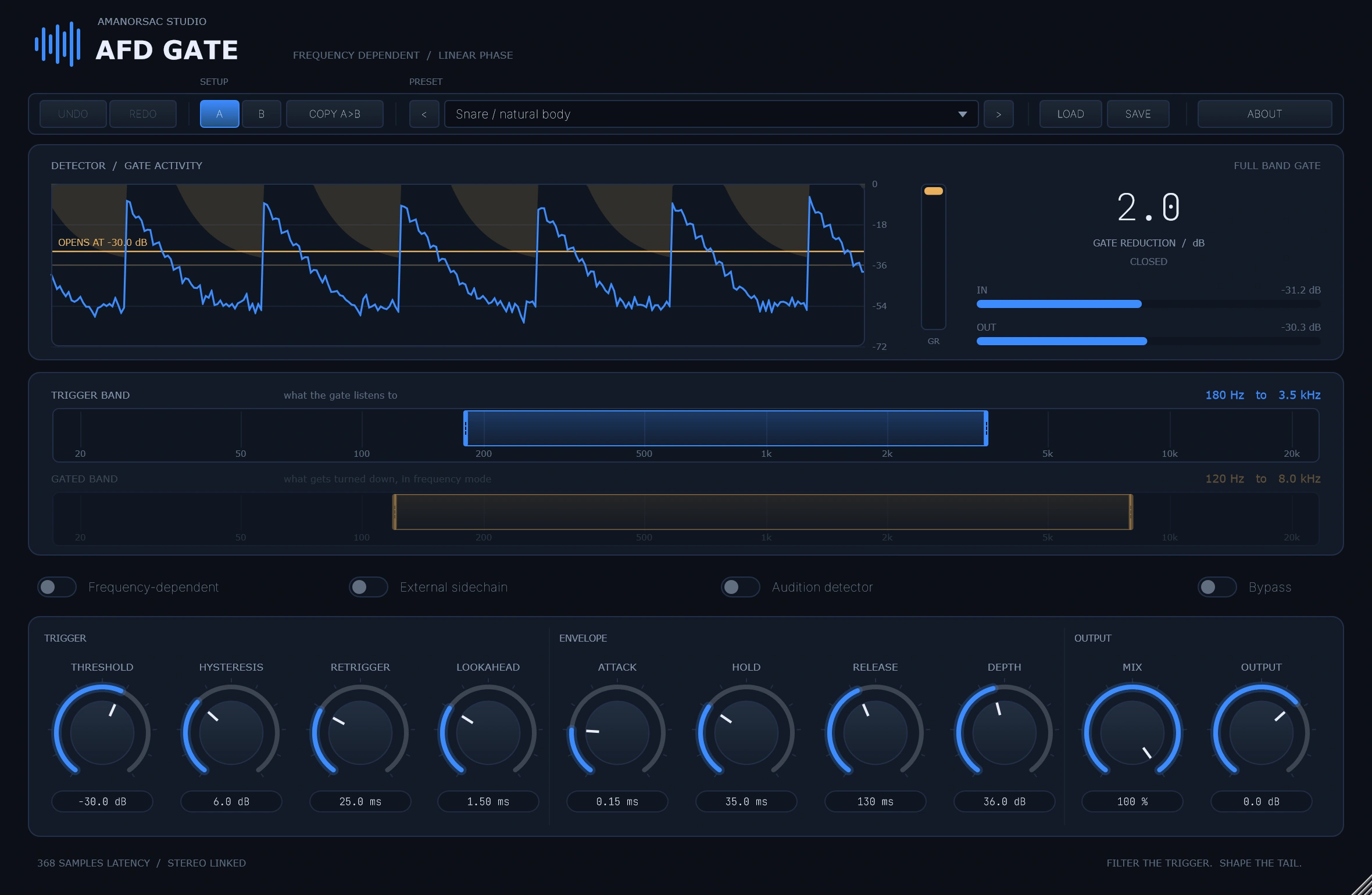
The band split is a 257-tap linear-phase complementary pair. When the gate is open at unity, the two bands add back up to exactly the signal you put in, so leaving the plug-in in the chain costs you nothing while it is not gating. The display draws the filtered detector signal against the threshold, with the hysteresis line and the gain reduction filled in behind, so if the gate misses a ghost note you can see why before touching a control.
Attack and release are smoothed in decibels so a release falls evenly. Hold bridges the gaps, hysteresis stops chatter, and retrigger lockout stops wash from flapping the gate. Lookahead delays the detector less than the audio, so the gate is open when the transient lands, and the latency reported to your DAW does not change when you change it. An external sidechain can take the decision from another track.
On the kit
Seven factory presets, one for each job. Kick: the trigger band sits where the beater is and everything above is ignored. Snare: the natural body of the drum, with hysteresis holding the gate open through the ring. Cymbal spill: in frequency mode the snare opens the gate and only the band above it is turned down.
What else is out there
Your DAW's own gate is free and decides on the whole signal. FabFilter Pro-G is a superb full-featured gate and expander at around $169 at the time of writing, with sidechain filtering on the detector, which is half of what AFD Gate does; what it does not do is reduce only a chosen band while leaving the rest alone, which is the other half. AFD Gate is one job, done properly, for $12.
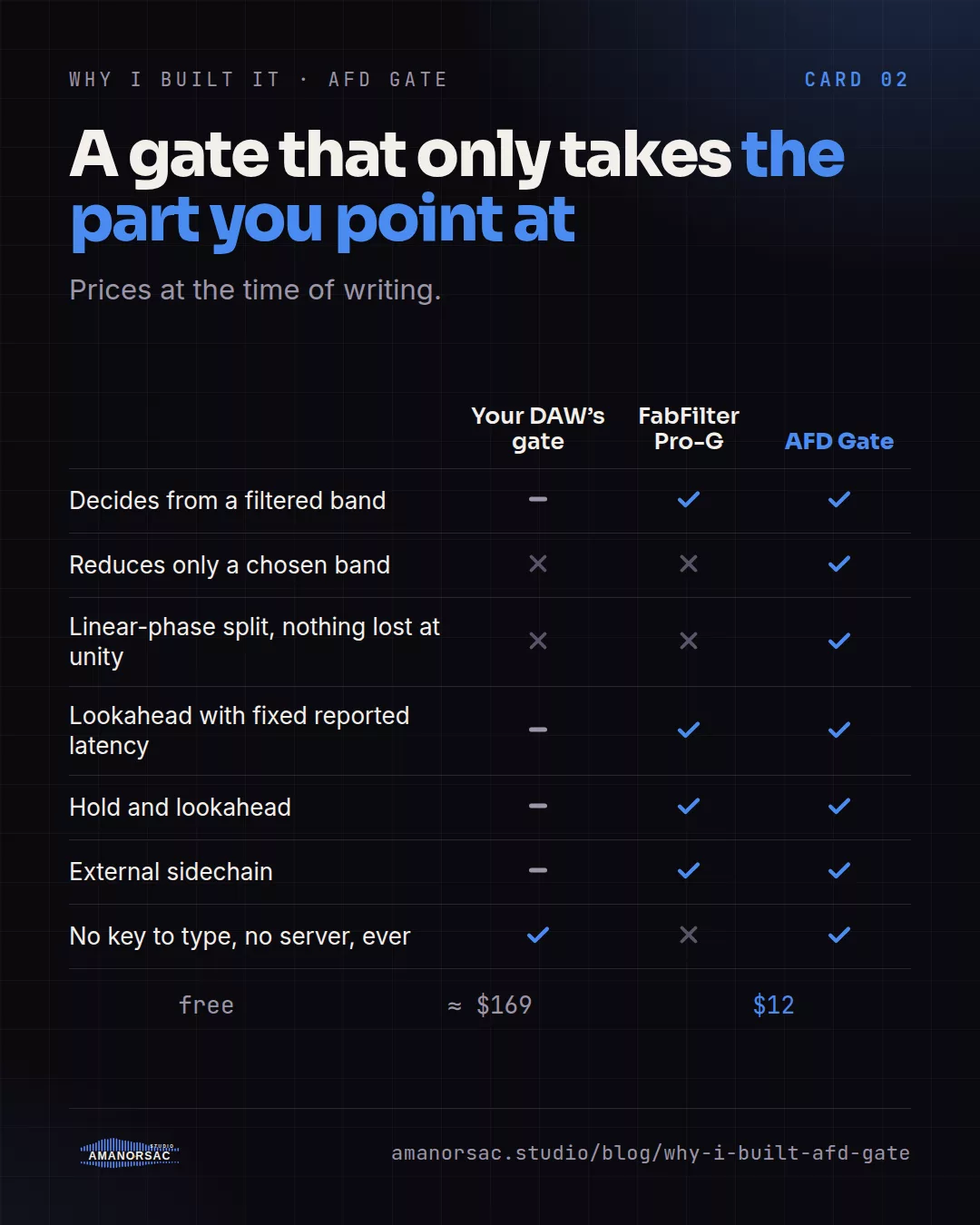
No activation, ever
Once AFD Gate is yours it simply runs. There is no key to type, no server to reach and nothing phoning home. Install it on every computer you own. It passes pluginval at strictness level 10 with no warnings, and it is tested at 44.1, 48, 96 and 192 kHz.
Who it is for
Anyone mixing close-miked drums: live recordings, church multitracks, rock and gospel sessions. Live engineers who want spill out of the snare channel without a thin snare.
Price
$12, once. VST3 and standalone for Windows x64 and macOS. The Windows build is not code signed yet, so SmartScreen warns the first time; choose More info, then Run anyway. It is also part of the Studio Bundle.
Written by Stephen Amanor Sackey — producer, mix engineer and music director, Virginia. More about the studio.